


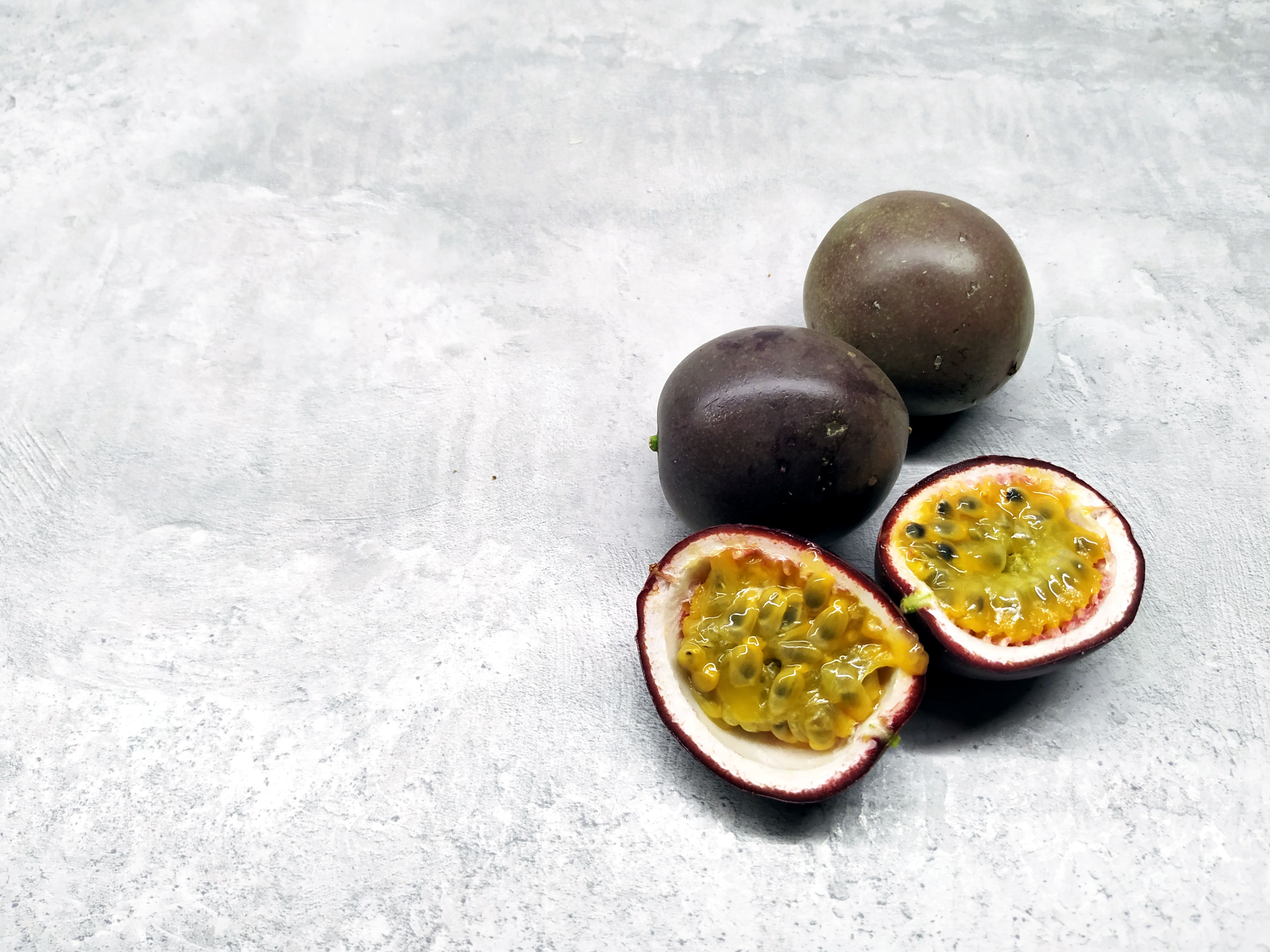
Passion fruit
The piceatannol secret — high insoluble fiber, GABA-sensitivity-enhancing apigenin, and the fruit cousin of resveratrol.
In 1 minute
What does it provide? Exceptionally concentrated insoluble fiber (≈ 10 g/100 g in the whole seed+flesh combination, fiber predominantly in the seeds — bifidogenic substrate, adds stool volume), piceatannol (stilbenoid — a polyphenol class with a C=C carbon skeleton connecting two aromatic rings —, the "sibling" of resveratrol, with 3–5× better plasma absorption, antioxidant and insulin sensitivity improver), carotenoids (β-carotene, phytoene), and vitamin C (30 mg/100 g, collagen synthesis). Do NOT strain out the seeds — that is where the active ingredient lies.
How much? Daily 1–2 medium fruits (≈ 60–120 g flesh + seed), 3–5× per week. Clinical RCTs with 30 g/day passion fruit peel flour showed moderate LDL, triglyceride reduction and insulin resistance improvement in T2DM (Janebro 2008, de Queiroz 2012).
When to avoid? Latex allergy (cross-reactivity with Passifloraceae-family fruits — anaphylaxis risk), MAO inhibitor therapy (phenelzine, moclobemide — theoretical harman interaction), advanced kidney disease (CKD 4–5, potassium 348 mg/100 g), active IBS flare or diverticulitis (insoluble fiber irritation), infant < 1 year (seed aspiration risk — can be given pureed and sieved).
Passion fruit is a native fruit of the tropical rainforests of South America, originally growing wild in the Mata Atlântica rainforest on the Brazilian-Paraguayan border. The name "passiflora" was given in the first half of the 17th century by Spanish missionaries: the flower's 10 petals reminded them of Christ's 10 apostles, the three-armed pistil of the nails, the five anthers of the five wounds — hence the "passion" (suffering) name. Pero de Magalhães Gândavo's 1576 Brazilian chronicle ("História da Província Sancta Cruz") is one of the first European written mentions. The Hungarian and Portuguese name "maracuja" derives from the Tupi people's "mara kuya" (= "food that nourishes").
At the end of the 19th century, Brazilian plantation owners began commercial-scale cultivation, and by the early 20th century Australia, Hawaii, and South Africa had also adopted it. Today Brazil is the world's largest producer (≈ 1 million tons/year), and passion fruit juice plays the role of Brazilian national beverage. Modern bioactive research started explosively in 2005, when a Japanese group (Matsui and colleagues) described piceatannol as the main stilbenoid component of passion fruit seed — this is the "more bioavailable sibling" of resveratrol, and has been the subject of independent RCTs ever since. (Wikipedia, PMC)
🔬 Scientific Background
Passion fruit is a dual-matrix food: the fruit flesh (yellow "arille") is high in insoluble fiber, vitamin C, and carotenoid content, while the seeds embedded in it capsule-like (which are eaten together in traditional consumption) carry piceatannol, scirpusin, and polyphenols in extreme concentrations. In the whole (seed + flesh) intake, fiber is ≈ 10 g/100 g — comparable to chia seed and flaxseed (Ramos 2007). PMC
From the piceatannol perspective: 100 g of seed-flesh mix contains about 4–6 mg of piceatannol, giving 3–5× plasma bioavailability compared to a similar dose of resveratrol (Setoguchi 2014, Japanese human PK study). Piceatannol inhibits phosphodiesterase-4, is antioxidant, and is an insulin sensitivity improver in animal models. Frontiers
At the microbiome level, a 2019 mouse model showed that passion fruit fiber (PFP — passion fruit peel) increased Bifidobacterium and Faecalibacterium proportions and elevated SCFA production (particularly butyrate). Human data are limited for now, but the high insoluble fiber + polyphenol matrix biologically justifies the bifidogenic expectation. PMC
Clinical outcomes: small human RCTs with 30 g/day passion fruit peel flour showed moderate LDL, triglyceride reduction and insulin resistance improvement in T2DM (Janebro 2008, de Queiroz 2012). The sleep literature is strong for the Passiflora leaf extract (NOT the fruit), but the fruit's apigenin content carries theoretical GABA-A-modulatory potential. Phytomedicine
- + Fat (yogurt, coconut milk, walnut): carotenoids (β-carotene, phytoene) are fat-soluble — together 2–4× absorption.
- + Live culture (yogurt, kefir): fiber + live culture is a classic synbiotic combination — passion fruit's high insoluble fiber is a distinctly bifidogenic substrate.
- + Vitamin C matrix (citrus, pepper): additional vitamin C to stabilize piceatannol and support iron absorption (passion fruit itself provides 30 mg vitamin C/100 g).
- + Oats or chia (breakfast): additional β-glucan + omega-3 → combined lipid and glycemic support.
- + Polyphenol matrix (dark chocolate, green tea): stilbenoid-flavonoid synergy — such combinations are frequent in Mediterranean + tropical hybrid diets.
- + Apricot / mango: carotenoid stacking on the lycopene-zeaxanthin axis.
- MAO inhibitor therapy (phenelzine, tranylcypromine, moclobemide): the warning applies to Passiflora-containing herbal preparations (harman alkaloids); for fresh fruit only theoretical, but caution advised at large doses.
- Sedatives, alcohol in large amounts: Passiflora extracts are additive; the fruit's effect is probably minimal, but monitor in sensitive individuals.
- Anticoagulant (warfarin, DOAC) + high-dose passion fruit extract: the polyphenols' antiplatelet potential is a theoretical risk; culinary fruit amounts are safe.
- Iron supplement + large fiber dose: time separation (at least 1 hour) — high fiber can inhibit absorption.
- Latex-containing medical devices / latex allergy: Passifloraceae-family fruits are often cross-reactive with latex.
- Latex allergy / Passifloraceae allergy: pronounced cross-reactivity — to be avoided.
- Advanced kidney disease (CKD 4–5) under potassium restriction: moderately high potassium (348 mg/100 g) — caution in dosing.
- IBS acute flare: high insoluble fiber can provoke symptoms in sensitive phase — start with small portions.
- Active diverticulitis: in acute phase the seeds are potentially irritating — can be reintroduced after subsidence.
- 1 week before planned surgery: if taking Passiflora as an herbal extract, stop (theoretical risk of anesthetic interactions).
- MAO inhibitor therapy: caution (see above).
- Infant (under 1 year): many seeds pose a choking/aspiration risk — pureed and sieved.
Serving: daily 1–2 medium fruits (≈ 60–120 g flesh + seed), 3–5× per week.
Preparation:
1. Halve lengthwise with a sharp knife — the fruit is a "scoop-out" type, the skin is not eaten.
2. Scoop out the jelly-like flesh containing the seeds — never strain!
3. Add to breakfast, snack, or dessert matrix.
Classic patterns:
- Breakfast: Greek yogurt + 1 passion fruit scooped + chia seed + walnut
- Smoothie: banana + passion fruit (seeds and all) + coconut milk + spinach — a carotenoid bomb
- Dessert: dark chocolate mousse with passion fruit coulis (seeds preserved on top)
- Brazilian tradition: mousse de maracujá (condensed milk + juice + cream — here the seeds are usually removed, this is the exception)
- Salad dressing: passion fruit flesh + olive oil + honey + lime → tropical vinaigrette
Storage: at room temperature 1 week (the skin wrinkles — this is a sign of ripeness!); refrigerated 2 weeks; scooped flesh frozen preserves piceatannol for 6 months.
What not to do: don't cook for a long time (≥ 70 °C, 10+ minutes) — carotenoids and piceatannol degrade. Don't strain out the seeds. Don't eat the skin (thin, inedible).