


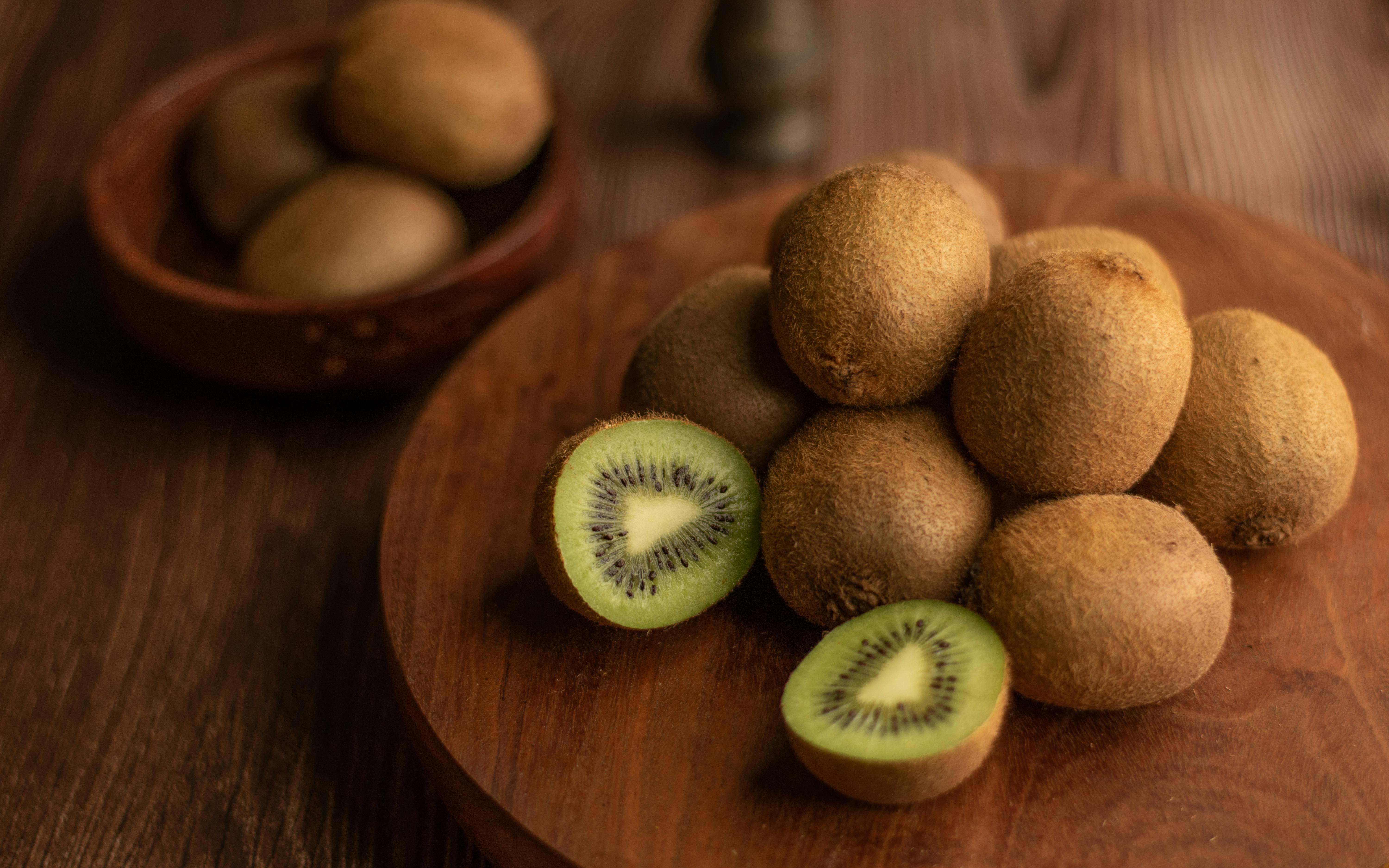
Kiwifruit
Chinese gooseberry with a New Zealand rebrand — pectin, polyphenols, and a special protease, actinidin.
In 1 minute
What does it provide? Pectin, soluble fiber, polyphenols (epicatechin, chlorogenic acid), vitamin C (≈ 90 mg/100 g), and actinidin — a cysteine protease that accelerates protein digestion.
How much? 2 kiwifruit per day (green or gold) — this is the established dose of clinical constipation RCTs (Chan 2007, Eady 2019, Bayer 2022).
When to avoid? Kiwifruit/latex allergy (well-known cross-reactivity), active aphthous stomatitis (acid sensitivity), warfarin use with high doses of kiwifruit (vitamin K content).
Kiwifruit's three-thousand-year Chinese past starts in the middle valleys of the Yangtze, where the wild climbing vine species of the Actinidia genus were known as "mihóutao," or "monkey plum." For centuries it remained more of a wild treat in Tang and Song court recipe scrolls, until at the end of the 1900s a New Zealand missionary woman, Mary Isabel Fraser, brought some seeds home from Hubei province. The Whanganui gardener Alexander Allison around 1910 raised the first fruit-bearing vines from these on New Zealand soil — this became the genetic cradle of modern kiwifruit cultivation.
The rediscovered fruit initially went by the name "Chinese gooseberry," but the Cold War American market needed another name: in 1959, New Zealand exporters renamed it "kiwifruit" after their national bird, the kiwi — a brilliant marketing move that brought global fame. Today the Hayward variety is the classic green kiwifruit (selected in 1924 in Hayward Wright's garden), while Zesy002/SunGold is the gold variant. An interesting twist in the story: the enzymatic meat-tenderizing power of kiwifruit — the cysteine protease called actinidin — was discovered by New Zealand steakhouses in the 1970s when they noticed that fresh kiwifruit could break down beef in hours.
🔬 Scientific Background
Kiwifruit delivers a bioactive matrix built on "three pillars": (1) soluble fiber (pectin) ≈ 3 g/100 g, (2) polyphenols and vitamin C (≈ 90 mg/100 g, higher than orange), (3) actinidin — a cysteine protease that remains active at the stomach's acidic pH (optimum pH 4–6, ≈ 40–55 °C) and works with pepsin to accelerate protein digestion. The three components together explain why kiwifruit works so consistently on GI endpoints.
The strongest pillar of clinical evidence is chronic constipation and IBS-C: the multicenter, randomized Chan 2007 RCT, Eady 2019 international RCT, and Bayer 2022 crossover RCT all showed significant CSBM (Complete Spontaneous Bowel Movements) elevation, improved Bristol score, less abdominal discomfort with 2 green kiwifruit/day for 4 weeks. The Chan 2021 (also referenced as Bayer) crossover study tested 2 green kiwifruit/day against psyllium (7.5 g/day) — kiwifruit was at least as effective, with less bloating.
At the microbiome level, the Blatchford 2017 randomized pilot study with gold kiwifruit (Livaux) for 12 weeks in prediabetic individuals showed Coriobacteriaceae (including Collinsella) elevation. Other small human studies with kiwifruit-derived powder (Actazin/Livaux) signaled Faecalibacterium prausnitzii elevation. Actinidin measurably improves protein digestion in the gastrointestinal tract (Kaur 2010, Rutherfurd 2011), which provides a "comfort effect" with protein-rich meals.
- + Protein-rich meal (meat, fish, legumes): actinidin accelerates gastric protein breakdown — worth eating raw, at the end/start of a meal.
- + Yogurt, kefir: synbiotic breakfast — pectin + live culture gives a broader SCFA response.
- + Oat β-glucan (oatmeal): double soluble fiber, "comfort effect" for a sensitive stomach.
- + Nuts (almond, walnut): fat + improved polyphenol absorption; moderate glycemic peak.
- + Spinach, kale: vitamin C + non-heme iron — improved iron absorption.
- + Green kiwifruit consumed with skin: the skin delivers even more fiber — though many consumers don't like the "cucumber-like" texture.
- Prolonged, high-temperature cooking (≥ 60–65 °C, longer time): actinidin inactivates — if the enzyme effect is the goal, raw or minimally heated.
- Dairy desserts (gelatin pudding, cream): actinidin breaks down collagen/gelatin — the dessert "runs." Heat-treated or frozen kiwifruit, however, is stable.
- Warfarin with larger doses of kiwifruit: vitamin K content (moderate level) can affect INR — medical consultation recommended.
- Active oral injury (canker sore, herpes, after dental procedure): oxalates and acids sting — worth waiting.
- Latex allergy with known positivity: classic latex-fruit syndrome — serious anaphylaxis has also occurred.
- Kiwifruit allergy, latex-fruit syndrome: actinidin itself is an allergen (Act d 1) — anaphylaxis has also occurred. With a positive test, strictly to be avoided.
- Severe GERD/reflux flare: the high vitamin C and fruit acids can provoke — more tolerable during a meal.
- Kidney stones, calcium-oxalate tendency: moderate oxalate content — 1–2 pieces daily safe, large amounts as a course to be avoided.
- Infant (under 8–10 months): allergen sensitivity possible — introduction cautiously, in small portions.
- Active gastroenteritis, vomiting-diarrhea: avoid acidic fruit in acute phase.
- Aspirin sensitivity (salicylate intolerance): kiwifruit has moderate salicylate content — can cause symptoms in sensitive individuals.
- Warfarin treatment: due to vitamin K content, regular INR monitoring needed if consumption is constant (2+ kiwifruit/day).
Daily serving
2 kiwifruit per day (green or gold) — the established dose of clinical RCTs, at breakfast/snack timing for stool effect.
Preparation pattern
- Wash thoroughly (especially for consumption with skin).
- Halved, scooped with a spoon: classic method, quick snack.
- Sliced into rounds with skin: on salad, in fruit salad.
- Raw, as part of fruit salad: don't mix with gelatin/dairy pudding — actinidin breaks it down.
Classic patterns
Morning constipation protocol: 2 green kiwifruit + yogurt + rolled oats + flaxseed — clinically validated CSBM booster.
New Zealand marinade: ½ kiwifruit pulp + olive oil + garlic + pepper → beef/chicken marinade for 2–4 hours. Actinidin substantially tenderizes.
Green smoothie: 1 kiwifruit + spinach + apple + ginger + water — vitamin C × polyphenol × chlorophyll.
Tropical fruit salad: kiwifruit + mango + pineapple + lime — just don't let it "rest" 30+ minutes, because the texture runs (actinidin + bromelain together).
Storage
Unripe at room temperature (can be ripened with an apple — ethylene), ripe in fridge 7–10 days. Frozen (halved): 6 months. Dried is rare but available.
What not to do
Don't put raw kiwifruit in gelatin dessert (won't set). Don't cook long at high heat (actinidin is lost). Don't overdo if you're latex-allergic. Don't always pick gold — green is cheaper and more clinically validated.
References
[1] Chan AO et al. Increasing dietary fiber intake in terms of kiwifruit improves constipation in Chinese patients. World J Gastroenterol 2007;13(35):4771-4775.
[2] Eady SL et al. The effect of 'Zesy002' kiwifruit (Actinidia chinensis var. chinensis) on gut health function: a randomised cross-over clinical trial. J Nutr Sci 2019;8:e18.
[3] Bayer SB et al. Two kiwifruit a day for functional constipation: a randomized controlled trial. Aliment Pharmacol Ther 2022;55(8):961-973.
[4] Chan AO et al. Kiwifruit vs. psyllium in IBS-C: randomised crossover trial. Aliment Pharmacol Ther 2021;53(11):1207-1216.
[5] Kaur L et al. Actinidin enhances gastric protein digestion in humans. J Agric Food Chem 2010;58(8):5068-5073.
[6] Blatchford P et al. Kiwifruit fermentation drives changes in human gut microbiota. J Nutr Sci 2017;6:e52.
[7] Drummond L. The composition and nutritional value of kiwifruit. Adv Food Nutr Res 2013;68:33-57.
[8] Lucas-González R et al. Actinidin: properties and food applications. Foods 2021;10(7):1611.
[9] Lucas JS et al. Kiwifruit allergy: a review. Pediatr Allergy Immunol 2003;14(6):420-428.
[10] Monash University. High and Low FODMAP foods. Monash FODMAP database.