


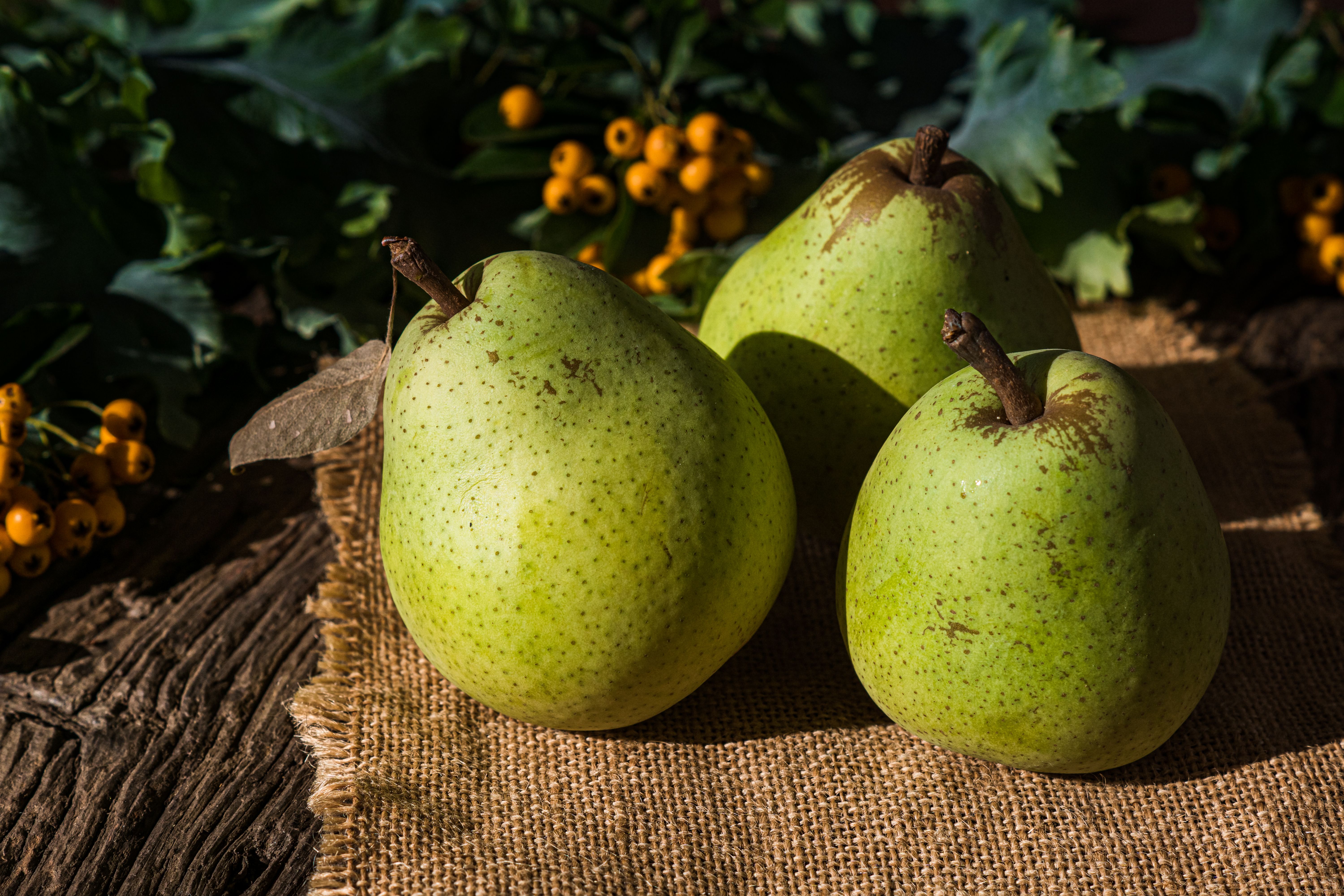
Pear
The Renaissance Versailles favorite — pectin-dominant juicy fiber with polyphenols in the skin.
In 1 minute
What does it provide? Pectin-dominant soluble fiber (≈ 3 g/100 g), polyphenols (chlorogenic acid, catechin, arbutin, quercetin), and smaller amounts of sorbitol — gentle stool-loosening, prebiotic matrix.
How much? 1 medium pear per day (≈ 150–180 g) with skin — this delivers ~5–6 g of fiber, a significant portion of the daily requirement.
When to avoid? IBS elimination phase (simultaneous fructose + sorbitol "double FODMAP" — in reintroduction, ≈ ¼ medium pear / ≈ 40 g is the starting test serving); fructose malabsorption; sorbitol intolerance; Rosaceae allergy (birch pollen × OAS).
Pear was born in two ancient cradles at once: in East Asia (origin of nashi pears) and in the Caucasus–Near East region, from which the European line originated. Homer, in Book VII of the Odyssey, in the description of King Alcinous's garden, specifically calls the pear a "gift of the gods." Theophrastus already distinguished between wild and cultivated lines in the 4th century BCE, and Cato and Pliny named dozens of Roman varieties — Pliny alone lists more than forty variants, including the "Tiberius pear," especially favored by the emperor.
During the Middle Ages, countless new varieties were born in French and Italian monastery gardens; at Louis XIV's court, a true pear craze raged, and more than a hundred varieties grew in La Quintinie's Potager du Roi at Versailles. The sweetest Williams (or Bartlett) pear was discovered in 1765 in a schoolmaster's garden in Aldermaston, England, and from there conquered the world. From the 18th–19th centuries the variety reached North America and Australia; today it is one of the foundational pillars of temperate-zone fruit cultivation, along with European (Pyrus communis) and Asian (P. pyrifolia) lines.
🔬 Scientific Background
Pear's fiber profile is pectin-dominant: 100 g of raw pear ≈ 3.1 g fiber (about half soluble), one medium (≈ 180 g) fruit is 5–6 g — about 20% of the daily 25–38 g fiber recommendation from a single fruit. The pectin ferments in the colon, forms SCFAs (especially acetate + propionate), and selectively supports Bifidobacterium and some butyrate-producing groups (Faecalibacterium, Roseburia). According to EU-approved health claims, 10 g pectin with a meal reduces postprandial blood glucose elevation, and 6 g pectin daily contributes to maintaining normal blood cholesterol levels.
The skin's polyphenol profile (chlorogenic acid, catechin, arbutin — the latter a hydroquinone glycoside characteristic of pear) is 2–3× higher than the flesh's polyphenol content. According to in vitro and animal data, pear pomace increases SCFA production and moderates dysbiosis, but human RCT evidence specifically for pear is limited — clinical relevance is largely translative (pectin and fruit-polyphenol literature).
From a FODMAP standpoint, pear belongs to the "double high" group: it simultaneously contains excess fructose (more than glucose) and sorbitol — therefore avoided in the IBS elimination phase, with only about 5 g of taste fitting per Monash. In reintroduction, small portions can be tested, and for many tolerance improves.
- + Whole fruit consumed with skin: the polyphenols and bulk of fiber are in the skin. Wash thoroughly, don't peel.
- + Live culture (yogurt, kefir): pectin × Bifidobacterium — synbiotic synergy.
- + Nuts (almond, walnut): fat + improved polyphenol absorption, moderate glycemic peak.
- + Oat/barley β-glucan: two types of soluble fiber — broader SCFA profile.
- + Whole-grain AXOS sources (wheat, rye): broad fermentation activity.
- + Gentle heat (steaming, brief baking): pectin dissolves, the bulk of polyphenols is preserved.
- Another high-FODMAP fruit (mango, watermelon, apple) at the same time: cumulative fructose load — IBS-sensitive individuals get symptoms.
- Large amounts on an empty stomach: osmotic effect (sorbitol) can cause diarrhea-like reaction.
- Iron supplementation + larger polyphenol dose at the same time: chelation — ≥ 2-hour separation.
- Prolonged acidic cooking (pH ≤ 4, 30+ minutes): partial pectin hydrolysis — for compote, watch the time.
- Sweetened pear compote/preserve: concentrated sugar + sorbitol — IBS flare and glycemic peak.
- IBS elimination phase (FODMAP protocol): "double high" — to be avoided in the first 4–6 weeks; in reintroduction, careful test with small portion.
- Fructose malabsorption + sorbitol intolerance: classic symptomatic fruit — selectively testable in small portions.
- Rosaceae allergy (apple, peach, apricot, almond): cross-reactivity possible (Pyr c 1, LTP).
- Infant (under 4 months): not before solid food introduction; between 6–12 months, sieved, cooked pear puree is a common first fruit.
- Gastroparesis, severe GI motility disorder: due to high fiber content, precooked, in small portions.
- Kidney-stone history, oxalate restriction: low-to-moderate oxalate, not a main concern.
- Diabetes (DM2): due to high fructose, as part of a meal, not by itself — with skin, to moderate glycemic peak.
Daily serving
1 medium pear (≈ 150–180 g) with skin — as part of a meal or as a snack, cautiously for IBS-sensitive individuals.
Preparation pattern
- Thorough washing under running water with a soft scrubber.
- Raw, with skin: sliced on salad, as a snack.
- Baked: 180 °C, 20–30 minutes — with a little cinnamon, walnut.
- Pureed for infant (6+ months): cooked with skin for 10 minutes, pushed through a sieve.
Classic patterns
Pear-arugula salad: sliced pear + arugula + walnut + blue cheese crumble + balsamic vinegar — classic polyphenol × bitter green pairing.
Pear poached in red wine: with skin, cinnamon, star anise — in a low-FODMAP serving, polyphenol synergy is maximal.
Breakfast oatmeal with pear: oat β-glucan + grated pear + almond — pectin × β-glucan combination.
Pear-beet smoothie: ½ pear + beet + ginger + lemon juice — vibrant, polyphenol-rich (cautious dosing for FODMAP-sensitive individuals).
Storage
Unripe pear at room temperature 2–3 days, then in fridge 5–7 days. Dried 6–12 months, buy sulfite-free. Frozen (pre-cooked): 6 months.
What not to do
Don't eat in large amounts on an empty stomach if you're sensitive. Don't cook long with strong acid (pectin hydrolysis). Don't replace fresh pear with pear juice — concentrated sugar, lost fiber.
References
[1] Reiland H, Slavin J. Systematic review of pears and health. Nutr Today 2015;50(6):301-305.
[2] EFSA NDA Panel. Scientific Opinion on pectins. EFSA Journal 2010;8(10):1747.
[3] Li X et al. Composition and biological activities of polyphenols in pear fruits. Food Funct 2015;6(3):745-756.
[4] Salta J et al. Antioxidant phenolic compounds in selected pear varieties. J Sci Food Agric 2010;90(7):1230-1235.
[5] Monash University. High and Low FODMAP foods. Monash FODMAP database.
[6] Wojdyło A et al. Polyphenolic compounds and antioxidant activity of new and old apple and pear varieties. Molecules 2014;19(11):18650-18669.
[7] USDA FoodData Central. Pears, raw — full nutrient profile.
[8] Fang Z et al. Pectin from pear pomace: extraction and prebiotic effects. Carbohydr Polym 2022;278:118970.