


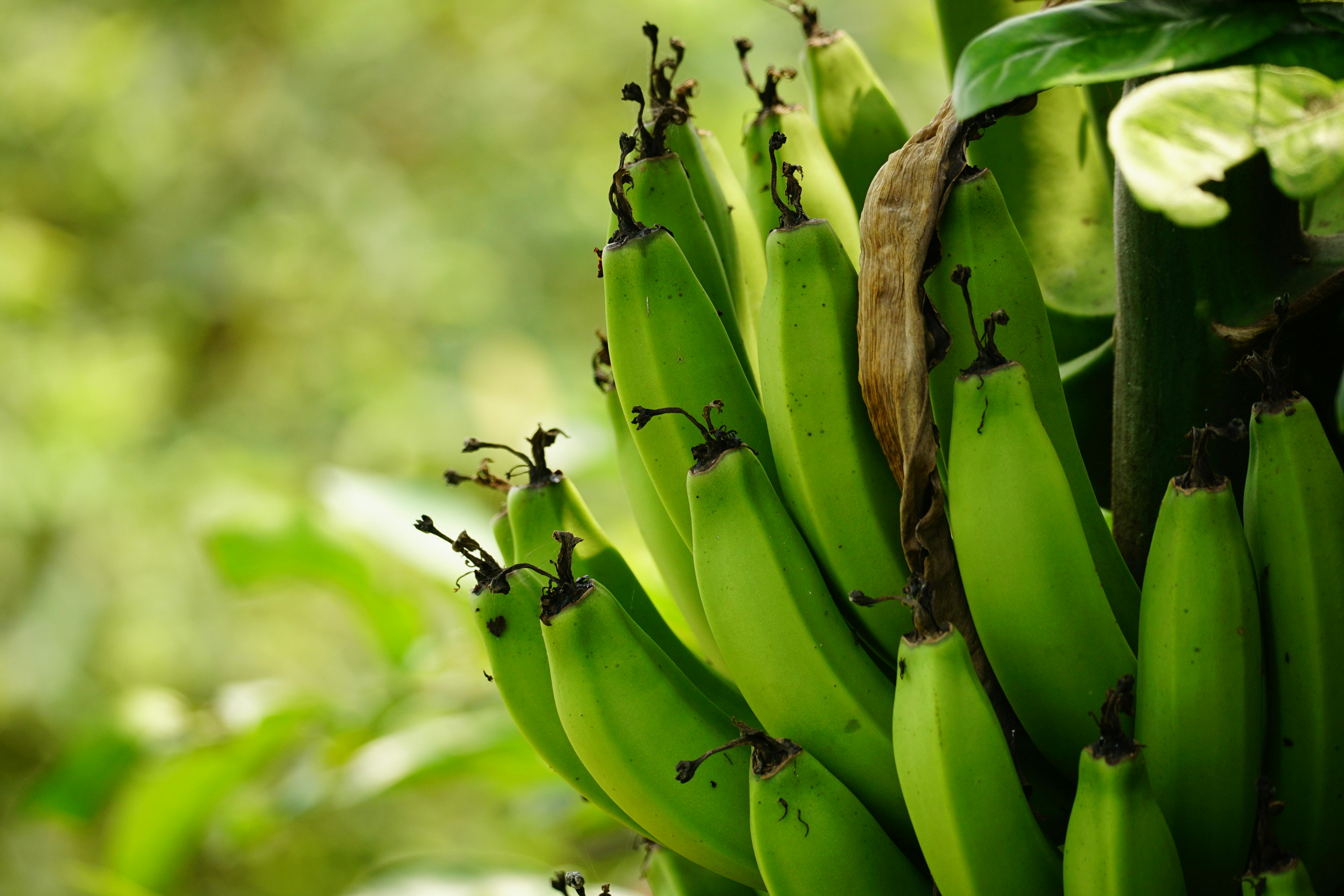
Green Banana
Unripe banana is not a defect — the classic colonic substrate of resistant starch (RS2).
In 1 minute
What does it provide? Resistant starch type II (RS2, 17–30 g/100 g unripe banana flesh), soluble fiber, moderate amounts of polyphenols — induces butyrate production through colonic fermentation.
How much? 1 medium unripe (green) banana in cooked form (≈ 100–120 g) several times per day/week, or 1–2 tbsp green banana flour (UBF/GBF) in yogurt, smoothie.
When to avoid? Acute SIBO flare (RS sensitivity), severe hyperkalemia (banana potassium content is high), latex-fruit syndrome with known positivity.
Banana is one of the world's earliest domesticated plants: archaeological traces show that Musa acuminata was cultivated 7,000 years ago in Papua New Guinea's Kuk Swamp. From here it spread west through the Pacific island world, then through South Asia to India, where Alexander the Great's soldiers already admired it on the 327 BCE campaign — tradition holds that it was mentioned as one of the Indian yogis' main foods, hence the Roman name "Musa sapientum" (the wise men's banana). With the Islamic conquest it spread further toward Africa, and Portuguese traders brought it to the Atlantic islands (Canary Islands, Madeira), and from there to the New World in the early 16th century.
Cultivated bananas are all seedless, vegetatively propagated clones — meaning the world's largest "vegetative gene pool." Plantains have traditionally been consumed green in Africa, Central, and South America cooked, fried, or pureed — matoke, fufu, tostones, patacones. 19th-century Caribbean cultivation and the late-century refrigerated shipping made Cavendish the world's leading dessert banana; in the 1950s, the previous Gros Michel was wiped out by Panama disease. Many folk remedies recommend green banana for diarrhea — modern research traces this effect back to its high resistant starch (RS2) content.
🔬 Scientific Background
The starch of green (unripe) banana is ≈ 60–80% resistant starch (RS), predominantly type II (RS2 — native granule, amorphous structure, alpha-amylase resistant). During ripening, the starch quickly converts to sugar (fructose, sucrose): a ripe yellow banana contains < 1% RS. So "banana" is DRAMATICALLY different from a microbiome standpoint when green vs. ripe.
In the colon, RS2 is fermented by Ruminococcus bromii, Eubacterium rectale, Roseburia intestinalis, and Faecalibacterium prausnitzii groups, giving a butyrate-dominant SCFA profile — especially valuable for colonocyte health (butyrate is the main energy source of the colon epithelium).
The most robust area of clinical human RCT evidence is pediatric diarrhea: in Rabbani 2010's randomized study, a green-banana-enriched diet shortened persistent diarrhea in cases of both Shigella co-infection and non-co-infection. In pediatric functional constipation, Pereira 2010 RCT brought a reduction in laxative requirement with "green banana biomass." In adults, green banana flour (UBF) showed satiety, glycemic peak moderation, and moderate LDL reduction (Menezes 2011 RCT).
Kitchen technology key: cooking breaks down RS2, but the cook → cool 12–24 hours → reheat process forms RS3 (retrograded) starch — also resistant, and clinically important. This is a "dietary trick" we also use with potatoes.
- + Inulin/FOS (Jerusalem artichoke, chicory): double prebiotic matrix — human data show more distal fermentation and butyrate enhancement.
- + Live culture (yogurt, kefir): synbiotic — RS2 + Bifidobacterium.
- + Oat β-glucan: double soluble fiber matrix.
- + Cooled cooked banana ("cook → cool"): RS3 formation, double resistant starch source.
- + Green banana flour in smoothie, pancake batter: "invisible" RS boost.
- + Fermented foods (kimchi, sauerkraut): synbiotic synergy.
- Acute SIBO flare (bloating, pain): RS2 is gas-producing — start with a small dose.
- High-dose potassium-lowering medications without severe renal failure: banana potassium content is high (350–400 mg/100 g).
- Too rapid increase (from 0 to 30+ g RS/day): bloating, gas — gradual introduction.
- Prolonged, high-heat preparation: RS2 is lost if not chilled afterward.
- Sugary green-banana snack/candy: concentrated sugar + less RS — compromises.
- Latex allergy with known positivity: cross-reactivity (Mus a 1, Mus a 5).
- Active SIBO flare: RS2 causes bloating — gradual introduction after treatment.
- Severe renal failure, hyperkalemia: due to potassium restriction, moderate the serving.
- Latex-fruit syndrome: classic banana allergy, anaphylaxis has also occurred.
- Infant (under 6 months): gentle ripe banana puree can be introduced, green banana cannot.
- Functional diarrhea (acute infectious): green banana helps — ripe banana rather softens.
- Active, severe IBD flare (CD, UC): RS2 is generally well tolerated, but individual reaction possible.
- Diabetes, if eating ripe banana: ripe yellow banana glycemic index is 51–60 — as part of a meal.
- Migraine trigger sensitivity (tyramine content): rare, but can provoke.
Daily serving
1 medium unripe (green or greenish) banana in cooked form — or 1–2 tbsp green banana flour (UBF) in yogurt/smoothie.
Preparation pattern
- Green banana boiled: boil with skin for 15–20 minutes (like potatoes), then peel. Eat whole/puréed.
- "Cook-cool" RS3 trick: boil, chill in fridge 12–24 hours, then reheat (or eat cold).
- Green banana flour: a spoonful in smoothie, pancake batter — tasteless, high RS.
- Plantain (cooking banana): sliced and fried ("tostones") or boiled.
Classic patterns
Caribbean "mofongo": boiled-mashed plantain + garlic + olive oil — side dish.
Ugandan "matoke": steamed green banana in banana leaf.
Brazilian "biomass": boiled green banana pureed, an RCT-validated adjuvant in pediatric functional constipation.
Morning RS smoothie: 1 tbsp green banana flour + yogurt + berries + oats.
Latin American "patacones": green-banana slices, fried, twice-pressed — side dish with meat.
Storage
Green banana at room temperature 3–5 days (ripening). Refrigerated, ripening slows (skin turns black, flesh stable) — 1–2 weeks. Green banana flour in a sealed package 12–24 months. Frozen (cooked, peeled): 6 months.
What not to do
Don't wait for yellow/spotted if you want RS2. Don't cook long at high heat and eat hot (RS2 is lost). Don't put in sugary dessert — RS effect is compromised. Don't overdo it if you're in SIBO flare.
References
[1] Rabbani GH et al. Green banana-supplemented diet in the home management of acute and prolonged diarrhoea in children: a community-based trial in rural Bangladesh. Trop Med Int Health 2010;15(10):1132-1139.
[2] Pereira MdC et al. Green banana biomass: a nutritional approach for chronic functional constipation. Nutr Hosp 2010;25(6):988-994.
[3] Menezes EW et al. Chemical composition and nutritional value of unripe banana flour (Musa cavendishii). Plant Foods Hum Nutr 2011;66(3):231-237.
[4] Englyst HN et al. Classification and measurement of nutritionally important starch fractions. Eur J Clin Nutr 1992;46 Suppl 2:S33-S50.
[5] Topping DL, Clifton PM. Short-chain fatty acids and human colonic function: roles of resistant starch and nonstarch polysaccharides. Physiol Rev 2001;81(3):1031-1064.
[6] Birt DF et al. Resistant starch: promise for improving human health. Adv Nutr 2013;4(6):587-601.
[7] Falcomer AL et al. Health benefits of green banana consumption: a systematic review. Nutrients 2019;11(6):1222.
[8] Denardin CC, Walter M. Resistant starch and its health implications. Cienc Rural 2020;50:e20200043.
[9] Monash University. Banana (unripe) — low FODMAP portion.