


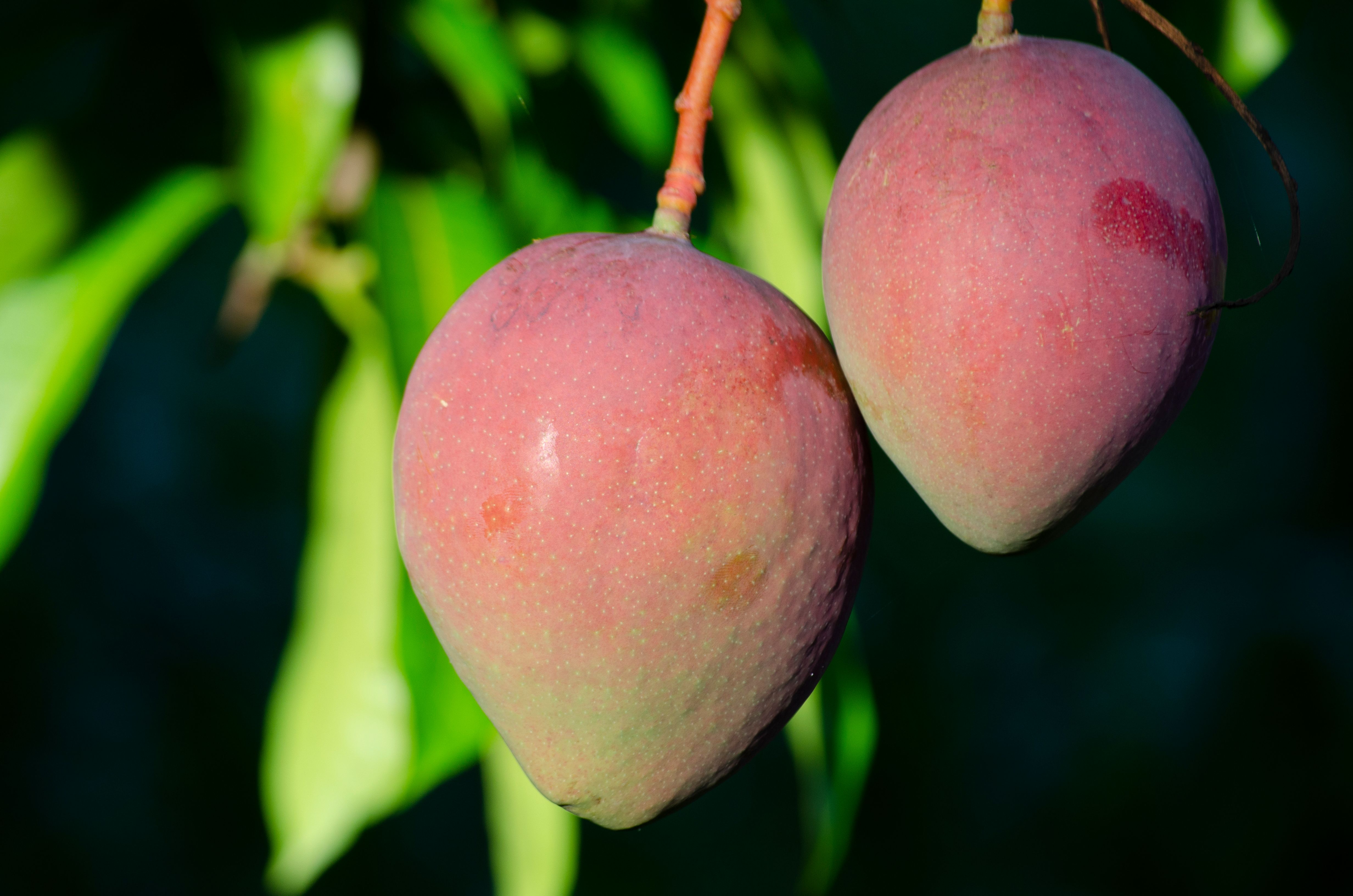
Mango
Fruit of the Hindu "wish-fulfilling tree" — gallotannins, fiber, and human evidence for gut inflammation reduction.
In 1 minute
What does it provide? Dietary fiber (≈ 1.6 g/100 g, about 2.6 g in a 165 g cup of sliced mango), gallotannins (gallic acid derivatives), mangiferin (in a small fraction of the flesh, concentrated in the skin), carotenoids (β-carotene, β-cryptoxanthin), vitamin C — moderate LDL and inflammation reducer.
How much? Fresh mango 100–200 g (≈ half a medium mango); IBS low-FODMAP portion ≈ 40 g (larger amount — e.g., 1 whole medium mango ≈ 200 g — is already high FODMAP). Clinical RCTs used 300 g/day.
When to avoid? In large amounts (≥ 100 g) for fructose-sensitive / in IBS elimination; contact dermatitis (urushiol in the peel — poison ivy / poison sumac cross-reactivity); cashew allergy (Anacardiaceae family).
Mango's homeland is today's India–Bangladesh–Myanmar cultivation area of roughly 4,000 years, where Mangifera indica already received the name "kalpavriksha," or "wish-fulfilling tree," in Hindu sacred texts. Buddha traditionally gave sermons in the shade of a mango grove, the Amrapali garden; Kalidasa texts from the 4th century link the mango blossom to Holika's festival. Mughal emperors were veritable mango obsessives: Akbar reportedly had 100,000 mango trees planted in the Lakh Bagh "Hundred Thousand Mango Garden" of Darbhanga in the 16th century, and some of the trees are still fruit-bearing today.
In the Middle Ages, Arab and Persian traders took it to East Africa (9th–10th centuries) — the word "mango" came into our language via the Tamil "mānkāy" through the Portuguese "manga" form. Portuguese traders carried it to West Africa, Brazil, and the Caribbean between the 16th–18th centuries, and the Spanish took it via the Manila Galleon route through the Philippines to today's Mexico. Akbar's successor, Emperor Jahangir, declared in his autobiographical diary: "Of all the fruits, the best is the mango" — and this history lives on today in the Alphonso, Dasheri, and Langra varieties. It first reached European tables among the Victorian-era colonial elite, and is today the second-most-exported fruit worldwide after banana.
🔬 Scientific Background
Mango flesh contains fiber (soluble pectin + insoluble cellulose), gallotannins (gallic acid mono-, di-, and pentaesters), mangiferin (xanthone glycoside, in a small fraction of the flesh, concentrated in the skin and seed), and carotenoids. The gut flora breaks down gallotannins into phenolic acids (4-hydroxybenzoic acid, gallic acid), and these mediate the systemic effects.
The strongest pillar of clinical human evidence is the Venancio 2018 randomized, controlled 4-week crossover RCT: 300 g/day fresh mango vs. an equal-fiber-amount (1 g) cellulose control in functional constipation — the mango group achieved greater improvement in defecation frequency, valerate SCFA elevation, and reduced plasma endotoxin (LBP) + IL-6 (inflammation markers). It's particularly interesting that the effect could not be explained by the fiber-matched group — the role of gallotannins and mangiferin is likely.
Barbosa Lima 2024 RCT — fresh mango for 3 weeks → improvement in microbiome diversity, reduction in fecal permeability markers (zonulin) in healthy young adults. Mango polyphenol extracts in in vivo animal models showed elevation of Bifidobacterium, Lactobacillus, Akkermansia and colitis moderation.
Clinical trap — urushiol sensitivity: mango belongs to the Anacardiaceae family (cashew, pistachio, poison ivy/poison sumac). Mango skin and seed contain urushiol (an alkylresorcinol mixture), which can cause contact dermatitis — especially in poison ivy/oak-sensitive individuals. The flesh is urushiol-poor, safely consumable.
- + Yogurt, kefir (mango lassi): classic Indian synbiotic combination.
- + Prebiotic fiber (inulin/FOS, AXOS): polyphenol × fiber synergy.
- + Lime, lemon juice: vitamin C × polyphenol antioxidant synergy.
- + Olive oil, coconut fat: fat aids carotenoid absorption.
- + Hot pepper, chili (salsa): capsaicinoid + polyphenol — Mediterranean-Mexican synergy.
- + Whole grain (oats, bulgur): β-glucan × pectin broader fermentation.
- Cashew + mango in larger amounts for Anacardiaceae-allergic individuals: cross-reactivity.
- Mango peel/sap skin contact — especially in poison-ivy-sensitive individuals: contact dermatitis (urushiol).
- Sweetened dried mango in large amounts: glycemic bomb, concentrated fructose.
- Other high-FODMAP fruits (pear, apple, watermelon) at the same time: cumulative fructose load.
- Prolonged, high-heat cooking: carotenoid and vitamin C loss.
- Mango juice strained fiber-poor: concentrated sugar, lost polyphenols.
- IBS elimination phase (FODMAP protocol): high fructose — small portion (≈ 40 g) testable.
- Cashew, pistachio, mango-peel allergy: Anacardiaceae cross-reactivity.
- Poison ivy / poison sumac contact sensitivity: mango peel can cause urushiol-induced dermatitis — peeled flesh is safe.
- Diabetes, uncontrolled glycemia: moderate glycemic index (51–56) — as part of a meal.
- Infant (under 6 months): introduce cautiously; can be allergenic.
- Severe renal failure, potassium restriction: moderate potassium (168 mg/100 g) — moderate serving.
- Active aphthous stomatitis: acidity may sting.
- Risk of vitamin A overdose (liver disease + high-dose A supplementation): β-carotene does not convert to excess vitamin A, but concentrated carotenoid supplementation should be avoided.
Daily serving
100–200 g fresh mango flesh (≈ half a medium mango). For IBS-sensitive ≈ 40 g (low FODMAP). For clinical RCT goal, 300 g/day.
Preparation pattern
- Peeling: carefully, with gloves if sensitive. The peel causes skin contact issues for urushiol-sensitive individuals.
- Lengthwise cut next to the pit: two "cheeks" can be obtained, then diced.
- Flesh slices: on salad, in smoothie, with cooked rice.
- Green mango chutney: Indian/Southeast Asian classic.
Classic patterns
Mango lassi: mango + plain yogurt + lime + ice + (optional honey) — classic Indian synbiotic.
Thai green mango salad ("som tam"): grated green mango + chili + lime + fish sauce + peanut.
Mexican mango salsa: diced mango + red onion + chili + cilantro + lime — for fish, roasted chicken.
Smoothie bowl: mango + spinach + lime + chia + coconut milk.
Breakfast yogurt bowl: plain yogurt + mango + walnut + rolled oats.
Storage
Unripe at room temperature 3–5 days (ripening). Ripe in fridge 5–7 days. Peeled, diced, frozen: 6 months. Dried (unsweetened): 6–12 months.
What not to do
Don't leave peel residue on the skin (for urushiol-sensitive individuals). Don't cook long at high heat (carotenoid and vitamin C loss). Don't choose sweetened dried instead of fresh. Don't mix too many other high-FODMAP fruits at the same time.
References
[1] Venancio VP et al. Polyphenol-rich mango (Mangifera indica L.) ameliorate functional constipation symptoms in humans beyond equivalent amount of fiber. Mol Nutr Food Res 2018;62(12):1701034.
[2] Barbosa Lima H et al. Fresh mango consumption and gut microbiota: a randomized controlled trial. Nutrients 2024;16(5):721.
[3] Kim H et al. Mango fruit polyphenols modify gut microbiota composition. Food Funct 2020;11(11):9982-9994.
[4] Lauricella M et al. Multifaceted health benefits of Mangifera indica L. (Mango). Nutrients 2017;9(5):525.
[5] Quirós-Sauceda AE et al. Mango (Mangifera indica L.) polyphenols: insights from animal models. Trends Food Sci Technol 2017;67:9-23.
[6] Imran M et al. Mangiferin: a natural miracle bioactive compound against lifestyle related disorders. Lipids Health Dis 2017;16:84.
[7] Oliver-Cervelló L et al. Anacardiaceae cross-reactivity and mango contact dermatitis. Contact Dermatitis 2018;78(1):75-77.
[8] Monash University. Mango — low FODMAP portion 40 g.
[9] USDA FoodData Central. Mangos, raw — full nutrient profile.