


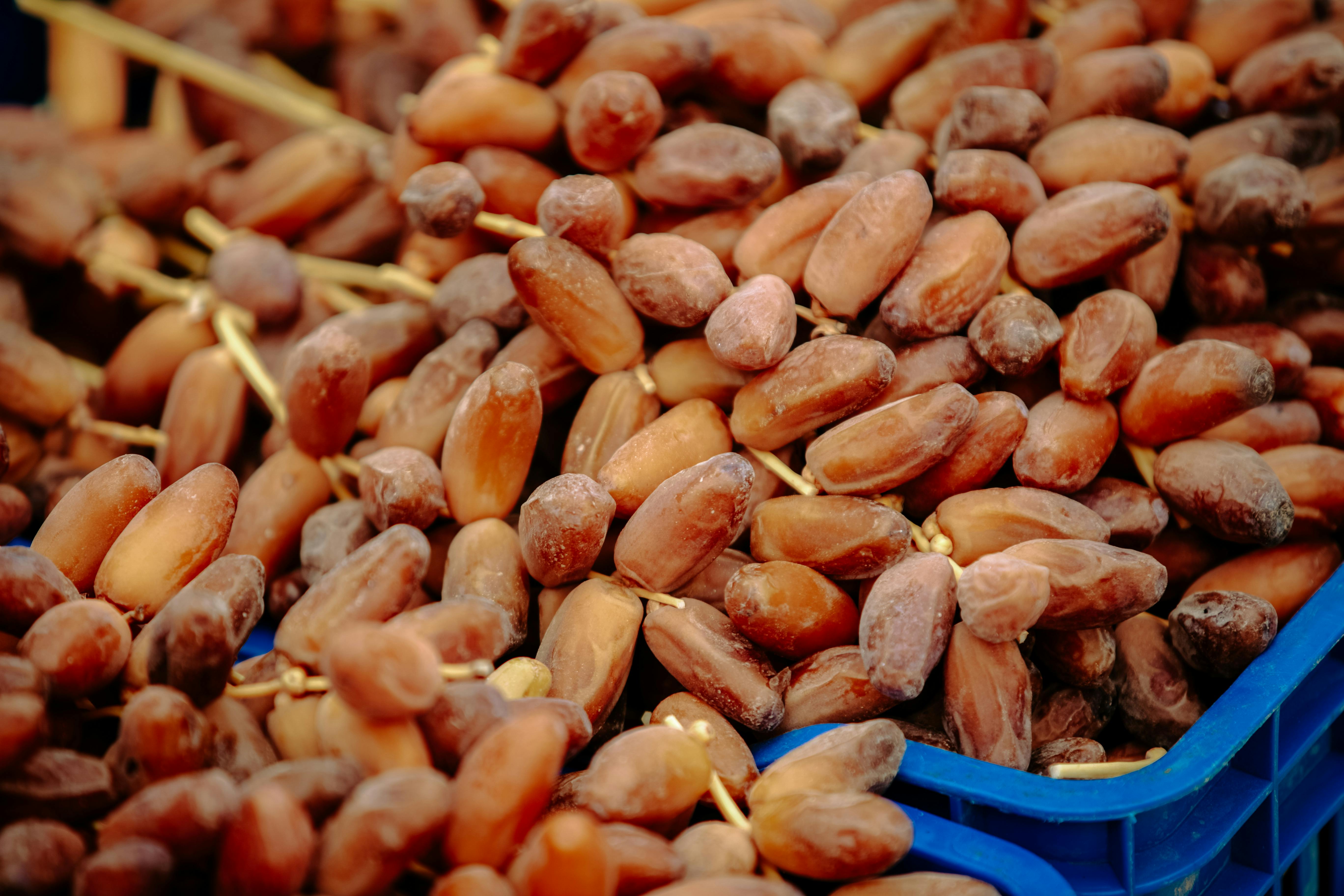
Date
The fruit of the Sumerian "tree of life" — a natural sweetener with a moderate glycemic peak and functional gut benefit.
In 1 minute
What does it provide? Dietary fiber (≈ 7 g/100 g), (poly)phenols (gallic acid, caffeic acid, proanthocyanidins), potassium (≈ 700 mg/100 g), magnesium, a little iron — a natural sweetener with a moderate glycemic peak compared to white sugar.
How much? General: 2–3 dates/day (≈ 50 g). In a clinical bowel RCT, 7 fruits (≈ 50 g) for 3 weeks. In energy balls 1–2 pieces.
When to avoid? IBS with sorbitol/fructan sensitivity (portion control), severe uncontrolled glycemia, dental sensitivity (sticky), hyperkalemia in kidney failure.
The date palm is one of the longest-domesticated fruit-bearing trees: archaeological data point to the Persian Gulf and Mesopotamia region as the most likely origin, with evidence going back over 6000 years. In Sumerian mythology, the date palm is the tree of life — "gisimmar" — and Sumerian hymns say a palm has "360 uses": from the sweet fruit to the tree's fibers, from the leaves' pure-fiber bags to the seeds' occasionally ground coffee substitute. Hammurabi's code around 1750 BCE already regulated the date sector and date taxes — cutting down a tree could cost one's head.
In the ancient Near East and Egypt, the date was a cultural icon: on wall paintings the sacred tree of the god Thoth, and date baskets were placed in pharaohs' tombs (particularly next to Tutankhamun) as food for the afterlife. In the Bible, the word "palm" (tamar) also refers to the date palm, and the Jordan Valley city of Jericho earned the name "city of palms." Archaeological sensation: in 2008, Israeli researchers successfully germinated a 2000-year-old Judean date seed found at Masada fortress (from Herod's era, around 70 CE) of the extinct variety — the tree, named "Methuselah," is still alive. Spanish missionaries brought the species to the New World in the 18th–19th centuries; today the Coachella Valley (California) is one of the centers of the Medjool variety.
🔬 Scientific Background
Date composition is surprising: the three ripening phases (khalal — hard, green; rutab — soft, partly ripe; tamr — full ripeness) are dramatically different. Fully ripe date sugar content is ≈ 65–75% (fructose + glucose in nearly equal ratios — versus white sugar's 100% sucrose), but fiber (≈ 7 g/100 g) and polyphenols (≈ 100–300 mg gallic acid equivalent/100 g) moderate the glycemic peak. Main varieties: Medjool (large, soft, "royal"), Deglet Noor (smaller, less sweet), Barhi, Khadrawy.
Clinical human evidence: Eid 2014 randomized, controlled, crossover trial — 7 dates (≈ 50 g) for 21 days in healthy adults → increase in stool frequency, reduction in fecal ammonia level, reduction in fecal-water genotoxicity. The whole microbiome composition did not show a large shift, but functional endpoints consistently improved. This is a typical "functional microbiome benefit" pattern.
Date glycemic index is surprisingly low-to-moderate (35–55, cultivar-dependent), which does not mean "free in diabetes" — portion control is critical. Alkaabi 2011 study showed 50 g of date in T2D did not cause significant blood glucose elevation as part of a standard-carbohydrate-structured meal.
- + Yogurt, kefir: synbiotic synergy.
- + Nuts (almond, walnut, cashew): base for energy balls, glycemic peak moderation (fiber + fat).
- + Inulin/FOS, AXOS (whole grains): prebiotic synergy.
- + Oat β-glucan: classic breakfast pairing.
- + Olive oil, tahini: Moroccan/Middle Eastern tradition — date + tahini dessert.
- + Seeds (chia, flax): broadening the fiber matrix.
- Other sugary dried fruits in larger amounts: additive glycemic load.
- Refined date syrup ("dibs"/silan) as a sugar substitute with minimal fiber content: concentrated sugar.
- Large amounts on an empty stomach in diabetes: glycemic peak.
- Iron supplementation with polyphenol-rich dates: slight chelation — ≥ 1-hour separation.
- Sugary sweets + date snack together: overdosing.
- Prolonged, high-heat roasting: caramelization, polyphenol loss.
- IBS elimination phase (FODMAP): sorbitol + fructan — portion control (Monash 2023 retest: 1 Medjool low FODMAP).
- Diabetes, uncontrolled glycemia: portion control mandatory — 1–2 pieces as part of a meal, NOT as a snack.
- Severe kidney failure, hyperkalemia: high potassium content — moderate the serving.
- Dental sensitivity: sticky texture, cariogenic — at end of meal, not as a snack.
- Infant (under 1 year): halved/sliced, limited, due to choking hazard.
- Severe obesity in calorie management: calorie-dense (≈ 280 kcal/100 g) — portion control.
- Latex-fruit syndrome (rare connection): theoretical cross-reactivity.
- Acute gastritis flare: slight acidity, generally tolerable.
Daily serving
2–3 Medjool dates/day (≈ 50 g) general. For clinical bowel effect target 7 pieces (≈ 50 g) for 3 weeks. In energy balls 1–2 pieces.
Preparation pattern
- Can be pitted or unpitted — pitted is more convenient.
- Raw: as a snack, stuffed with almond.
- For energy balls: date + walnut/almond powder + cacao + coconut shreds — pureed.
- In cake/cookies: natural sweetener, partly replaces sugar.
- In smoothie: soaked and pureed.
Classic patterns
Almond-stuffed Medjool: classic Middle Eastern snack.
Energy balls: 200 g date + 100 g almond + 30 g cacao rolled in coconut shreds.
Moroccan tagine: chicken + date + almond + cinnamon + saffron.
Tahini-date "dessert": date + tahini + sesame seed — Middle Eastern sweet.
Breakfast muesli: oatmeal + 2 chopped dates + walnut + cinnamon.
Smoothie: banana + date + spinach + almond milk + cacao.
Date syrup (dibs/silan): in salad dressing (small amount).
Storage
Fresh Medjool refrigerated 1–2 months (soft). Dried in dry conditions at room temperature 6 months, frozen 12 months. Pureed refrigerated 1–2 weeks.
What not to do
Don't overdo it if diabetic. Don't snack on it chronically (dental sensitivity). Don't choose sugar-treated date syrup over pure fruit. Don't combine with other large sugary snacks.
References
[1] Eid N et al. The impact of date palm fruits and their component polyphenols, on gut microbial ecology, bacterial metabolites and colon cancer cell proliferation. J Nutr Sci 2014;3:e46.
[2] Alkaabi JM et al. Glycemic indices of five varieties of dates in healthy and diabetic subjects. Nutr J 2011;10:59.
[3] Al-Kuran O et al. The effect of late pregnancy consumption of date fruit on labour and delivery. J Obstet Gynaecol 2011;31(1):29-31.
[4] Rahmani AH et al. Therapeutic effects of date fruits (Phoenix dactylifera) in the prevention of diseases. Int J Clin Exp Med 2014;7(3):483-491.
[5] Vayalil PK. Date fruits (Phoenix dactylifera Linn): an emerging medicinal food. Crit Rev Food Sci Nutr 2012;52(3):249-271.
[6] Sirisena S et al. The emerging Australian date palm industry: date fruit composition. Foods 2015;4(2):134-149.
[7] Mrabet A et al. Date palm fruits as a potential source of functional dietary fiber: a review. Food Sci Technol Res 2019;25(1):1-10.
[8] Monash University. Dates — Medjool low FODMAP single fruit.
[9] USDA FoodData Central. Dates, medjool.