


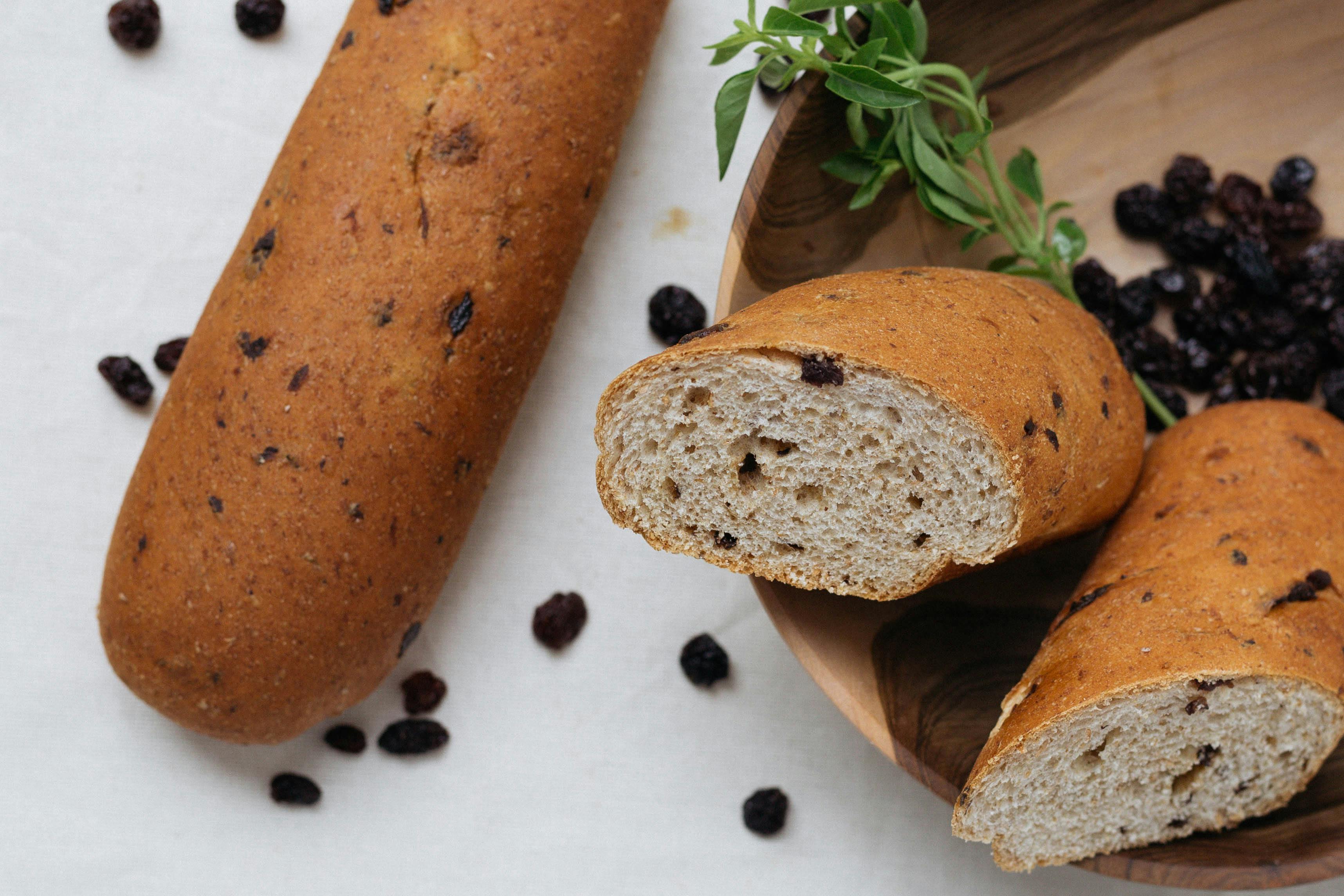
Raisin
The Olympus reward bite — fiber, tartaric acid, and anti-cariogenic polyphenols in a single dried grape.
In 1 minute
What does it provide? Dietary fiber (≈ 3.7 g/100 g), tartaric acid (≈ 1.5 g/100 g — supports bowel motility and SCFA production), polyphenols (caftaric acid, quercetin glycosides, rutin, anthocyanin in dark varieties), potassium, iron — functional gut health benefit.
How much? In a clinical bowel-effect RCT 120 g/day for 3 weeks. Dietary norm: 1 tbsp (≈ 13 g, low FODMAP) — daily snack or breakfast.
When to avoid? Sulfite sensitivity (golden raisin), dental sensitivity (cariogenic stickiness), uncontrolled diabetes, kidney stone history (calcium-oxalate tendency).
Raisin, the dried grape, is one of the world's oldest preservation results: sources put Persian and Egyptian cultivation around 2000 BCE, and it already appears in the Bible (e.g., 1 Sam 25:18 among Abigail's offered gifts). Phoenician and Armenian merchants carried it on to the Greek and Roman world, where raisin became a mass food: it was given as a prize at the Olympic sport competitions, used in religious ceremonies, and placed in graves as food for the afterlife. In the Roman-Carthaginian tradition appeared passum, a sweet wine made from semi-dried grapes; the recipe was preserved for us from the work of Mago, the Punic agronomist, by Columella.
From the Middle Ages, famous European centers took shape: Málaga has been exporting its dried grape since 1502 — today known as Pasas de Málaga with PDO origin protection. The small "korinka" (currant) native to the Corinth (Zante) island became, due to 15th-century Venetian traders, a classic ingredient of Christmas puddings and fruit cakes across Europe. In 1873, near Fresno, California, William Thompson farmer's seedless mutant cultivar — the Thompson Seedless — captivated the world: today this is the world's most widely cultivated raisin grape. In the early 20th century, the American "Sun-Maid" brand and the red-bonneted girl marketing made the raisin snack a favorite of generations.
🔬 Scientific Background
The bioactive matrix of raisin: fiber (soluble pectin + insoluble), tartaric acid (≈ 1.5 g/100 g — organic acid that acts osmotically and as microbial substrate), and polyphenols (caftaric acid, p-coumaric acid, kaempferol, quercetin-3-glucoside, rutin; in dark varieties anthocyanin too). Seedless Thompson raisin is the most common, the "golden" (light) generally treated with sulfur dioxide to preserve color.
Clinical human evidence: Spiller 2003 randomized crossover trial → 120 g/day raisin for 3 weeks in healthy adults: stool mass increase, bowel transit time shortening, SCFA (specifically propionate + butyrate) elevation, fecal bile acid reduction. Tartaric acid control alone did not produce bulk effect — meaning fiber + tartaric acid together are needed. Another 2-week dose-test study (84–168 g/day) showed no significant change — shorter duration.
Mandalari 2010 14-day human intervention with 3×28 g of raisin/day showed only minor and individual-dependent microbiome shifts (Faecalibacterium prausnitzii ↑, Bifidobacterium ↓), without diversity change. Patel 2011 study showed that raisin consumption produced a small but significant blood pressure reduction in prehypertension.
Dental paradox: Although raisin lives with the "sticky sugary snack" stereotype, in vitro studies (Wu 2008) show that oleanolic acid and other raisin polyphenols inhibit S. mutans (caries bacterium) and P. gingivalis (periodontal) adhesion. The net effect is mixed — raisin added to sugary muesli can elevate plaque acidity, but as part of a main meal is less cariogenic than many assume.
- + Yogurt, kefir: synbiotic synergy.
- + Oat β-glucan (breakfast): dual fiber matrix.
- + Nuts (almond, walnut): classic "trail mix" — fat moderates glycemic peak.
- + Whole-grain couscous, bulgur (AXOS): broader fermentation profile.
- + Cinnamon, cardamom: glycemic peak moderation, flavor harmony.
- + Lemon rice, Indian cuisine classics: pairing of fiber/acid effects.
- Sugary muesli/syrup with raisin together: additive sugar, cariogenic risk.
- During acute diarrhea: fiber + sorbitol effect.
- Sugary raisin sweets + dental sensitivity: caries.
- Iron supplementation with polyphenol-rich raisin: slight chelation — ≥ 1-hour separation.
- Prolonged high-heat roasting: caramelization, polyphenol loss.
- Red sweetened raisin-like snack: marketing — not equivalent to natural raisin.
- Sulfite sensitivity (asthma): "golden raisin" sulfur dioxide treatment is common — sulfite-free (dark) variant recommended.
- Diabetes, uncontrolled glycemia: portion control — 1–2 tbsp as part of a meal.
- Kidney stones, calcium-oxalate tendency: moderate oxalate content.
- Dental sensitivity: sticky texture, cariogenic potential.
- Acute diverticulitis flare: small seeds are a concern.
- Infant (under 1 year): halved or avoided due to choking hazard.
- Severe kidney failure, hyperkalemia: moderate-to-high potassium.
- Acute diarrhea: osmotic effect counterproductive.
- IBS elimination phase: small serving (1 tbsp low FODMAP) can be tested.
Daily serving
1 tbsp (≈ 13 g, low FODMAP portion). For clinical bowel-effect target 120 g/day for 3 weeks (but this is high FODMAP).
Preparation pattern
- Raisin is directly consumable; soaked (in water 10–30 minutes) it becomes softer.
- Snack: mixed with walnut, almond.
- In cookies/bread: classic, brief heat.
- Curry/rice: Middle Eastern, Indian cuisine.
Classic patterns
"Trail mix": raisin + almond + pumpkin seed + walnut + cacao nibs.
Carrot cake / cinnamon roll: classic baking use.
Indian pulao: rice + raisin + almond + cinnamon + cardamom.
Moroccan/Middle Eastern tagine: chicken + raisin + cinnamon + saffron.
Breakfast muesli: oatmeal + raisin + walnut + milk/yogurt.
Cod-liver salad: cod-liver/tuna + raisin + apple + walnut + mayonnaise.
Storage
In sealed packaging at room temperature 6–12 months. Refrigerated 12–24 months. Soaked, refrigerated 5–7 days.
What not to do
Don't overdo it if diabetic. Don't snack on it chronically (dental). Don't choose sulfated golden if asthmatic. Don't combine with large sugary snacks.
References
[1] Spiller GA et al. Effect of daily raisin consumption on gastrointestinal transit time in healthy adults. J Am Coll Nutr 2003;22(suppl).
[2] Mandalari G et al. Faecal microbiota response to raisin and grape consumption: a 14-day human intervention. Br J Nutr 2010;103(11):1684-1689.
[3] Patel BP et al. Effect of raisin consumption on blood pressure: a meta-analysis. Postgrad Med 2011;123(5):131-141.
[4] Wu CD, Mao Z et al. Effects of raisins on caries-related microflora. Phytochemistry 2008;69(7):1573-1581.
[5] Williamson G, Carughi A. Polyphenol content and health benefits of raisins. Nutr Res 2010;30(8):511-519.
[6] Kaminskas A et al. Sun-dried raisin polyphenol profile and antioxidant activity. Foods 2022;11(2):195.
[7] Anderson JW, Waters AR. Raisin consumption by humans: effects on glycemia and insulinemia. J Food Sci 2013;78(suppl):A11-A17.
[8] Monash University. Raisins — low FODMAP portion 13 g.
[9] Pasiakos SM et al. Sun-dried raisins: a dietary intervention to support cardiometabolic health. Adv Nutr 2021;12(3):1110-1124.