


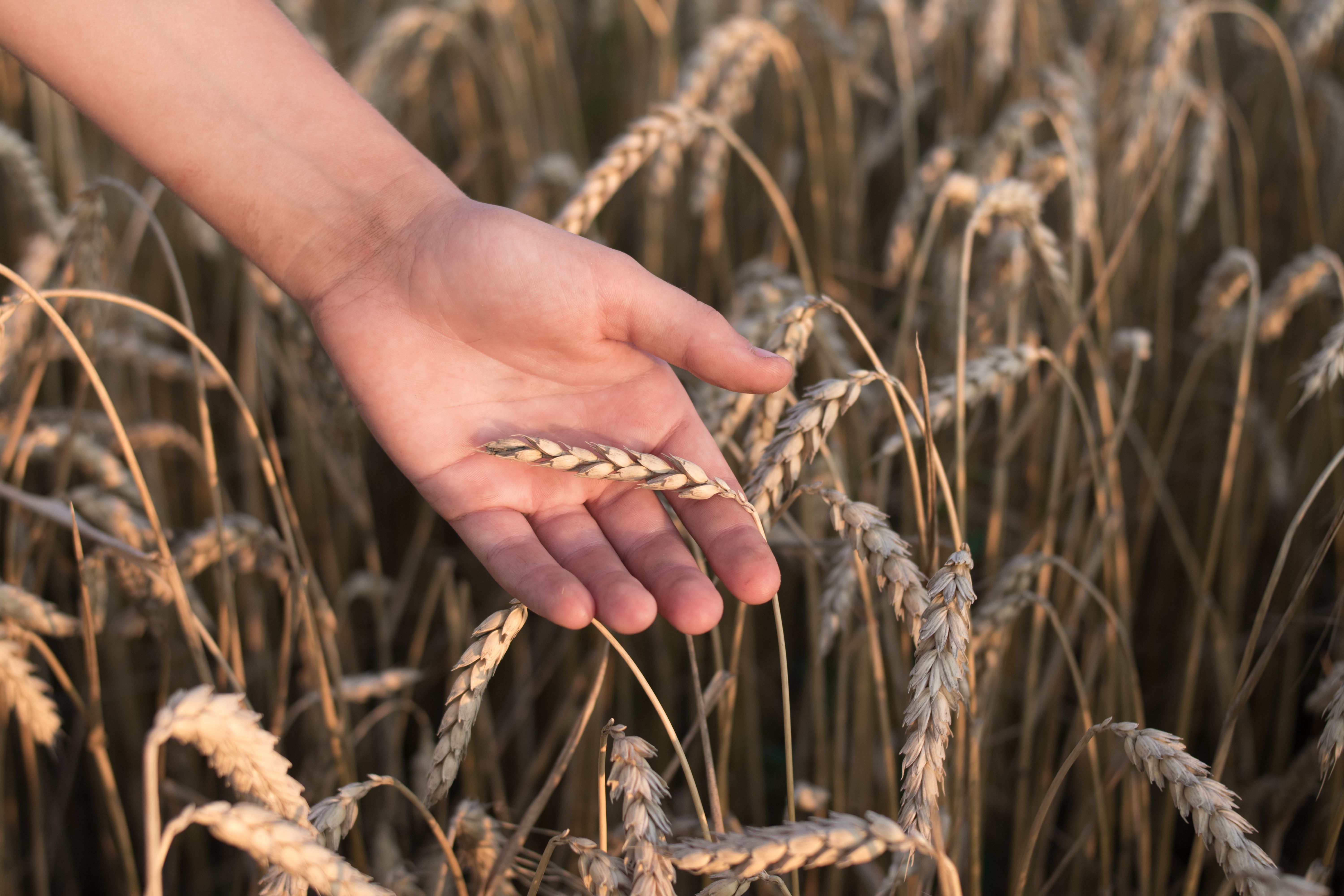
Spelt
The ancient grain of Benedictine monasteries — arabinoxylan-rich, moderate β-glucan, but gluten-containing: not a celiac
Spelt in 1 minute
What does it provide? High arabinoxylan (AX) content — 7–9 g/100 g in spelt bran, higher than in common wheat (5–7 g/100 g). Moderate β-glucan (≈ 0.5–1 g/100 g), ferulic acid (200–500 mg/kg in the bran layer), lignan, and high manganese content (1.3 mg/100 g — about 65% of the recommended daily intake per serving). AX reaching the colon is a substrate for Bifidobacterium, Roseburia, and F. prausnitzii — human RCTs show SCFA elevation and a "bifidogenic" effect (François 2012, Lecerf 2012).
How much? Whole-grain spelt bread 60–100 g, or spelt pasta / flakes 50–70 g (dry) daily. When switching to ancient grain, do so gradually — AX fermentation can transiently cause bloating at first.
When to avoid? Celiac disease and confirmed wheat allergy (spelt contains gluten — not gluten-free), severe IBS elimination phase (fructan content), active NCGS phase (individual trial with sourdough form), classic ATI (amylase trypsin inhibitor) sensitivity.
Spelt (Triticum spelta) is one of the hexaploid ancient wheats: genetically it arose from a cross between emmer (Triticum dicoccon) and a wild grass (Aegilops tauschii) about 8,000–9,000 years ago. According to finds, it spread from Anatolia and the Iranian Plateau through the Balkans and Central Europe; it was the staple grain of Celtic and Germanic tribes alongside continental einkorn. In pastoral and farming cultures, spelt's advantage was its hulled (palaceous) grain: the husk wraps the kernel, so it is more resistant to disease and moisture than modern wheats — storage and overwintering are more reliable. In Pliny and Roman cookbooks it appears as "far"; the classic ingredient of puls (porridge-like gruel).
In medieval Europe, spelt was a staple of monastery gardens and cool, damp mountain regions. Hildegard of Bingen, the 12th-century Benedictine abbess, devotes an entire chapter in Causae et curae to spelt ("dinkel") and considers it the noblest grain — still today one of the favorite references of the German esoteric and bio movement. From the late 19th century, modern higher-yielding free-threshing wheat varieties pushed spelt out of mainstream cultivation, and by the mid-20th century it was barely grown. The 1980s organic-reform movement and the Hildegard tradition brought it back; today Germany, Switzerland, Italy (farro), and more recently Hungary are significant producers. Modern nutritional science values spelt for its higher arabinoxylan, bran phenolic acid, and mineral content compared to common wheat — but emphasizes that it is not gluten-free and is only a solution for NCGS depending on individual tolerance.
Scientific Background
Spelt (Triticum spelta) has a hexaploid genome (AABBDD) like common bread wheat (T. aestivum) — the two are crossable, and the gluten fraction structure is similar. Spelt's gliadin profile differs somewhat: quantitatively the high-molecular-weight glutenin (HMW-GS) ratio is higher, and the expression of certain α-gliadin epitopes is lower (Geisslitz 2020, Geisslitz 2019). This does not mean spelt is celiac-safe — celiakogenic epitopes are present, and spelt consumption provokes active celiac disease just the same (Spaenij-Dekking 2005).
Arabinoxylan (AX) is spelt's main prebiotic fiber: bran AX content is 7–9 g/100 g, endosperm AX content is 1.5–2 g/100 g (Andersson 2013). AX in the colon is a substrate for Bifidobacterium adolescentis, B. longum, Roseburia, and F. prausnitzii — in François 2012's human RCT, 6 weeks of AX supplementation significantly raised the Bifidobacterium ratio and butyrate output. Ferulic acid is present in the bran layer in covalently bound form — colonic bacterial ferulic-acid esterase activity releases it and converts it to anti-inflammatory dihydroferulic acid (Vitaglione 2008).
β-glucan content is moderate (0.5–1 g/100 g), smaller than oat's (≈ 4 g/100 g) or barley's (≈ 3 g/100 g), but contributes to the viscous fiber matrix and slower glycemic profile. Spelt's manganese, zinc, magnesium, and iron content is slightly higher than common wheat's — 100 g whole-grain spelt provides about 65% of the manganese RDI and 30% of the magnesium RDI. Lignan profile (mainly secoisolariciresinol diglucoside) is moderate; colonic bacteria convert it to enterolactone with phytoestrogen activity.
During sourdough fermentation, spelt's fructan content drops significantly (Loponen & Gänzle 2018), and gluten peptides undergo partial hydrolysis. This is why some NCGS patients tolerate sourdough spelt better than yeast-leavened wheat — but it does not solve celiac disease.
- + Sourdough fermentation: reduces fructan content, partial gluten hydrolysis, improves tolerability.
- + Olive oil, walnut, almond (Mediterranean pattern): fat + MUFA + lignan synergy.
- + Legumes (chickpea, lentil) in spelt bowl: complementary amino acid profile + synergistic fermentation.
- + Fermented vegetables (sauerkraut, kimchi): carbohydrate + live culture → SCFA synergy.
- + Green herbs (basil, oregano): polyphenol complement.
- + Yogurt or kefir: synbiotic breakfast with whole-grain spelt flakes.
- In a celiac diet: spelt is not gluten-free — strictly avoid.
- Highly refined, white spelt-flour products: most of the bran-AX and ferulic acid is lost.
- Iron supplementation in the same meal: phytate can chelate Fe — temporal separation.
- High-dose fast carbohydrates (sugar, white rice) together: glycemic spike.
- In active NCGS phase: trial with sourdough spelt if symptoms improve; otherwise avoid.
- Yeast-leavened, quick-risen spelt pasta for IBS patient: fructan is not broken down → bloating.
- Celiac disease: absolutely avoid — spelt is gluten-containing, and celiakogenic epitopes are present.
- Wheat allergy (IgE-mediated): high cross-reactivity — avoid.
- NCGS: individual trial, only with sourdough form; avoid in active phase.
- IBS elimination phase (Monash low FODMAP 4–6 weeks): spelt's fructan content is high — small portions of sourdough bread may be tolerable.
- Severe ATI (amylase trypsin inhibitor) sensitivity: spelt also contains ATI — avoid.
- Acute bowel obstruction, severe stricture: high fiber — risky.
- Severe kidney disease (CKD 4–5) with phosphorus restriction: moderate phosphorus — under dietitian supervision.
- Infant (under 1 year): gluten introduction per WHO and ESPGHAN is allowed from 4–6 months in small amounts.
References
[1] Geisslitz S et al. Comparative quantitative LC-MS/MS analysis of 13 amylase/trypsin inhibitors in ancient and modern Triticum species. Sci Rep 2020;10(1):14570. Link
[2] Geisslitz S et al. Wheat ATIs: characteristics and role in human disease. Front Nutr 2019;6:153. Link
[3] Spaenij-Dekking L et al. Natural variation in toxicity of wheat: potential for selection of nontoxic varieties for celiac disease patients. Gastroenterology 2005;129(3):797–806. Link
[4] Andersson AAM et al. Contents of dietary fibre components and their relation to associated bioactive components in whole grain wheat. Food Chem 2013;136(3-4):1243–1248. Link
[5] François IE et al. Effects of a wheat bran arabinoxylan oligosaccharide on human gut microbiota. Br J Nutr 2012;108(12):2229–2242. Link
[6] Lecerf JM et al. Xylo-oligosaccharide (XOS) in combination with inulin modulates both the intestinal environment and immune status in healthy subjects. Br J Nutr 2012;108(10):1847–1858. Link
[7] Vitaglione P et al. Cereal dietary fibre: a natural functional ingredient to deliver phenolic compounds into the gut. Trends Food Sci Technol 2008;19(9):451–463. Link
[8] Loponen J, Gänzle MG. Use of sourdough in low-FODMAP baking. Foods 2018;7(7):96. Link
[9] Monash University. High and Low FODMAP foods — spelt. Monash FODMAP database. Link