


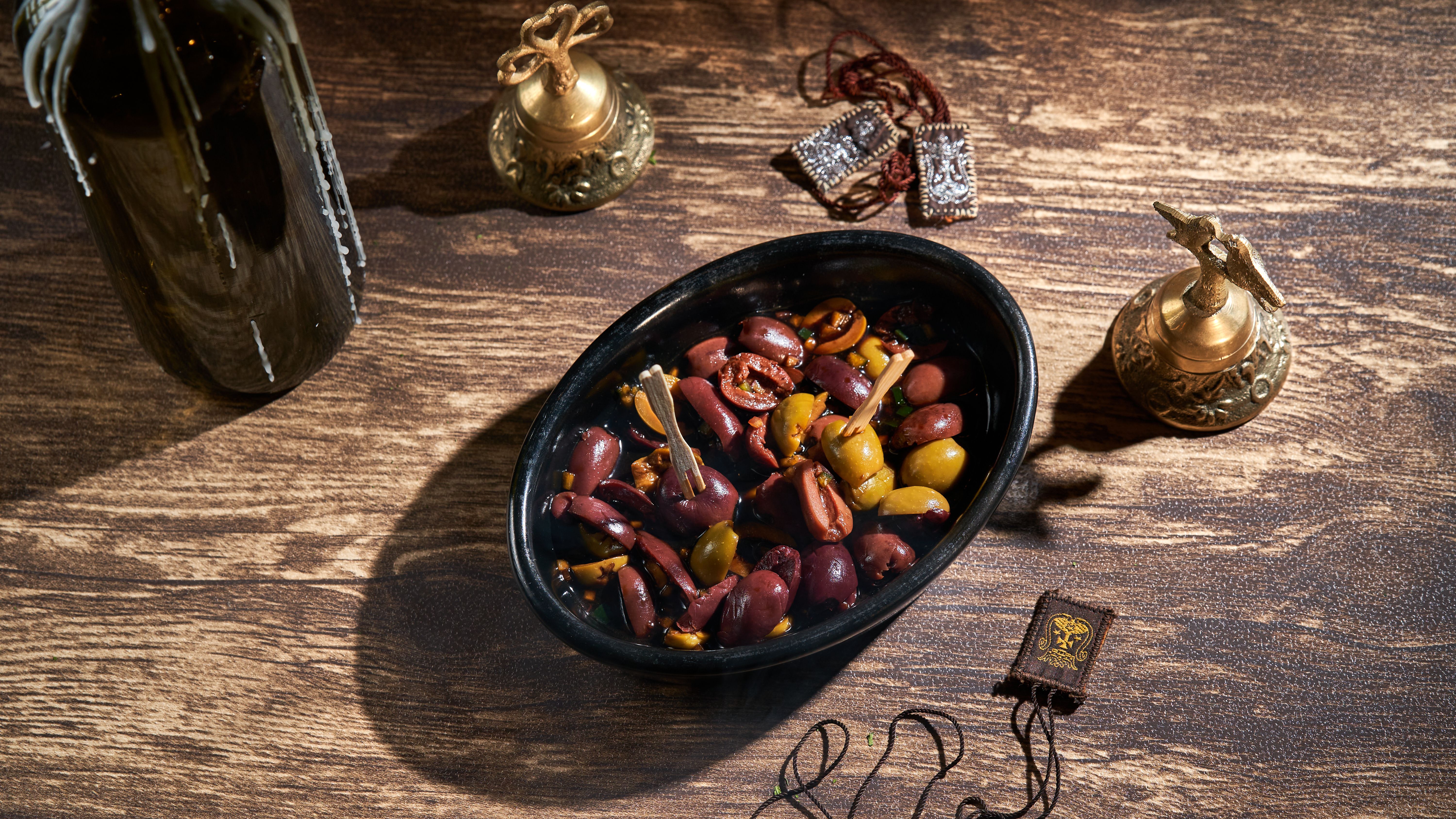
Table olives
An ancient Mediterranean fermentum — Greek-style and Spanish-style, with the oleuropein → hydroxytyrosol transformation.
In 1 minute
What does it provide? With Greek-style (natural, barrel) fermentation: live lactic acid bacteria (Lactiplantibacillus plantarum, Lb. pentosus — gut-flora-supporting strains) and yeasts (Wickerhamomyces, Saccharomyces cerevisiae), plus hydroxytyrosol and tyrosol (degradation products of the bitter oleuropein glycoside — powerful antioxidant polyphenols). EFSA-recognized health claim: olive polyphenols protect blood lipids from oxidative damage (≥ 5 mg hydroxytyrosol/day, ≈ 20 g olives). Pilot RCT: 12 green olives daily for 30 days → IL-6 and oxidative stress markers reduced.
How much? 5–10 pieces (≈ 30–50 g) per day, Greek-style, refrigerated, NON-pasteurized product. The 80% MUFA (monounsaturated oleic acid) is cardiometabolically favorable.
When to avoid? Severe hypertension or heart failure with strict sodium restriction (≈ 700–750 mg Na/100 g — or rinse in cold water), MAO inhibitor therapy (tyramine content — hypertensive crisis), histamine intolerance (biogenic amines: histamine, tyramine, putrescine), active IBS flare if the brine contains garlic/onion (choose plain oiled form), California-style black olives (oxidized, NOT fermented — no live LAB), infant <2 years from the un-pitted form (choking risk).
The olive is the patron tree of the Mediterranean: according to Greek mythology, the olive tree grew from the Poseidon–Athena contest for Athens' favor, and archaeology seems to support this: at the Hishuley Carmel underwater site off today's Israeli coast, industrial-scale table olive preparation was already underway in stone basins with brine soaking in the middle of the 5th millennium BCE. Ancient Greek and Roman agronomic works — Columella's De re rustica and Pliny's Naturalis Historia — discuss pickling and salting techniques in detail, and Pliny devotes an entire chapter to the differences between various olive varieties. Monte Testaccio, built of some 250,000 amphora fragments dumped by the Roman state, still documents the industrial trade in olives and olive oil from the Empire's Iberian provinces.
Modern Spanish-style (lye-initiated) and Greek-style (natural barrel) fermentation both grow from ancient roots, and 20th-century California-style is only a faster adaptation of these. The science of starter cultures and brinology was only standardized in the 20th–21st century, but natural "barrel" fermentation still lives in Greek and southern Italian family farms, where the Lactiplantibacillus plantarum and Wickerhamomyces yeast combination still shapes the oleuropein → hydroxytyrosol conversion exactly as it did two thousand years ago.
🔬 Scientific Background
Fresh olives are extremely bitter due to oleuropein and other secoiridoid glycosides — inedible raw. Debittering happens with three main technologies:
1. Greek-style (natural, barrel): The fruits are placed directly into 8–10% brine. Spontaneous fermentation begins: Lactiplantibacillus plantarum, Lb. pentosus, Leuconostoc, and yeasts (Wickerhamomyces, Saccharomyces cerevisiae, Pichia). Over 6–12 months of ripening, oleuropein is partly broken down into hydroxytyrosol and tyrosol — this simultaneously reduces bitterness and increases bioactive polyphenol content.
2. Spanish-style (with lye): The olives are first soaked in 1.5–2% NaOH solution (lye) for 8–10 hours → oleuropein hydrolyzes quickly. After washing, they ferment in 3–4% brine. Faster, but lye treatment also loses some polyphenol.
3. California-style (oxidized, ripe black): Not a fermentation — they are blackened by iron-sulfate oxidation. It does NOT carry live LAB.
Human clinical data: - Pilot study (n=25, 30 days, 12 green olives/day): IL-6↓, MDA (oxidative stress)↓, body fat↓, muscle mass↑, fecal Lactobacillus↑ (non-significant trend). - Probiotic candidate Lb. pentosus LPG1 (olive-derived) showed human microbiota modulation in an RCT — this strengthens the probiotic potential of the olive matrix. - Animal experiment (Arbequina): blood pressure reduction and flora shift in SHR hypertensive model.
Polyphenols: Hydroxytyrosol is antioxidant and anti-inflammatory — EFSA's recognized health claim: "olive polyphenols contribute to protecting blood lipids from oxidative damage" (≥ 5 mg hydroxytyrosol/20 g).
Limitations: High Na content (~ 700–750 mg Na/100 g), and brine ingredients (garlic, onion) may add FODMAPs.
- + Extra virgin olive oil (EVOO): complementary polyphenol matrix (oleocanthal + hydroxytyrosol).
- + Whole-grain bread, legumes (hummus): fiber + polyphenol synbiotic.
- + Tomato, fresh greens: Mediterranean salad matrix.
- + Cheese, herbs (oregano, rosemary): classic tapas/meze.
- + Seaweed dashi (only in a miso soup context): related polyphenol-fiber synergy.
- + Resistant starch (cooked-then-cooled rice): SCFA support.
- High-Na meals (cheese, salty cheese, cured meat): Na accumulation.
- MAO inhibitor therapy: if you eat a lot — biogenic amine risk.
- High-dose iron supplementation: polyphenols can chelate — separate by ≥ 2 hours.
- Boiling: if live LAB is the goal — don't boil for long.
- Migraine-provoking diet: olive brine (biogenic amines) is a trigger for sensitive individuals.
- Severe hypertension, heart failure with Na restriction: portion control or rinsing in cold water (reduces Na).
- Migraine (especially with MAO inhibitor therapy): biogenic amines (tyramine, histamine, putrescine) are a trigger.
- Histamine intolerance: test with a small portion.
- Active IBS flare, if the brine is garlicky/oniony: to be avoided — choose plain, oiled variants.
- Severe kidney failure with Na/K limits: portion control.
- California-style black olives (oxidized): don't consider them fermented — no live LAB.
- Olive allergy (rare): strictly avoid.
- Infant < 2 years: pit choking risk (only pitted).
Daily serving
5–10 pieces (≈ 30–50 g) daily or 3–5 × 50 g weekly.
Preparation pattern — homemade Greek-style olives
- 1 kg fresh green or ripe olives (pitted or whole), with a small slit in each.
- Soaking: 7–10 days in cold water (changed daily) — much of the oleuropein leaches out.
- Brine: 1 liter water + 100 g salt (10%).
- Layered in a jar: olives + bay leaf + garlic (to taste) + oregano.
- Weight down. Room temperature for 3–6 months.
- Optionally rinse before consumption to reduce Na.
Classic patterns
Greek salad: tomato + cucumber + pepper + olives + feta + olive oil + oregano.
Tapas: olives + cheese + cherry tomato + EVOO + baguette.
Olive tapenade: pitted olives + EVOO + garlic + capers + lemon zest — blended.
Side for Mediterranean fish.
Pizza topping.
Storage
In brine refrigerated airtight 6 months–1 year. Surface mold → skim off the top. In oil: refrigerated 1 month.
What not to do
Don't boil at high heat for long. Don't discard the brine (usable for dressing). Don't choose a pasteurized industrial product if live LAB is the goal.
References
[1] Lavermicocca P et al. Table olive fermentation by Lactobacillus plantarum strains. Int J Food Microbiol 2010.
[2] Accardi G et al. Nutraceutical effects of table green olives — pilot study. Endocr Metab Immune Disord Drug Targets 2016.
[3] Pino A et al. Lactobacillus pentosus LPG1 from table olives — probiotic in humans (RCT). J Funct Foods 2019.
[4] Rocha J et al. Arbequina olives in spontaneously hypertensive rats — BP and gut microbiota. RSC Adv 2020.
[5] EFSA. Olive oil polyphenols health claim (Regulation 432/2012/EU).
[6] Bautista-Gallego J et al. Brining for table olives — review. Food Microbiol 2013.
[7] Hurtado A et al. Lactic acid bacteria from fermented table olives. Food Microbiol 2012.
[8] Monash University. Olives FODMAP serving guide.