


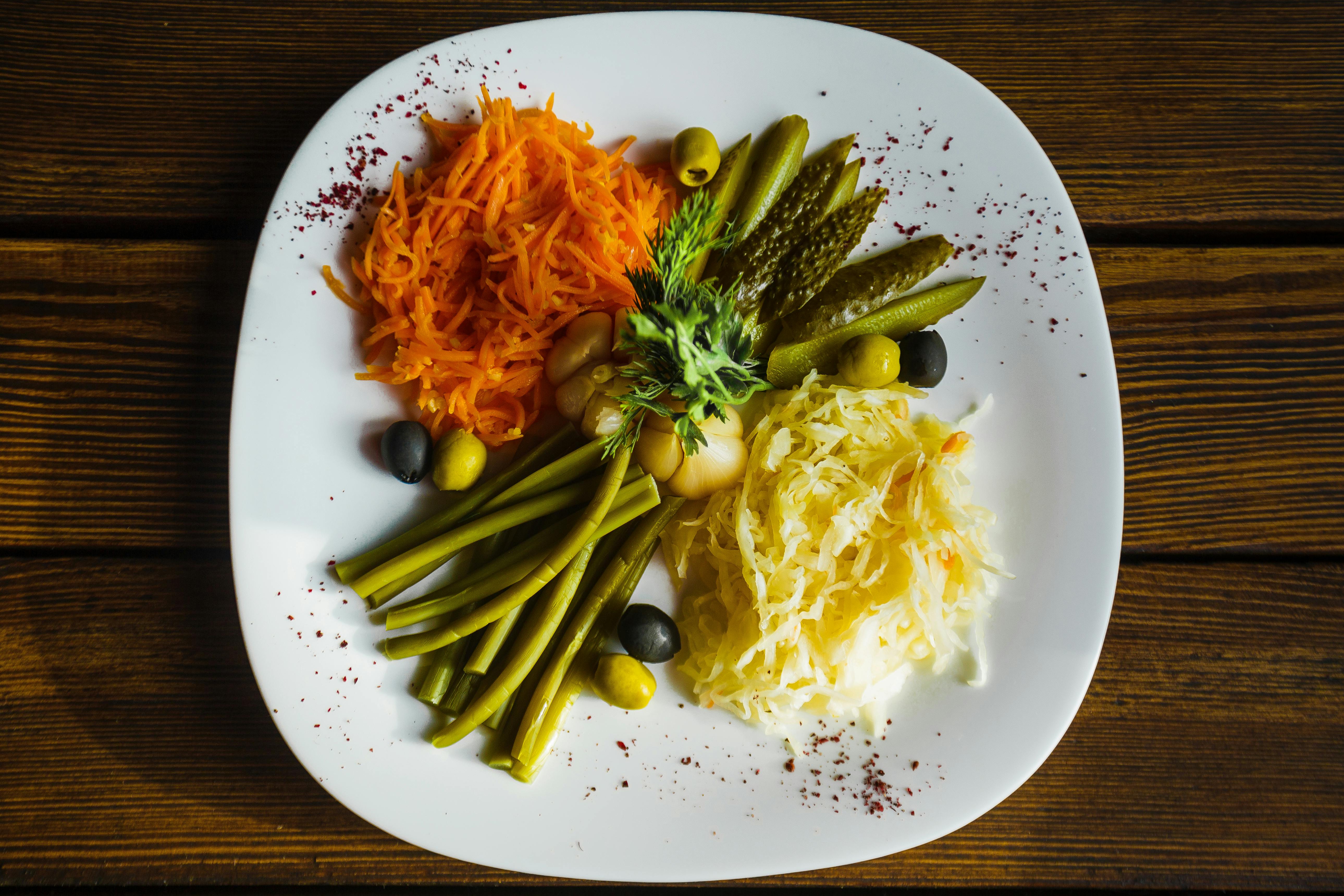
Fermented mixed vegetables
An ancient winter technology — carrot, pepper, cauliflower, green bean lactic-acid fermented. NOT a vinegar pickle.
In 1 minute
What does it provide? Live lactic acid bacteria (mainly Lactiplantibacillus plantarum and Leuconostoc — they ferment successively in brine), lactic acid, exopolysaccharides (postbiotic matrix), polyphenols (Brassica glucosinolates, pepper carotenoids, carrot pectin), and fiber. A mixed-vegetable blend offers a broader microbiota-substrate repertoire than purely cabbage-based fermentums. Wastyk 2021 (Stanford, 10 weeks): microbiome diversity increase, reduction of 19 inflammatory signaling proteins. The pH < 4.6 acidity of lacto-fermentation PROTECTS AGAINST Clostridium botulinum.
How much? Introduction: 30 g/day. Maintenance: 50–100 g (≈ ½ cup) daily or 3–4 × 100 g/week, from a REFRIGERATED, NON-pasteurized product. Due to high Na, 100 g/day is the practical upper limit.
When to avoid? Strict Na-restricted hypertension and heart failure (300–700 mg Na/100 g), MAO inhibitor (phenelzine, tranylcypromine — tyramine crisis), histamine intolerance (biogenic amines), active reflux disease and peptic ulcer flare, severe immunosuppression (live microbes), children under 2, the first days of a SIBO flare, Hashimoto's during strict iodine-restricting protocols (Brassica glucosinolates are moderately goitrogenic).
The tradition of fermented mixed vegetables is as old as settled life: according to archaeology, vegetable mixtures were already being fermented in salt-mixed barrels in China along the Silk Road in the 3rd millennium BCE. In Mesopotamia and the Near East, salting, anaerobic storage, and the winter supply of caravanserais all relied on these mixtures, and the cooks of Roman legions (Cato wrote about this in De re rustica) were already layering mixed "muria" pickles for military camp messes. In medieval Europe, cabbage-based pickles, and in East Asia, kimchi variants, represented the main line of mixed-vegetable fermentum, and in both traditions the Leuconostoc → Lactobacillus succession filled the same winter vegetable shelves.
The industrialization of the 19th–20th centuries brought controlled technology, starter cultures, and pasteurization from barrel pickling: Hungarian villages mainly used oak barrels or large ceramic crocks, while in Korea and China the earthenware jars buried in the ground (onggi, ying-bi) remained the standard. Today, artisanal, cold-shelf, non-pasteurized products are experiencing a renaissance, and 21st-century microbiome research merges this multi-thousand-year tradition with the world of Cell RCTs.
🔬 Scientific Background
Fermented mixed vegetables (mixtures of carrot, pepper, cauliflower, Brussels sprouts, green bean, radish, onion) ferment in 2–3% brine in an anaerobic environment. The LAB succession is similar to that of other vegetable fermentums: Leuconostoc mesenteroides → Lactiplantibacillus plantarum/brevis → Pediococcus. The mixing of ingredients, however, produces interesting synergies: Brassica glucosinolates, pepper carotenoids, carrot pectins, and the polyphenols that differ from vegetable to vegetable together offer a broader microbiota-substrate repertoire than purely cabbage fermentums.
Lacto-fermented vegetable ≠ vinegar pickle. The pH drop of lacto-fermentation comes from the lactic acid produced by bacteria; the vinegar version comes from acetic acid. The latter contains no live microbes, only acid preservation.
Clinical evidence (category-level evidence is strong, RCTs specific to individual mixed-vegetable combinations are still sparser):
- Wastyk 2021 (Stanford): 10-week fermented-food-rich diet (including fermented vegetables) → microbiome diversity↑, 19 inflammatory signaling proteins↓. - Sauerkraut crossover 2025: 100 g/day fresh vs. pasteurized → species-level microbiome change, serum SCFA elevation. - Kimchi RCT 2024: body fat reduction, LDL/TG improvement → model fermentum for mixed vegetables. - Nielsen 2018 (IBS): lacto-fermented cabbage produced symptom improvement in IBS.
Limitations: Sodium content is typically high (300–700 mg Na/100 g, often 500+ mg) — portion control with sodium sensitivity. Biogenic amines (histamine, tyramine) can also form, kept modest with good manufacturing practice. The pasteurized vs. live difference: live LAB mainly in the live product, postbiotics in both.
- + Whole grains (AX/AXOS), oat β-glucan, legumes: fiber + LAB = synbiotic synergy.
- + Resistant starch (cooked-then-cooled rice, potato): RS3 + LAB → butyrate production.
- + Live yogurt, kefir, sauerkraut: multi-fermented diet.
- + Olives, olive oil: Mediterranean polyphenol synergy.
- + As a side on a cold platter: classic Hungarian/Central European pattern.
- + Cold or lukewarm serving (NOT boiled): if live LAB is the goal.
- High-Na meals (sausage, salted meat): Na overload.
- MAO inhibitor therapy: tyramine → hypertensive crisis.
- Hot soup/braising ≥ 70 °C: loss of live LAB.
- Antibiotic course: reduced effect — wait until the course ends.
- Large amounts on an empty stomach: acidity → reflux.
- Iron supplementation: separate by ≥ 2 hours.
- Severe hypertension, heart failure, Na restriction: portion control or rinsing.
- Histamine intolerance: biogenic amines — test with a small portion.
- MAO inhibitor (phenelzine, tranylcypromine) therapy: strictly avoid.
- Active reflux disease, peptic ulcer flare: acidity irritates.
- Thyroid disease (Hashimoto's): Brassica glucosinolates are moderately goitrogenic — dietary amounts OK.
- SIBO flare, IBS flare: high LAB intake may temporarily worsen symptoms.
- Severe kidney failure with Na/K limits: portion control.
- Severe immunosuppression: avoid live microbes.
- Infant < 2 years: high Na — to be avoided.
Daily serving
Introduction: 1–2 tbsp (≈ 30 g) daily.
Maintenance: 50–100 g (≈ ½ cup) daily or 3–4× weekly.
Preparation pattern — homemade mixed-vegetable fermentum
- 1 kg vegetable mix (e.g., 30% carrot + 25% cauliflower florets + 20% Brussels sprouts + 15% pepper + 10% green beans), diced.
- Brine: 1 liter water + 25 g (non-iodized) salt (2.5%).
- Spices: caraway, mustard seed, bay leaf, garlic to taste.
- Pack into a jar, cover with brine. Weight down.
- Room temperature (18–22 °C) for 5–10 days (to taste).
- Refrigerate.
Classic patterns
Giardiniera (Italian): carrot, cauliflower, pepper, celery — stored in oil.
Hungarian mixed pickle: cabbage + carrot + pepper + Brussels sprouts.
Polish surówka: cabbage + carrot + apple — fresher version.
Cold platter as a side: with meat, cheese, bread.
On salad: no dressing, just balsamic-olive.
Storage
Refrigerated airtight for 3–6 months. Surface mold → skim off the top, the rest is usable (if the aroma is not off).
What not to do
Don't cook at high heat. Don't use iodized salt. Don't let the vegetables rise above the brine (oxygen → mold).
References
[1] Wastyk HC et al. Gut-microbiota-targeted diets modulate human immune status. Cell 2021;184(16):4137–4153.
[2] Han K et al. Comparison of fresh versus pasteurised sauerkraut on the human gut microbiota and serum short-chain fatty acids: a randomised crossover trial. Front Microbiol 2025.
[3] Nielsen ES et al. Lacto-fermented sauerkraut improves IBS symptoms. Food Funct 2018.
[4] Marco ML et al. Health benefits of fermented foods (ISAPP). Curr Opin Biotechnol 2017;44:94–102.
[5] Behera SS et al. Lactic acid fermentation of vegetables: a review. Crit Rev Food Sci Nutr 2018.
[6] Choi IH et al. Kimchi RCT — lipid profile. J Med Food 2013.
[7] CDC. Botulism prevention in home fermentation. 2023.
[8] Monash University FODMAP. Fermented vegetables guide.