


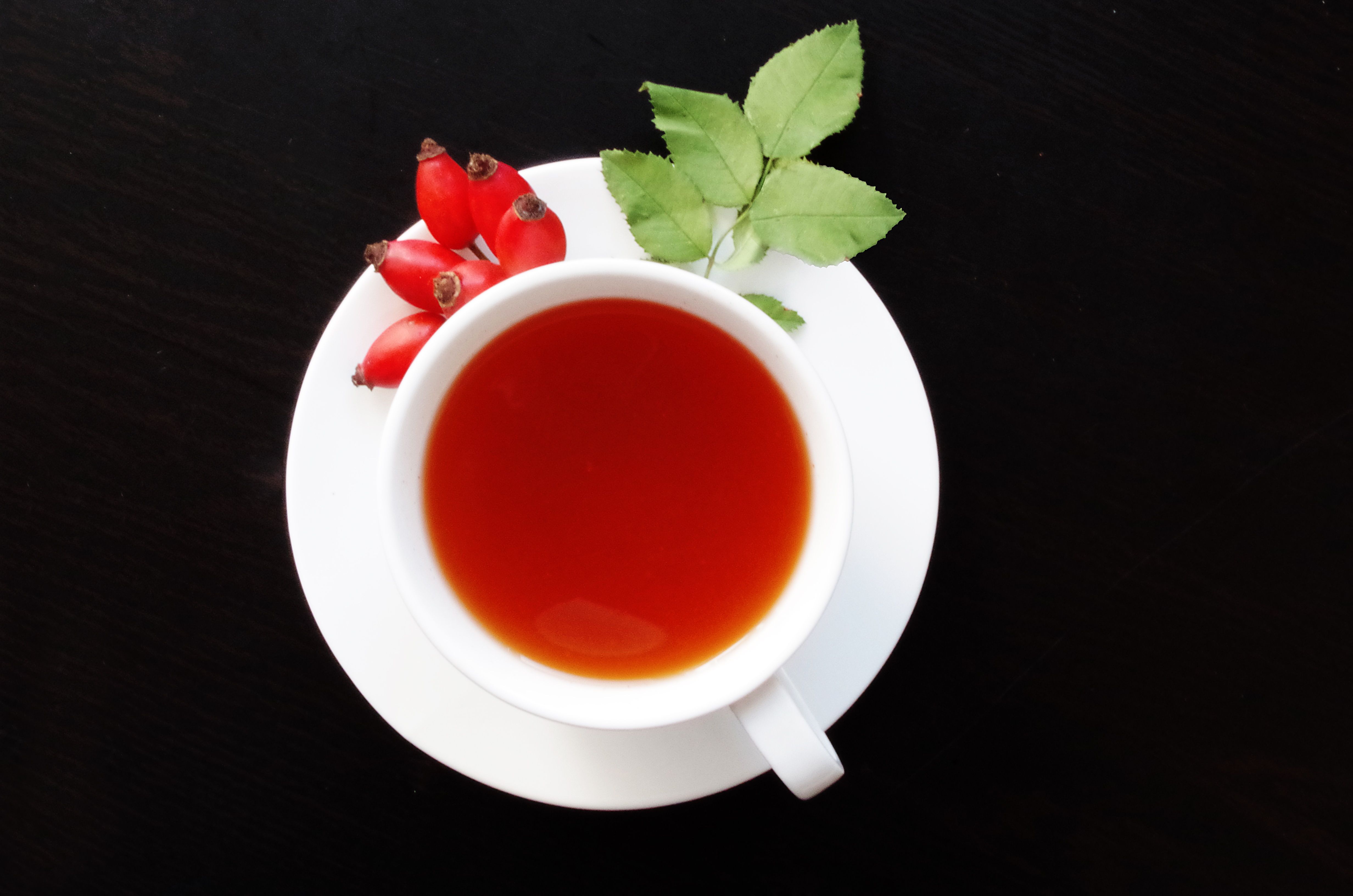
Rosehip tea
The vitamin C gold standard — flavonoid + L-ascorbic acid, galactolipid, and joint RCTs.
In 1 minute
What does it provide? Extremely concentrated vitamin C (400–2000 mg/100 g dried — Europe's highest plant source), GOPO galactolipid (a unique anti-inflammatory compound of Rosa canina — inhibits leukocyte chemotaxis, reduces TNF-α and IL-6), carotenoids (lycopene, β-carotene), anthocyanins (vascular-protective polyphenols), and pectin (soluble fiber — SCFA precursor in the colon).
How much? 1–3 cups of tea/day: 1–2 tbsp (≈ 5 g) crushed rosehip / 250 ml water, at max. 75 °C, steep 10–15 min (boiling → 50–70% of vitamin C is degraded). Or cold macerate: 30 g / 1 L, refrigerated 12 hr. Christensen 2008 meta-analysis (3 RCTs, 287 OA patients): 5 g rosehip powder/day for 3 months reduced knee pain (WOMAC), effect size 0.37.
When to avoid? Hemochromatosis or hereditary hemochromatosis (high vitamin C boosts iron absorption excessively); calcium oxalate kidney-stone tendency (vitamin C is partly converted to oxalate — > 500 mg/day is risky); G6PD deficiency (extreme vitamin C dose can cause hemolysis); warfarin therapy with high-dose rosehip extract; during pregnancy, extract preparations are to be avoided (tea is safe); metallic (iron/copper) vessels above 75 °C (vitamin C oxidizes).
The rosehip is one of the Carpathian Basin's most ancient winter sources of vitamins. The Hungarian tradition from the time of the Conquest already knew it. During World War II, when lemon imports ceased in Europe, the British government organized a nationwide rosehip-collection campaign — millions of children gathered the red berries at the edges of forests. In Hungary, "rosehip syrup" was a mandatory winter stock of rural households. Modern Danish phytopharmacological research in the 2000s identified the GOPO (galactolipid) fraction, which provides evidence for joint complaints.
🔬 Scientific Background
#### Active-substance profile
- Vitamin C — 400–2000 mg/100 g dried rosehip (extreme) - GOPO (galactolipid: (2S)-1,2-di-O-[(9Z,12Z,15Z)-octadeca-9,12,15-trienoyl]-3-O-β-D-galactopyranosyl-glycerol) — unique anti-inflammatory - Carotenoids — lycopene, β-carotene, rubixanthin - Anthocyanins — the fruit's red color - Polyphenols — quercetin, kaempferol, ellagic acid - Pectin — soluble fiber (in the fruit skin)
#### Clinical studies
Christensen et al. 2008 meta-analysis of 3 RCTs (287 osteoarthritis patients): 5 g rosehip powder/day for 3 months significantly reduced knee joint pain (WOMAC scale improvement), effect size 0.37, NSAID consumption decreased (Osteoarthritis and Cartilage 16(9):965-972).
Winther et al. 2005 randomized, double-blind study in 112 osteoarthritis patients: 3 months × 5 g/day → WOMAC pain score −65% (placebo: −30%) (Scandinavian Journal of Rheumatology 34(4):302-308).
Daels-Rakotoarison et al. 2002 in vitro study: rosehip extract inhibits neutrophil chemotaxis and reduces CRP (Phytotherapy Research 16(2):157-161).
#### Mechanism
- GOPO inhibits leukocyte chemotaxis, reduces inflammatory mediators (TNF-α, IL-6). - High vitamin C supports collagen synthesis (joint cartilage). - Anthocyanins are free-radical scavengers, vascular protectors. - Pectin has a prebiotic effect, generates short-chain fatty acids in the colon.
- With hibiscus — synergistic anthocyanin profile, a traditional Hungarian herbal tea mix.
- With honey — folk winter drink.
- With ginger + cinnamon — autumn warmer.
- With iron-rich vegan meals — vitamin C maximizes non-heme iron absorption (lentil, spinach).
- Iron-rich meat meals (paradox: vitamin C boosts iron absorption too much; to be avoided by hemochromatosis patients).
- Warfarin — vitamin C can slightly reduce the effect in large doses (>1000 mg/day).
- High heat — boiling → thermal degradation of vitamin C (max 75 °C).
- Long metallic contact — iron/copper catalyzes vitamin C oxidation.
- Hemochromatosis (iron-storage disease) — vitamin C excessively boosts iron absorption.
- Kidney-stone tendency (oxalate stones) — vitamin C is partly metabolized to oxalate (>500 mg/day risk).
- G6PD deficiency — extremely high vitamin C doses can cause hemolysis (>2000 mg/day).
- In pregnancy: 1–2 cups daily are safe; large-dose extract preparations are to be avoided.
- "Absolutely effective against colds." — Vitamin C supplementation mildly (8–14%) reduces the duration of a cold; it is not effective for prevention.
- "For winter only." — GOPO and anthocyanins support joints all year round.
Hot infusion (fast vitamin C extraction)
- Leaf-to-water ratio: 1–2 tbsp crushed rosehip (≈ 5 g) / 250 ml water.
- Water temperature: 75 °C (NOT boiling! Vitamin C breaks down rapidly above 75 °C).
- Steeping time: 10–15 min covered.
- Pouring into the cup: glass or porcelain; not metal!
Cold macerate (maximizing vitamin C)
- 30 g crushed rosehip / 1 L cold/room-temperature water.
- 12 hours in the refrigerator, covered.
- Strain, add lemon juice → vitamin C stabilization.
- Stable for 2–3 days in the refrigerator.
Active-substance extraction optimum
- Vitamin C: low heat (60–75 °C), short time, acidic medium.
- GOPO: fat-soluble — coffee-style pre-brewing OR long cold extraction (12+ hr) improves it.
- Anthocyanins: acidic medium stabilizes (lemon juice).
Storage
Airtight, in the dark; 1-year stability. Vitamin C content decreases 10–15% per year. Preferably whole rosehip (not powder), and only crush right before use.
References
[1] Christensen R, Bartels EM, Altman RD, et al. (2008). Does the hip powder of Rosa canina (rosehip) reduce pain in osteoarthritis patients? — a meta-analysis of randomized controlled trials. Osteoarthritis and Cartilage, 16(9):965-972.
[2] Winther K, Apel K, Thamsborg G (2005). A powder made from seeds and shells of a rose-hip subspecies (Rosa canina) reduces symptoms of knee and hip osteoarthritis. Scandinavian Journal of Rheumatology, 34(4):302-308.
[3] Daels-Rakotoarison DA, Gressier B, Trotin F, et al. (2002). Effects of Rosa canina fruit extract on neutrophil respiratory burst. Phytotherapy Research, 16(2):157-161.
[4] Mármol I, Sánchez-de-Diego C, Jiménez-Moreno N, et al. (2017). Therapeutic applications of rose hips from different Rosa species. International Journal of Molecular Sciences, 18(6):1137.