
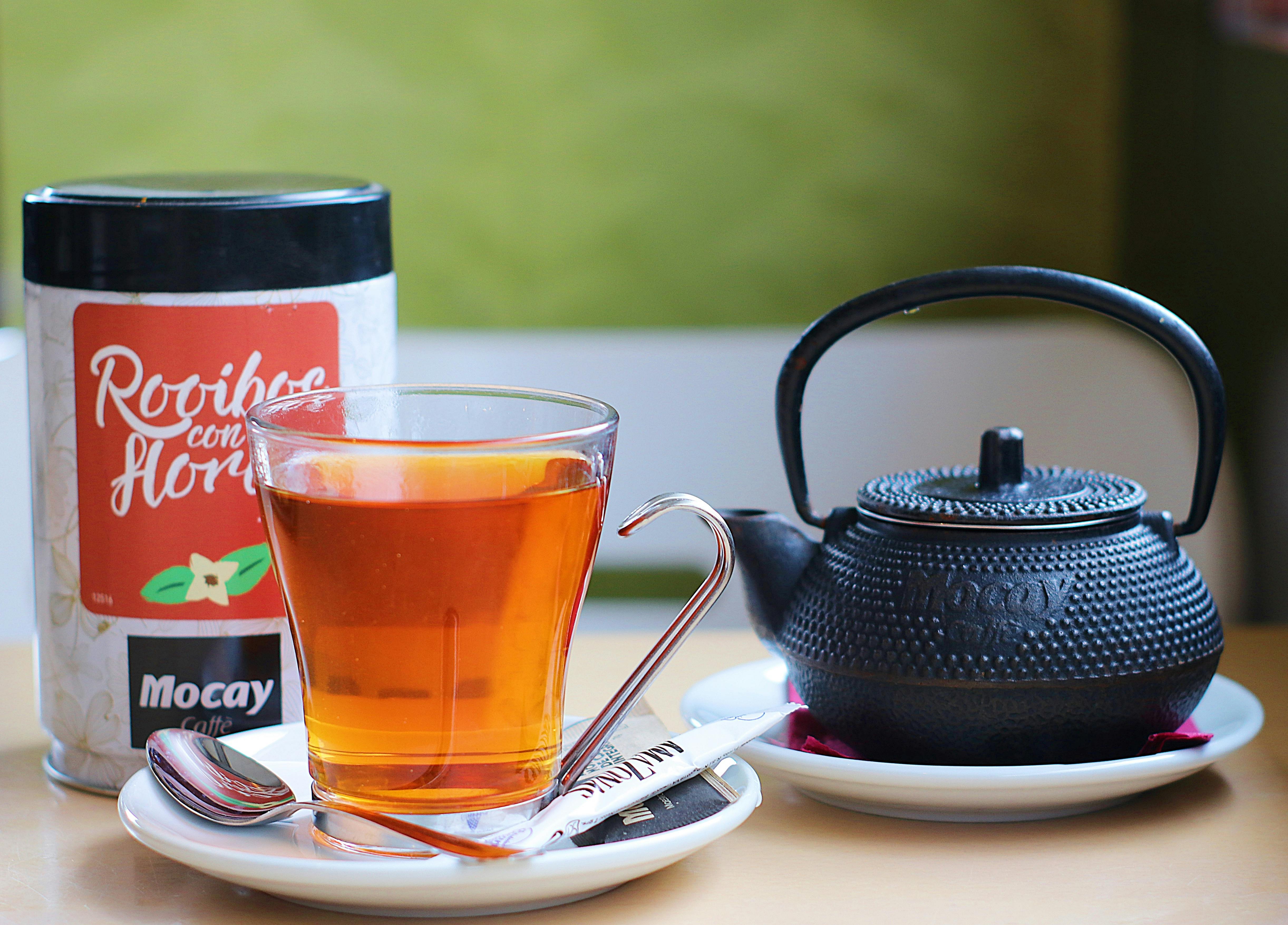
Rooibos
The African red bush — aspalathin, a unique flavonoid, in a caffeine- and tannin-free hydration drink.
In 1 minute
What does it provide? A naturally caffeine-free, low-tannin South African herbal tea. Rooibos is the only plant in the world that contains aspalathin — a unique dihydrochalcone C-glycoside with glucose-metabolism-modulating and antioxidant effects in human studies.
How much? 2–6 cups daily (1 cup ≈ 2.5 g dried cut leaf, 200 ml water, 95–100 °C, 5–7 min). The caffeine-free profile makes it safe in the evening too.
When to avoid? Severe liver disease (rare hepatotoxicity cases!), chemotherapy (CYP modulation), hormone-sensitive cancer (in vitro phytoestrogen signals); use caution alongside CYP3A4-sensitive drug substrates.
Rooibos ("red bush" in Afrikaans) is the exclusive product of the narrow, 300 km² endemic region of the Cederberg mountains in South Africa: the indigenous Khoisan peoples have gathered, trampled, and sun-dried its long needle-like shoots for centuries to brew it as "bushman's tea." Dutch colonial settlers adopted the tradition in the 17th–18th centuries and began trading it as "rooibos" from Cape Town. Demand exploded in the early 20th century, when European black-tea imports were interrupted by world wars — the Russian-Jewish merchant Benjamin Ginsberg launched the first commercial rooibos business in 1904. The caffeine-free, child-friendly drink became particularly popular in the Netherlands and Germany. (J Ethnopharmacol 2008)
Modern scientific interest was sparked by researchers at the University of Pretoria and Stellenbosch University in the 2000s. Aspalathin and nothofagin were characterized chromatographically, and they showed that the plant is the only natural source of aspalathin in the world. Beltrán-Debón 2011 (human crossover study) documented lipid-lowering and anti-inflammatory effects. Persson 2010 showed CRP and LDL reduction with regular rooibos consumption in a randomized study. Kawano 2009 described aspalathin in an animal experiment as a glucose-uptake-enhancing molecule, which was confirmed in a human pilot by Mathijs 2014 in T2DM. (Phytomedicine 2011, Phytother Res 2010)
🔬 Scientific Background
Rooibos comes to market in two types: traditional "red" rooibos (fermented — enzymatic oxidation, the source of the color and flavor) and "green" rooibos (unoxidized, with higher aspalathin and nothofagin content). The polyphenol matrix of green rooibos has 2–4× stronger antioxidant capacity in vitro, but its more characteristic grassy flavor makes its market smaller. Aspalathin is a unique C-glycoside that is partly inaccessible to normal small-intestinal glycosidases, so it reaches the colon, where the microbiome hydrolyzes it — eriodictyol and methylated flavonoid metabolites form. (J Food Compost Anal 2009)
The most robust area of clinical evidence concerns cardiovascular markers. Marnewick 2011 (n = 40, hyperlipidemic adults, RCT): 6 cups of rooibos/day for 6 weeks produced significant LDL (−11%) and triglyceride (−18%) reduction, and glutathione increase. Beltrán-Debón 2011 crossover study similarly documented CRP and lipid improvement. In T2DM, Mathijs 2014 pilot showed HbA1c improvement and insulin-resistance reduction — confirmed by 2020 green rooibos studies. Aspalathin in vitro enhances GLUT4 translocation and AMPK activation — a cell-level "insulin-sensitizing" mechanism. (Public Health Nutr 2011, Phytomedicine 2014)
At the microbiome level, rooibos polyphenols and C-glycosides moderately raise the proportion of Bifidobacterium and Lactobacillus in human in vitro fermentation models. Aspalathin degradation products show gut-barrier-strengthening (tight junction protein) effects in rodent colitis models. Human microbiome RCT evidence in this area is still sparse. (Mol Nutr Food Res 2018)
- + Milk or plant milk (rooibos latte): classic South African "red cappuccino" — caffeine-free "coffee substitute" afternoon experience.
- + Honey, lemon: flavonoid stabilization, flavor complexity.
- + Spices (cinnamon, cardamom, vanilla): South African chai-rooibos tradition.
- + Child drink (above 1 year): safe due to lack of caffeine, traditionally used against colic and restlessness — although clinical evidence is sparse.
- + Evening ritual (caffeine-free): doesn't disturb falling asleep.
- + DASH diet, Mediterranean diet context: cumulative polyphenol benefit.
- Chemotherapeutic agents (particularly tamoxifen, taxanes): in vitro CYP3A4 modulation and phytoestrogen signals — minimize or consult during oncological treatment.
- Atorvastatin, simvastatin, lovastatin (CYP3A4 substrates): weak interaction signals — medical monitoring.
- Antiretroviral therapy (ritonavir, atazanavir): CYP3A4 modulation — high-dose rooibos to be avoided.
- Anticoagulants (warfarin): a few case reports of moderate INR elevation — INR monitoring.
- Hormone-sensitive cancer therapy: in vitro moderate estrogen-receptor modulation — caution above 4 cups/day.
- Iron supplementation: due to small tannin content, 1 hour separation is advised (smaller effect than with black tea).
- Hot, fast sips: > 65 °C — esophageal cancer risk.
- Severe liver disease, unexplained ALT/AST elevation: a few European case reports of hepatotoxic reaction at high doses (≥ 6 cups/day for months) — minimize or stop.
- Hormone-sensitive cancer (breast, endometrial, prostate): caution at high doses due to in vitro phytoestrogen signals.
- Active chemotherapy, radiotherapy: CYP modulation and antioxidant interaction — consult oncologist.
- First trimester of pregnancy: little human data on high doses — moderate 2–3 cups/day considered safe.
- Lactation: caffeine-free, safer than caffeinated teas.
- Severe kidney failure: medical consultation due to moderate potassium content.
- Iron need (iron-deficiency anemia under treatment): don't consume with meals.
- Severe Fabaceae (legume) allergy: rare, but cross-allergy described.
- Aspalathus allergy (extremely rare): documented primarily as occupational asthma among South African rooibos-processing workers.
Serving: 2.5 g dried cut leaf (1 heaping tsp) / 200 ml water, 95–100 °C, 5–7 min. Rooibos does not turn bitter with long steeping (low tannin), so 10–15 min is also safe.
Preparation: red rooibos: pour hot water over in a covered vessel, 5–7 min — deep red color, honeyed-earthy flavor. Green rooibos: 80–85 °C water, 4–6 min — lighter color, fresher grassy-citrus profile. Can be infused multiple times.
Classic patterns:
- Red cappuccino / rooibos latte: strong rooibos infusion + frothed milk — caffeine-free "coffee experience"
- Rooibos chai: rooibos + cinnamon + clove + cardamom + ginger + milk + honey
- Iced rooibos: cold-brewed or chilled, orange juice + ice — child-friendly summer drink
- Rooibos after-dinner "ritual": 1 cup 30 min before bed — caffeine-free calming habit
- Rooibos sports drink: cold, a little honey + sea salt — natural electrolyte replenisher after training
Storage: in an airtight jar, in a dark, dry place. Polyphenol-stable for 1–2 years. Steeped tea: refrigerated, within 48 hours.
What not to do: don't consume "every day, unlimited" — rare hepatotoxic cases at 6+ cups/day. Don't drink during oncological treatment without medical consultation. Don't believe the "colic-curing" marketing for infants. Don't consume > 65 °C (esophageal cancer risk).