


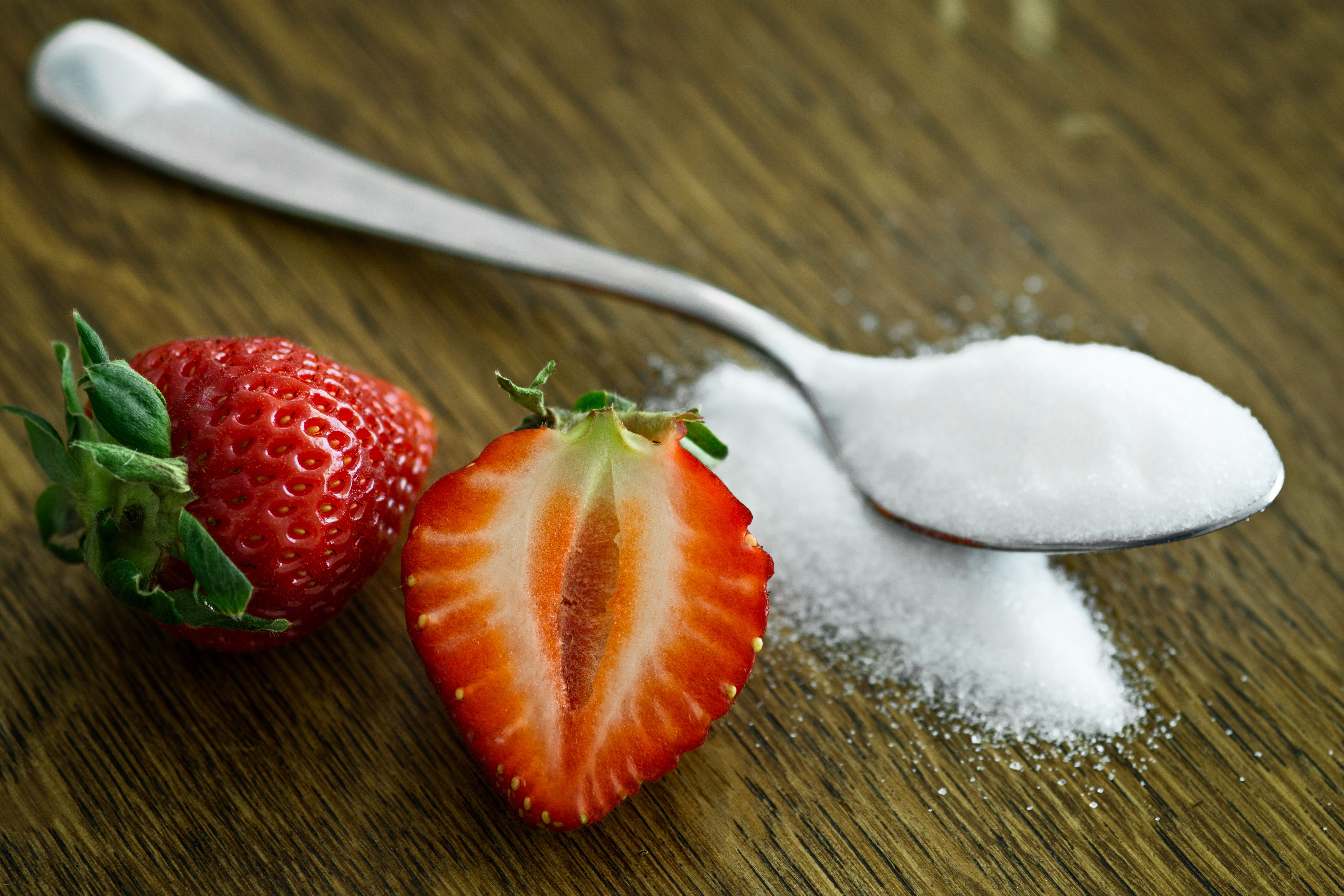
FOS (fructooligosaccharide)
Short-chain fructan supplement — fast bifidogenic effect from 2.5 g/day, but fructan-FODMAP with IBS sensitivity.
- Latin név
- β(2→1) fructan oligomer (DP 2–9)
- FODMAP
- 🔴 high (fructan-dominant)
- Evidence
- ★ ★ ★
- Microbiota
- Fast bifidogenic — Bifidobacterium spp.
- What does it provide?
- A short-chain fructan oligosaccharide (DP 2–9, main components: 1-kestose [GF2], nystose [GF3], fructofuranosyl-nystose [GF4]) that reaches the colon undigested from the small intestine and there selectively feeds Bifidobacterium. SCFA formation is rapid (acetate, propionate, butyrate), but fermentation is INTENSE — gas/bloating risk. Roberfroid 2010 Br J Nutr and Costabile 2010 Br J Nutr showed that FOS at 5–10 g/day significantly raises Bifidobacterium proportion within 1–2 weeks.
- How much?
- Start with 2.5–5 g/day (¼–½ tsp), titrate to 5–10 g/day over 1–2 weeks. The bifidogenic threshold is ≈ 2.5 g, optimum 5–10 g. GI tolerance threshold for gas/bloating is ≈ 10–15 g/day (high individual variability).
- When to avoid?
- Active IBS flare, Monash elimination phase (high FODMAP — fructan), active SIBO, confirmed fructose malabsorption, severe acute IBD flare (UC/Crohn's), infants < 1 year (no established safety for supplemental form; HMOs naturally present in breast milk are structurally different), simultaneous high-dose use of other fructan sources (inulin, agave fructan) — cumulative gas.
The "prebiotic" concept was created by Glenn Gibson and Marcel Roberfroid in 1995 (J Nutr), and FOS was the first molecule to clinically validate the concept. FOS is naturally present in fructan-containing plants (chicory root, Jerusalem artichoke, onion, garlic, artichoke, banana), and was first isolated by French chemist Tanret in the late 19th century via the enzymatic hydrolysis of inulin. The Japanese company Meiji Seika Kaisha launched industrial FOS production in 1983, initially using Aspergillus-derived fructosyltransferase to synthesize short-chain "scFOS" from sucrose.
In the 1990s, the Belgian company Beneo (then Orafti) launched a standardized FOS supplement via chicory-root inulin hydrolysis. Roberfroid's decades of research (Roberfroid 1998, 2010 Br J Nutr) established the fructan-prebiotic clinical evidence base, and by the 2000s EFSA accepted the bifidogenic evidence behind the "prebiotic" terminology (though the EU's strict regulatory bar prevented "health claim" approval). Today FOS is one of the largest segments of the global prebiotic market, present in functional foods, infant formulas (as HMO mimic) and as a standalone supplement.
🔬 Scientific Background
FOS (fructooligosaccharide) is a short-chain β(2→1)-linked fructan polymer with a degree of polymerization (DP) of 2–9. Main components: 1-kestose (GF2, DP 3), nystose (GF3, DP 4), 1F-fructofuranosyl-nystose (GF4, DP 5). Industrial production proceeds via two routes: (1) from sucrose using fructosyltransferase enzyme (short-chain "scFOS," Meiji), (2) via partial hydrolysis of chicory-root inulin (longer-chain "lcFOS" / oligofructose, Beneo). The two have similar clinical effects, but fermentation kinetics differ (shorter chain = faster, more proximal colonic fermentation).
Bifidogenic effect — RCT evidence. Costabile 2010 Br J Nutr in a placebo-controlled crossover RCT showed that 5 g/day FOS for 2 weeks significantly raised Bifidobacterium proportion in healthy adults. Roberfroid 2010 Br J Nutr review states the bifidogenic dose threshold is ≈ 2.5 g/day, optimum 5–10 g/day. The effect appears within 1–2 weeks and returns to baseline within ≈ 2 weeks of supplementation withdrawal ("wash-out").
Calcium/magnesium absorption. Coudray 1997 Eur J Clin Nutr and subsequent adolescent RCTs showed FOS at 8–15 g/day moderately raises colonic Ca and Mg absorption (≈ 10–20%), via SCFA-mediated mucosal acidification. This is particularly valuable in adolescent bone development (van den Heuvel 1999 AJCN).
Immunomodulation. Several small RCTs showed serum IgA elevation and reduced upper respiratory infection episode counts in infant-formula contexts, although the evidence is heterogeneous and clinical relevance debated.
Glycemic profile + lipid. FOS, as a non-digestible oligosaccharide, contributes essentially 0 calories (not absorbed in the small intestine), and long-term supplementation may slightly reduce triglycerides (colonic SCFA → hepatic lipogenic modulation).
GI tolerance and dose threshold. Slavin 2013 Nutrients review states fructan fibers cause dose-dependent gas load, and the typical tolerance threshold is 10–15 g/day in a single dose. Above 20 g/day, uncomfortable bloating and diarrhea are common. scFOS (short chain) ferments faster in the proximal colon, so its gas profile is more intense than long-chain inulin — relevant for IBS-sensitive individuals.
Regulatory status. FDA: GRAS (Generally Recognized As Safe) self-affirmation + GRN letters. EU: novel food status not required (dietary origin); EFSA prebiotic health claim NOT approved (due to high EU evidence bar), but Roberfroid and the scientific consensus support the prebiotic classification.
- + Live yogurt, kefir (synbiotic pattern): Bifidobacterium substrate + live strain.
- + Slow titration (2.5 g → 5 g → 10 g, 1–2 weeks per step): key to GI tolerance.
- + Morning coffee, tea, smoothie: can be mixed in (soluble powder).
- + Bone development context (adolescence): Ca/Mg absorption support.
- + Ample fluid intake: general fiber supplementation rule.
- + Other soluble fiber (psyllium) with slow titration: broader SCFA profile.
- Other high-FODMAP fructan fibers (inulin + agave fructan + GOS) simultaneously in large doses: cumulative gas/bloating.
- Active IBS flare (elimination phase): avoid.
- Added sugar / sweetener in large amounts: worsens metabolic profile.
- Abrupt start at 10+ g/day without titration: uncomfortable bloating risk.
- "FOS syrup" as a sweetener substitute (more common in Japan): mixed oligofructose + sugar — different profile.
- ⚠️ IBS elimination phase: strictly avoid (high FODMAP fructan).
- Active SIBO flare: fermentation overload, contraindication.
- Active UC/Crohn's flare: prebiotic introduction with caution, medical supervision.
- Fructose malabsorption (hydrogen breath test positive): avoid.
- Severe bloating sensitivity: PHGG or gum arabic is a better option (low FODMAP).
- Infants < 1 year (standalone supplement): no established safety; infant-formula FOS additive is separately regulated.
- Severe gastroparesis: gastric emptying disorder, fermentation overload.
- Recent bowel surgery: medical clearance required.
- Hereditary fructose intolerance (HFI): absolute contraindication.
"FOS and inulin are the same." PARTLY MYTH. Both are β(2→1) fructans, but inulin is longer (DP 2–60+), FOS shorter (DP 2–9). Clinical bifidogenic effect is similar, but FOS ferments faster and more proximally — more intense gas profile.
"The more, the better." MYTH. FOS is dose-dependently gas-inducing. 2.5–5 g is already bifidogenic, 10 g/day is optimum, tolerance often declines above 15+ g/day (bloating, diarrhea).
"FOS is natural, therefore IBS-friendly." MYTH. FOS is high FODMAP fructan, strictly avoid during IBS elimination phase. Individual tolerance can be tested with small doses (1–2 g) during reintroduction phase.
"FOS and HMO (human milk oligosaccharide) are equivalent." MYTH. HMO structure (galactose/glucose/sialyllactose backbone) differs significantly from fructan-FOS. The "FOS+GOS" mix in infant formula approximates HMO function but is not equivalent.
"FOS is a weight-loss miracle." MYTH. May have moderate satiety-enhancing effect, but does not cause weight loss on its own. Clinical documentation covers bifidogenic and bone-mineral absorption.
"FOS is only for adults." MYTH. Infant formula additive (FOS+GOS mix, 0.4–0.8 g/100 ml) is established practice under EFSA oversight — although evidence is mixed. In adults, 2.5–10 g/day is the typical supplement dose.
📚 References (selected)
1. Gibson GR, Roberfroid MB. Dietary modulation of the human colonic microbiota: introducing the concept of prebiotics. J Nutr 1995;125(6):1401–1412. 2. Roberfroid M et al. Prebiotic effects: metabolic and health benefits. Br J Nutr 2010;104(Suppl 2):S1–S63. 3. Costabile A et al. A double-blind, placebo-controlled, cross-over study to establish the bifidogenic effect of a very-long-chain inulin and a short-chain fructooligosaccharide in healthy human subjects. Br J Nutr 2010. 4. Slavin J. Fiber and prebiotics: mechanisms and health benefits. Nutrients 2013;5(4):1417–1435. 5. Coudray C et al. Effect of soluble or partly soluble dietary fibres supplementation on absorption and balance of calcium, magnesium, iron and zinc in healthy young men. Eur J Clin Nutr 1997. 6. van den Heuvel EG et al. Oligofructose stimulates calcium absorption in adolescents. Am J Clin Nutr 1999;69(3):544–548. 7. Hughes RL et al. Inulin-type fructans and human health. Adv Nutr 2022. 8. EFSA NDA Panel. Scientific opinion on fructooligosaccharides — health claims (rejected). EFSA Journal 2011.