


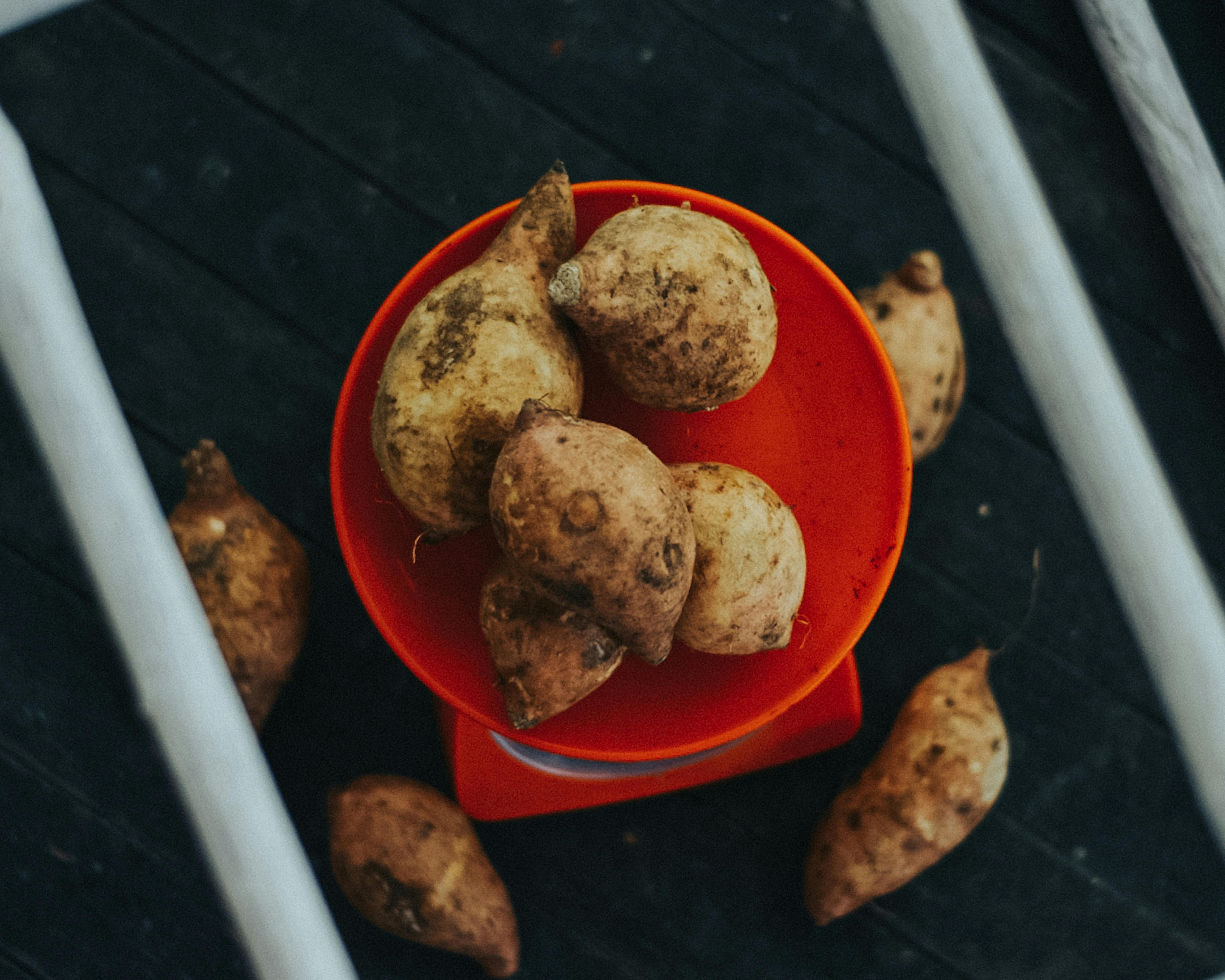
Yacon
Andean tuber-derived FOS syrup and powder — natural bifidogenic sweetener with chlorogenic-acid polyphenol bonus.
- Latin név
- Smallanthus sonchifolius (Poepp.) H. Rob.
- FODMAP
- 🔴 high (FOS-dominant)
- Evidence
- ★ ★
- Microbiota
- Bifidogenic FOS + polyphenol synergy
- What does it provide?
- The Peruvian-Andean yacon tuber (Smallanthus sonchifolius) provides a natural fructooligosaccharide concentrate (FOS, mainly DP 3–10), inulin fragments, and chlorogenic acid/caffeic acid polyphenols. Yacon is so far the only commercial "prebiotic natural sweetener" that is simultaneously fiber (≈ 40–70% dry-matter FOS) and plant polyphenol matrix. Commercial forms: yacon syrup (concentrated tuber concentrate) and yacon powder (lyophilized). Bifidogenic due to FOS content; antioxidant/antiglycation profile due to polyphenol content (Ojansivu 2011 Trends Food Sci Tech review).
- How much?
- Yacon syrup: 10–20 g/day (1–2 tbsp), start with 5 g, titrate over 1–2 weeks. Clinical RCT (Genta 2009 Clin Nutr): 0.29 g FOS/kg/day body weight (≈ 20 g syrup) for 120 days — weight loss, LDL reduction. Yacon powder: 5–10 g/day (1–2 tsp).
- When to avoid?
- Active IBS flare, Monash elimination phase (yacon is high FODMAP on the Monash list — fructan-dominant), active SIBO, fructose malabsorption, severe IBD acute flare, infants < 1 year, simultaneous high-dose use of other fructan sources (FOS supplement, inulin, agave fructan) — cumulative gas, Asteraceae allergy (yacon belongs to the Asteraceae family — small cross-reactivity risk).
Yacon (Smallanthus sonchifolius) is a native tuberous perennial of the Peruvian and Bolivian Andes, in the Asteraceae family (close relative of Jerusalem artichoke, artichoke, lettuce). The Inca Empire cultivated it as "llakum" or "aricoma" on mountain terraces at 2500–3000 meter altitude — fresh tubers were consumed as a sweet-juicy "Andean fruit" after meals or during long hikes for energy replenishment. Spanish chronicles (Cieza de León 1553) describe Inca "chacras" (garden-terraces) growing yacon, but after European colonization the plant fell into obscurity — unlike the potato and maize, which became global foods.
At the end of the 20th century, New Zealand, Brazil, and Japan brought yacon back: Brazilian researchers in the 1980s discovered that yacon tuber is a natural FOS concentrate, and around Lima industrial yacon syrup production began (pressed tuber juice with heat-concentration and centrifugation). In the 2000s, Dr. Oz's American TV show popularized yacon syrup as a "weight-loss superfood," and the Genta 2009 Clin Nutr RCT (Peruvian Tucumán University) established the clinical evidence: 120 days of 0.29 g FOS/kg/day yacon syrup in obese women caused significant weight, BMI, and LDL reduction. Today yacon syrup is a niche but growing premium segment of the global prebiotic market.
🔬 Scientific Background
Yacon tuber (Smallanthus sonchifolius) dry matter contains 40–70% fructooligosaccharides (FOS), mainly short-chain fructans of DP 3–10, with small amounts of inulin fragments (DP > 10). It has sweetening power (natural sweet taste of fructose from end-chain sugars), but human digestive enzymes do not break it down — caloric value is therefore low (≈ 1.5 kcal/g syrup) and glycemic index is low (GI ≈ 1–5).
Clinical human evidence. - **Genta 2009 Clin Nutr RCT (double-blind, placebo-controlled, n=55 obese women, Tucumán University): 0.29 g FOS/kg/day yacon syrup for 120 days caused significant weight reduction (−15% BMI), waist circumference reduction, LDL reduction, and elevated satiety, while insulin sensitivity improved. - Vaz-Tostes 2014 Br J Nutr RCT (T2DM): Yacon powder 20 g/day improved glycemic profile markers. - Habib 2011 Eur J Nutr: Yacon syrup reduced postprandial glucose response. - Polireddy 2013 Mol Nutr Food Res:** In vitro and animal model — antioxidant capacity, chlorogenic-acid mediated effects.
Polyphenol profile. Yacon has significant chlorogenic acid (5-CQA, 3,5-diCQA) and caffeic acid content — antioxidant, moderate α-glucosidase inhibitor (postprandial glucose reduction). The polyphenol matrix distinguishes yacon from purified FOS: not only fiber but also a plant polyphenol package.
Microbiome effect. Due to FOS content, it is bifidogenic — Bifidobacterium and Lactobacillus selectively multiply (Sumiyanto 2012 Microbial Ecol). SCFA production with acetate-, propionate-, butyrate profile.
Yacon syrup vs. yacon powder differences. - Yacon syrup: concentrated, dark brown, honey-like consistency, ≈ 60–70% dry matter, FOS ≈ 50%, more concentrated chlorogenic acid. Due to industrial heat-concentration, A PORTION OF THE FOS may hydrolyze to fructose (≈ 5–15% free fructose in finished syrup — important note). - Yacon powder: lyophilized, light brown, more taste-neutral, FOS ratio more preserved (40–60%), polyphenol content variable.
FODMAP status. The Monash University FODMAP database classifies yacon as high FODMAP due to dominant fructan content. Avoid during IBS elimination phase.
GI tolerance. Reminiscent of FOS pattern — bifidogenic threshold ≈ 5 g/day FOS-equivalent, gas/bloating threshold ≈ 15–20 g syrup. High doses (> 30 g syrup) may cause abdominal discomfort, diarrhea.
Regulatory status. FDA: GRAS (generally recognized as safe for consumption). EU: dietary food; novel food status not required (long dietary use in Peru-Bolivia). No EFSA-recognized health claim.
Adulteration warning. Expensive yacon syrup is often blended with sugar syrup or date syrup. Reliable source, FOS content marking (≥ 40%) recommended.
- + Morning oatmeal as a natural sweetener: replaces honey or maple syrup without a glycemic spike.
- + Live yogurt, kefir: synbiotic pattern — FOS substrate + live strain.
- + Tea, coffee sweetener: GI-neutral sweetness.
- + Smoothie: prebiotic, polyphenol bonus.
- + Slow titration (5 g → 10 g → 20 g/day, 1–2 weeks per step): GI tolerance.
- + Ample fluid intake: general fiber rule.
- Other high-FODMAP fructan fibers (FOS supplement, inulin, agave fructan) simultaneously in large doses: cumulative gas/bloating.
- Active IBS flare (elimination phase): avoid.
- Yacon syrup adulterated with sugar syrup: worsens metabolic profile — reliable source needed.
- Abrupt start at 20+ g/day without titration: abdominal discomfort.
- "Yacon syrup as unlimited sweetener": dose threshold 15–20 g/day.
- ⚠️ IBS elimination phase: strictly avoid (high FODMAP).
- Active SIBO flare: fermentation overload.
- Active UC/Crohn's flare: prebiotic introduction with caution.
- Fructose malabsorption: avoid (syrup may contain ≈ 5–15% free fructose).
- Asteraceae allergy (Jerusalem artichoke, artichoke, ragweed, chrysanthemum): small cross-reactivity risk.
- Severe bloating sensitivity: PHGG or gum arabic is a better option.
- Infants < 1 year: no established safety data.
- Diabetes on insulin therapy: low GI, but follow with medical oversight.
- Recent bowel surgery: medical clearance.
- Hereditary fructose intolerance HFI: absolute contraindication.
"Yacon syrup is the same as agave syrup." MYTH — categorically. Agave syrup is 60–80% free FRUCTOSE (sweetener, calorie-dense, partly glycemia-raising). Yacon syrup is 40–60% FOS (fiber, prebiotic, low glycemia). TWO DIFFERENT PRODUCT CATEGORIES.
"Yacon syrup is an unlimited low-calorie sweetener." MYTH. Calories are moderately reduced (≈ 1.5 kcal/g syrup), but due to FOS content there is a dose-dependent gas load. 15–20 g/day is the optimum; > 30 g is the diarrhea threshold.
"Yacon is a miracle cure for weight loss." PARTLY MYTH. The Genta 2009 RCT is positive (15% BMI reduction in 120 days in obese women), but clinical replication is heterogeneous and the population is selective (obese women). The realistic picture: a moderate cumulative adjunct, NOT a standalone weight-loss miracle.
"Yacon syrup is IBS-friendly because it's natural." MYTH. Yacon is HIGH FODMAP (on Monash list). Strictly avoid during IBS elimination phase.
"Yacon and Jerusalem artichoke are the same." MYTH. Both are Asteraceae family, both tuberous, both contain fructans — BUT Jerusalem artichoke is inulin-dominant (long chain, DP 2–60), yacon is FOS-dominant (short chain, DP 3–10). Clinical profile similar, chemical structure differs.
"Yacon syrup and yacon powder are interchangeable." PARTLY. Both are FOS sources, but the syrup is slightly hydrolyzed due to heat-concentration (≈ 5–15% free fructose), while the powder is lyophilized — different profile.
"The FDA recognizes yacon's LDL-lowering effect." MYTH. Neither FDA nor EFSA has approved any health claim for yacon. Clinical evidence is moderate; RCTs are positive but have not met the claim threshold.
📚 References (selected)
1. Genta S et al. Yacon syrup: beneficial effects on obesity and insulin resistance in humans. Clin Nutr 2009;28(2):182–187. 2. Ojansivu I, Ferreira CL, Salminen S. Yacon, a new source of prebiotic oligosaccharides with a history of safe use. Trends Food Sci Technol 2011;22(1):40–46. 3. Vaz-Tostes MD et al. Yacon flour supplementation on insulin resistance and lipid profile in T2DM. Br J Nutr 2014. 4. Habib NC et al. Yacon syrup and its effects on intestinal glucose absorption and postprandial glycemia. Eur J Nutr 2011. 5. Sumiyanto J et al. Bifidogenic activity of yacon FOS in fecal microbiota. Microb Ecol 2012. 6. Polireddy K et al. Antioxidant and antiinflammatory effects of chlorogenic acid from yacon. Mol Nutr Food Res 2013. 7. Roberfroid M. Prebiotic effects: metabolic and health benefits. Br J Nutr 2010;104(Suppl 2):S1–S63. 8. Monash University FODMAP database — yacon syrup high-FODMAP listing.