
Nori
The "Japanese sushi wrapper" — porphyran, B12 content (vegan paradox), and a centuries-old fermented tradition.
In 1 minute
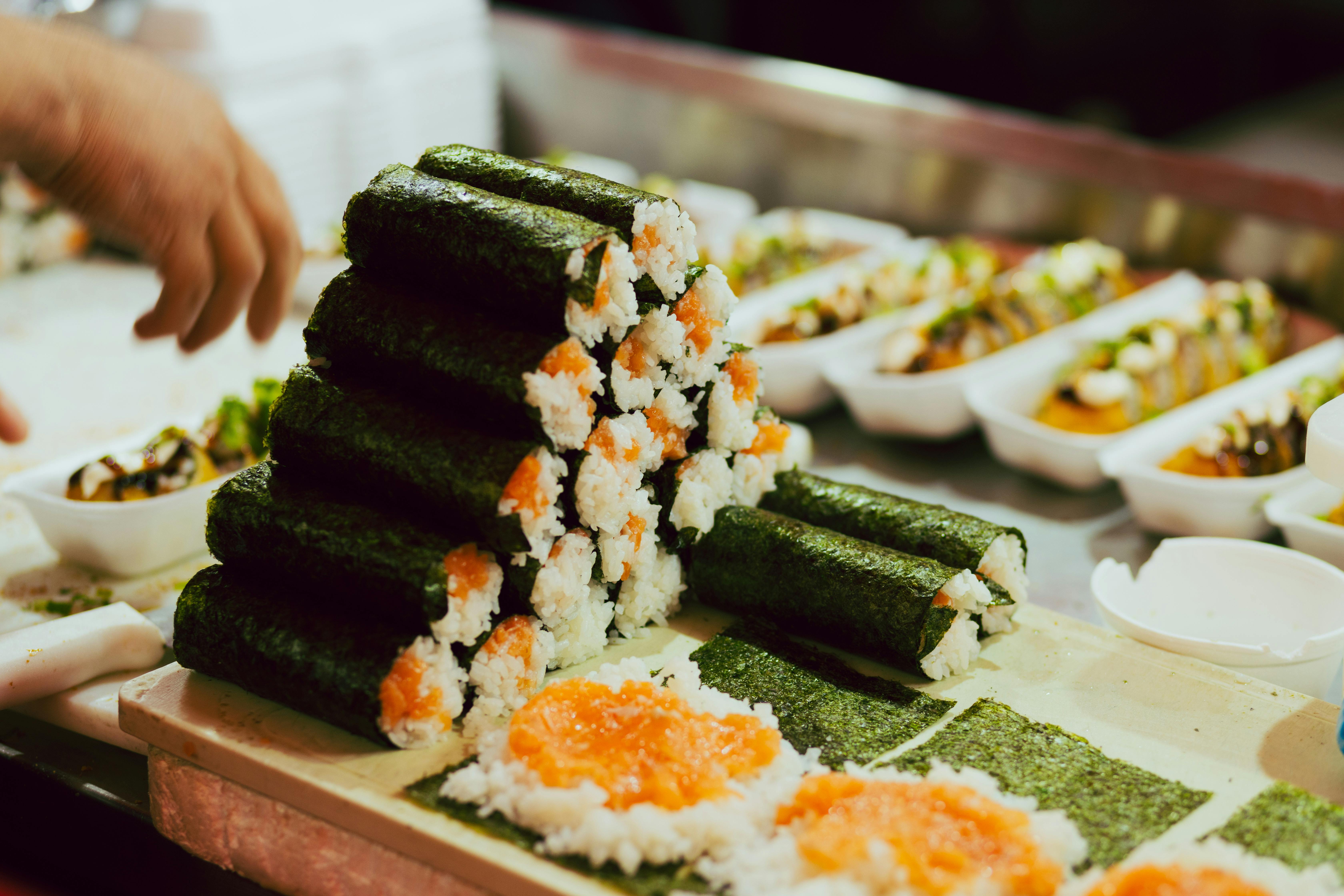
What does it provide? Roasted red alga (base of sushi rolls, staple of Japanese breakfast) — complete protein, biologically active B12, iodine (moderate, NOT excessive), EPA ω-3, and the sulfated polysaccharide porphyran, which is documented to be broken down by a horizontally transferred bacterial gene in the gut flora of the Japanese population.
How much? 1–3 sheets (≈ 2–8 g dry matter) daily or every other day. One nori sheet contains about 2–4 μg of B12 and 30–50 μg of iodine (moderate compared to brown seaweeds).
When to avoid? Hyperthyroidism (Graves' disease) iodine sensitivity, Hashimoto's thyroiditis under strict iodine restriction, protocols prohibiting high iodine intake, before thyroid scintigraphy.
Nori is a centuries-old symbol of Japanese coastal culture — Heian-era (794–1185) court tax lists already mention it as a valuable tribute commodity. The 17th-century Edo period boosted deliberate cultivation: in shallow coastal waters, bamboo bundles were erected to which wild spores adhered — initially it succeeded almost "as if by magic," sometimes yes, sometimes no. Fishermen regarded good years as "gifts from the sea" and gave thanks for them with separate Shinto rituals.
The scientific breakthrough in nori cultivation is associated with British phycologist Kathleen Drew-Baker: in 1949, she discovered that the Porphyra life cycle goes through a barely known microscopic conchocelis phase living inside seashells. This discovery made industrial spore cultivation possible, and Drew-Baker's name entered Japanese cultural history as the "Goddess of Nori" (a statue and annual commemoration preserve it in Uto city). In 2010, Jan-Hendrik Hehemann and his team published in Nature one of the 21st century's greatest microbiome discoveries: the human gut bacterium Bacteroides plebeius acquired the porphyranase enzyme from the marine bacterium Zobellia galactanivorans through horizontal gene transfer — it is specifically carried by the Japanese population, hardly found in European-American samples. Thus, nori is the only known food for which a human-specific, culture-specific microbiome adaptation exists.
🔬 Scientific Background
Nori belongs to the red algae (Rhodophyta) family, with a high (30–50%) protein content whose amino acid profile is more favorable than terrestrial plants (methionine and cysteine ratios are higher than in legumes). The roasted, toasted (yaki-nori) version preserves most of the B12 content alongside flavor and aroma development — in contrast to high-temperature cooking.
Active B12 — critical point: nori is the best-documented plant/algal active B12 source. According to Watanabe (1999, 2014), Croft (2005), and Bito (2017) studies, Pyropia/Porphyra contains 1–8 μg cyanocobalamin and methylcobalamin per dried sheet — biologically active forms, not just pseudo-B12. A 2017 Japanese RCT (Bito) demonstrated that 9 g of dried nori/day corrected elevated MMA levels in vegan participants over about 4 weeks — that is, nori is the only alga that is a clinically recognizable B12 source. (Note: due to storage and production variability, not a standalone vegan B12 strategy.)
Porphyran and the human-specific microbiome enzyme: Hehemann et al. (Nature 2010) demonstrated that in the Japanese gut flora, Bacteroides plebeius carries porphyranase and β-agarase genes acquired through horizontal gene transfer from the marine bacterium Zobellia galactanivorans. In European-American metagenomic databases, this enzyme is absent or sporadic. Therefore, in traditional nori-consuming cultures, porphyran is a useful substrate; elsewhere it ferments partly via another route, partly passes out unchanged.
Iodine moderation: in contrast to brown seaweeds (kombu: 1500–8000 μg/g; wakame: 100–500 μg/g), nori's iodine content is moderate (10–40 μg/g dried). One sheet ≈ 30–50 μg iodine — this is 20–30% of the WHO adult daily recommendation (150 μg), within a safe margin.
Other bioactives: the combination of taurine (cardioprotective amino acid), EPA (eicosapentaenoic acid, ω-3, about 1–3% lipid fraction), mycosporine-like amino acids (MAAs — UV-protective), and carotenoids (zeaxanthin, lutein) provides a cardioprotective and anti-inflammatory matrix. Several Japanese epidemiological cohorts (JPHC, Takachi 2010) documented an inverse association between sea-algae consumption and cardiovascular mortality.
- + Rice + vinegar + sesame (sushi, onigiri): classic Japanese synergy — the retrograded phase of rice starch acts as resistant starch and SCFA substrate, vinegar moderates the glycemic response, sesame adds carotenoid and lignan support.
- + Avocado, salmon, tuna (modern sushi): absorption of fat-soluble carotenoids (zeaxanthin, lutein) increases multifold.
- + Fried egg (Japanese breakfast): B12 synergy, protein complementarity.
- + Green tea (matcha, sencha): catechins + nori carotenoids antioxidant synergy, classic Japanese pairing.
- + Citrusy dressing (ponzu — soy + yuzu/lemon): iodine and carotenoid absorption improves.
- + Live cultures (miso, natto, pickled vegetables): microbiome support for fermenting porphyran and other sulfated polysaccharides.
- + Live cultures in general (kefir, yogurt, kombucha): synbiotic approach for fermenting nori polysaccharides.
- Levothyroxine (L-thyroxine): separate timing by ≥ 4 hours — iodine and some algal polysaccharides may interfere with absorption.
- Antithyroid medications (carbimazole, propylthiouracil): iodine load may influence therapy — medical consultation.
- Amiodarone: itself an iodine-containing drug — additive iodine load.
- Warfarin + large amounts of leafy greens (spinach, kale) + lots of nori: combined effect of disturbances in vitamin K balance — INR monitoring.
- Too-hot drink (≥ 80 °C) + nori flakes: B12 partially degrades. Roasting (short, ≤ 200 °C, < 30 s), however, does not damage it.
- Too much wasabi/soy (in Na-laden meals): nori itself is low sodium, but sushi accompaniments (soy, pickles) often add high Na intake — moderation.
- Hyperthyroidism (Graves' disease), active phase: iodine load may worsen — avoid or limit to under 1 sheet/week.
- Hashimoto's thyroiditis under strict iodine-restriction protocol: medical consultation — some endocrinologists restrict iodine intake.
- 1–2 weeks before thyroid scintigraphy (radioactive iodine): avoid all sea algae.
- Severe form of acne vulgaris: some case reports suggest acne worsening at high iodine intake — moderate.
- Kidney disease on iodine-restricting diet: medical consultation.
- Histamine intolerance, mastocytosis: some affected individuals do not tolerate stored or poorly stored seafood — fresh, well-stored nori is generally acceptable.
- Pregnancy and breastfeeding: specifically recommended for moderate consumption — moderate iodine load (50–150 μg/day) supports fetal neurological development. Overdose (≥ 1100 μg/day) to be avoided.
- Infant/small child (< 3 years): small amounts acceptable, but moderate due to high iodine sensitivity — pureed, in small quantities.
Daily serving: 1–3 sheets (≈ 2–8 g dried) or 1–2 tbsp flakes (furikake sprinkle).
Preparation pattern:
1. Onigiri (rice ball): 1 cup Japanese rice + ¼ tsp salt + filling (umeboshi, salmon, tuna-sesame) → hand-shaped triangle → ½ sheet of nori wrapped around.
2. Maki roll (sushi): on a bamboo mat 1 sheet of nori + ½ cup cooled, vinegared sushi rice + filling (cucumber, avocado, salmon) → roll tightly, slice with a cold knife into 6–8 pieces.
3. Furikake (dried sprinkle): 2 tbsp toasted sesame + 1 sheet nori (finely crumbled) + 1 tsp salt + ½ tsp sugar + dried bonito (optional) — sprinkled over rice, salad.
4. For miso soup: 1–2 sheets of nori cut into strips, added to the hot soup before serving (do NOT boil in) — B12 is preserved.
5. Snack roast: a little sesame oil + salt + 1 sheet of nori → 5 seconds over high flame on each side — crispy snack.
Storage: in airtight packaging, in a cool-dry place — moisture is a critical enemy; dampening ruins the texture. To be consumed within 1–2 months after opening. Frozen: 6 months.
What not to do: don't cook for long at high temperature (B12 loss). Don't store in a humid place. Don't confuse with kombu or wakame (they are high in iodine — different profile).