


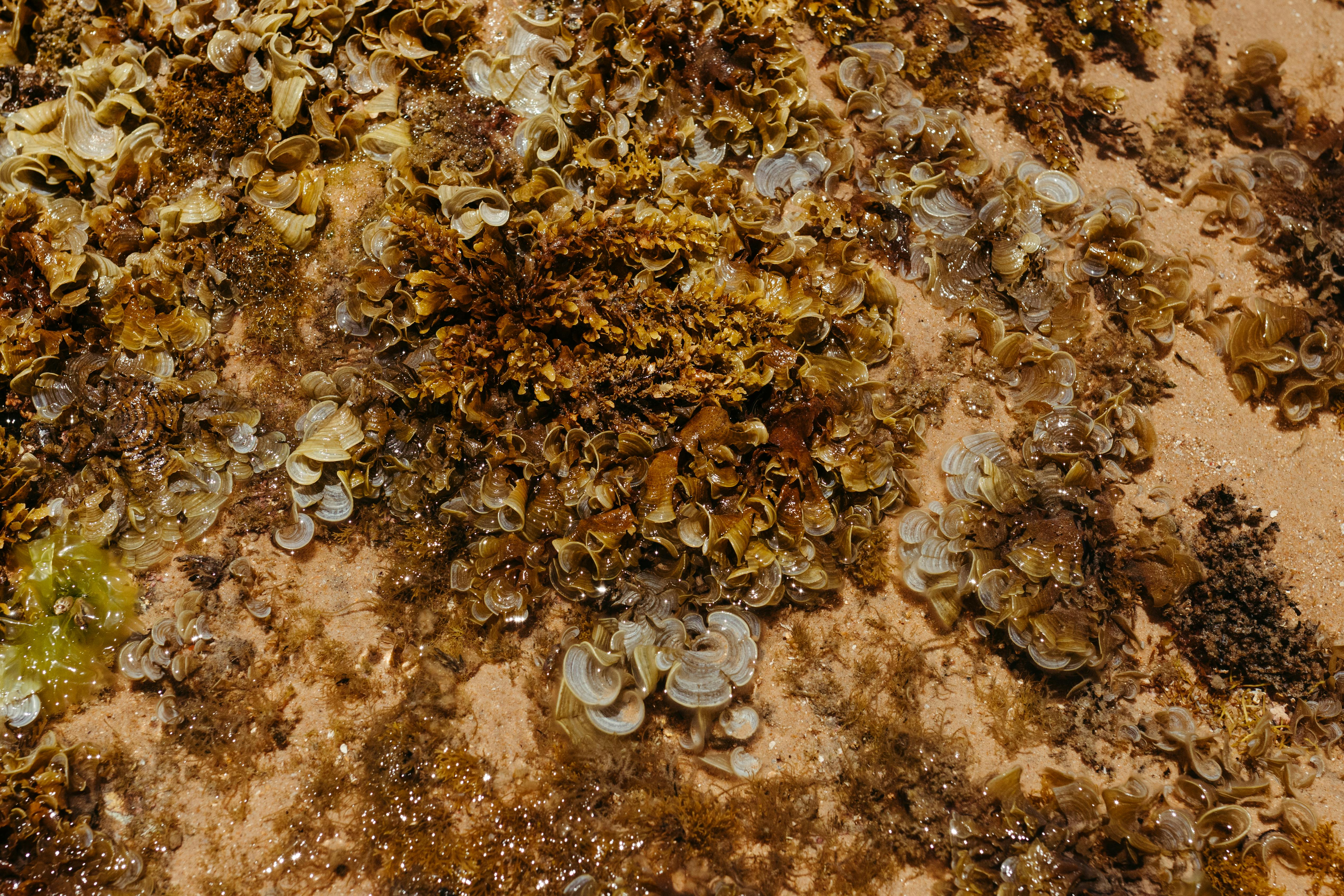
Irish moss (Chondrus crispus)
The traditional "carrageen-gel" alga — Galway Bay gathering, Irish fluidity gel, and a lung-immune tradition.
In 1 minute
What does it provide? A naturally gelling red alga from the northern Atlantic coastline — Irish and Scottish gastronomic-medicinal tradition. Contains sulfated galactans, moderate iodine, iron, R-phycoerythrin. The essence of the "carrageenan debate": WHOLE Chondrus food is NOT the same as purified, degraded poligenan (additive carrageenan E407 is also not the same as the degraded form).
How much? In traditional form 2–5 g of dried alga per day (tea, gel, pudding). Avoid higher doses because of iodine load and the carrageenan debate.
When to avoid? Active IBD (Crohn's, ulcerative colitis), Hashimoto's / thyroid disease with iodine sensitivity, > 5 g/day in pregnancy, levothyroxine users (temporal separation), allergy to red algae.
Irish moss literally saved lives in coastal communities during the 19th-century "Great Irish Famine" (1845–1849) — when Phytophthora infestans destroyed the potato harvest, Irish moss soup, pudding, and tea were among the few foods available. Traditional use, however, is much older: 12th–13th-century Irish manuscripts already mention Chondrus as a folk medicine for chest complaints (bronchitis, asthma, cough). "Irish moss pudding" — milk, sugar, and a few pinches of Chondrus for gelling — became a baby-porridge-like classic of 19th-century Victorian cuisine. In the Caribbean (Jamaica, Trinidad), the "Irish moss drink" (a sweet, spiced milk-based drink with coconut and nutmeg) arrived with Irish immigrants at the end of the 19th century, underwent local cultural adaptation — it remains a street drink today.
The industrial carrageenan story began in the 1830s in Boston: Irish immigrants identified a gathering site at the mouth of the Charles River as "Carrageen Cove" (Pleasant Point). During the 1862 Civil War, carrageenan became the rope stiffener and beer foaming agent — this is the basis of the American food-industry carrageenan market. From the mid-20th century, global carrageenan production shifted to tropical algae cultivations in Southeast Asia (Kappaphycus alvarezii "cottonii", Eucheuma denticulatum "spinosum"). The "carrageenan debate" exploded in 2001, when Joanne Tobacman published mouse and cell model data: degraded carrageenan (poligenan) induces IBD-like inflammation. Important: whole-alga Irish moss and cold-extracted food-grade carrageenan (E407) are NOT the same as degraded poligenan — this distinction is the key to the debate. (Salisbury 1849, Pereira 2018, Tobacman 2001, McKim 2014)
🔬 Scientific Background
Human RCTs on Chondrus crispus are relatively rare, and carrageenan food-safety data come largely from animal experiments. Liu et al. (2015, Food Funct) in an Irish pilot study showed that 4 g/day of dried Chondrus over 8 weeks produced a slight LDL reduction and an increase in antioxidant capacity in healthy individuals. Respiratory symptom studies on small samples (chronic bronchitis) indicated a mild expectorant and soothing effect of traditional Irish moss tea — but no modern RCT has been done.
The essence of the carrageenan debate is distinguishing three different entities:
1) Additive carrageenan (E407, food-grade, non-degraded form): according to WHO/JECFA (2014, 79th meeting) and EFSA (2018 re-evaluation), accepted as food for adults, ADI "not specified." The 2017 EFSA opinion, however, states regarding infant formula that its use is NOT NECESSARY and reduction is warranted.
2) Degraded carrageenan (poligenan): a lower molecular weight form produced during laboratory processing. In animal IBD models (Tobacman 2001, Bhattacharyya 2008) inflammation-inducing — prohibited in food. Critics argue that the studies methodologically do not represent human digestion (very high dose, isolated poligenan fraction).
3) Whole red alga (Chondrus crispus culinary use): neither degraded nor processed — traditional cooking (milk boiling, gelling) does not produce poligenan, and the food-industry carrageenan debate does NOT AUTOMATICALLY apply to it. In IBD/IBS patients, however, caution is advised because the scientific debate is unresolved.
A 2017 open-format human study (Bhattacharyya, Nutr Healthy Aging) described mild symptomatic improvement in Crohn's patients on a carrageenan-free diet — but due to methodological limitations of the study, the evidence level is low.
At the microbiome level: in vitro, carrageenan fractions can be fermented by certain Bacteroides species (Du Pré 2019), but no robust human RCT yet exists. Sulfated galactan prebiotic potential exists, but the risk-benefit ratio remains to be clarified.
Iodine: the moderate iodine content (50–90 µg/g dried) at 2–4 g of dried alga per day provides ~100–360 µg of iodine — this is below the WHO upper limit (1100 µg/day), but in thyroid disease (Hashimoto's, Graves', medication treatment) it should be monitored.
- + Irish moss tea: 15 g dried moss + 1 L water, 30-minute soak, 15-minute simmer, strain → sweetened, with lemon or ginger — traditional respiratory tea.
- + Irish moss gel: 20 g dried + 500 ml water, 8-hour soak, rinse off (washing out sand, salt contamination!), blend to a smooth gel. In the fridge for 1 week — into smoothies, desserts, soup as a thickener.
- + Caribbean-style Irish moss drink: gel + plant milk (coconut, almond) + nutmeg + cinnamon + cane sugar — sweet, thick drink.
- + Vegan panna cotta substitute: gel + plant milk + vanilla + sweetener → an alternative to traditional gelatin/agar.
- + Soup thickener: 1 tbsp of gel to the finished soup, creamy texture.
- + Vitamin C-rich matrix (lemon, tomato): iron absorption improvement.
- Levothyroxine (thyroid hormone replacement) directly together: the alga's iodine content and high viscosity can reduce absorption. Take the drug 4 hours before or after the alga.
- With other iodine sources (kombu, seaweed, iodized salt, stacked): daily iodine load can exceed the 1100 µg WHO upper limit — risk of thyroid disturbance.
- Stacked with carrageenan-additive foods, if you have IBD/IBS: don't consume whole Irish moss and many E407-containing processed products (yogurts, plant milks, ice creams) at the same time. The debate is unresolved — only one carrageenan source at a time.
- From an unknown source without heavy-metal COA: algae are bio-accumulators — cadmium, arsenic risk. Only from verified products.
- Active inflammatory bowel disease (Crohn's, ulcerative colitis, microscopic colitis): specialist consultation. The carrageenan debate is unresolved, and Bhattacharyya's 2017 pilot in Crohn's patients described symptomatic improvement on a carrageenan-free diet. As a trial, a carrageenan-free diet is a reasonable choice.
- Hashimoto's thyroiditis, Graves' disease, thyroid nodule: iodine load may interfere with thyroid function — endocrinologist consultation recommended before regular consumption.
- Levothyroxine users: separate the medication in time (≥ 4 hours) from algae consumption.
- Pregnancy and breastfeeding: moderate amounts (≤ 5 g/day dried) traditionally safe, but from a quality-controlled (heavy-metal COA) product and in minimal amounts.
- Infants, small children: the EFSA 2017 does not recommend the use of carrageenan additive in infant formula; caution for culinary gel as well.
- Anticoagulant treatment: sulfated galactans show mild anticoagulant activity in vitro — high doses to be avoided.
- Renal failure with iodine sensitivity: caution regarding iodine load.
- Allergy to red algae (rare): contraindication.
Daily serving: 2–5 g dried Chondrus.
Preparation pattern — Irish moss gel (base):
1. 20 g dried Chondrus + 500 ml water: soak for 8 hours (preferably overnight).
2. Rinse with plenty of cold water — removing sand, salt, shell fragments.
3. Blend to a smooth gel (adding a little water if needed) — thick, translucent-whitish substance.
4. Storable in a jar in the fridge for 5–7 days.
Classic patterns:
- Irish moss tea (traditional respiratory): 15 g dried + 1 L water, 30-minute soak, 15-minute simmer, strain, with lemon and ginger.
- Irish moss pudding (Victorian): gel + milk + sugar + vanilla — baby-porridge-like.
- Caribbean Irish moss drink: gel + plant milk + nutmeg + cinnamon + cane sugar.
- Vegan panna cotta: gel + plant milk + vanilla + sweetener, set in the fridge.
- Smoothie thickener: 1 tbsp of gel into the blender for the creamy texture.
- Soup creamer: stir 1 tbsp of gel into the finished soup.
Storage: dried Chondrus dry, airtight, in a dark place for 12 months. Freshly prepared gel in the fridge for 5–7 days.
Purchasing: look for "wildcrafted," "sustainably harvested," "Atlantic-sourced" (Ireland, Scotland, Maine, Nova Scotia) marking. Avoid the unclear-origin product — important from the heavy-metal COA (cadmium, arsenic) standpoint. "Irish moss" as a name is not always a guarantee: check that it is Chondrus crispus, not a Sea Moss / Gracilaria genus mix.
What not to do: don't eat raw, unwashed (sand, shell pieces). Don't store processed gel without refrigeration. Don't combine in large amounts with other iodine sources. In IBD, don't experiment without medical consultation.