
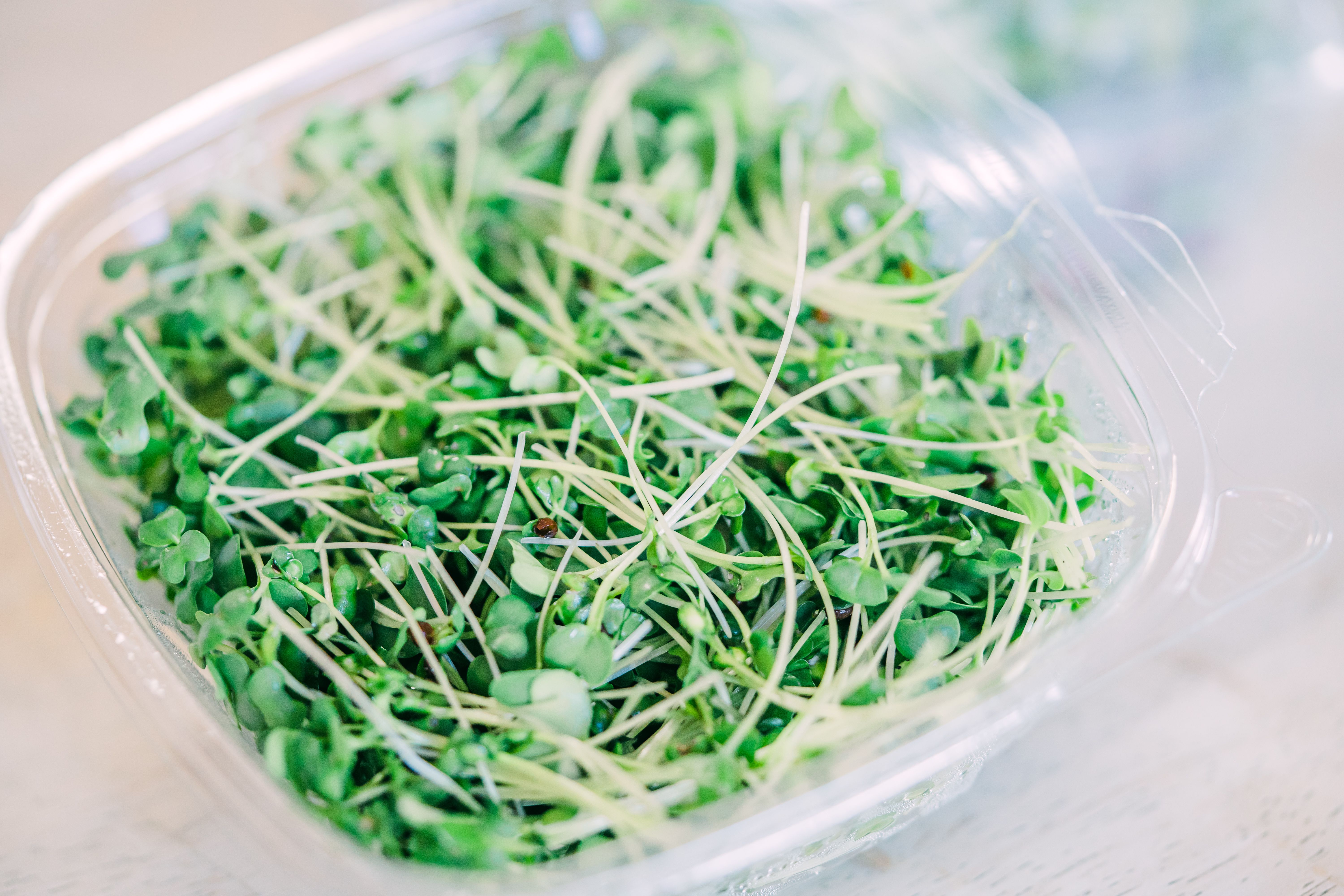
Broccoli sprout
The sulforaphane concentrate — 50–100× the sulforaphane of mature broccoli, and chemopreventive RCTs.
In 1 minute
What does it provide? One of nutrition science's strongest natural NRF2-activator sources — a sulforaphane concentrate, providing 10–100× the mature broccoli amount per unit mass (Fahey 1997, Johns Hopkins).
How much? 30–100 g fresh sprouts daily (1–3 handfuls) — 20–60 mg sulforaphane equivalent. Most effective fresh and CHEWED (the myrosinase activates).
When to avoid? Thyroid disease (Hashimoto's, iodine deficiency) in large amounts — capsule-level doses to be avoided. Salmonella/E. coli risk: in pregnancy, infants, immunocompromised, only home-sprouted with verified hygiene. Anticoagulant + capsule dose.
Sprouted seedling consumption has millennia-old Chinese and Indian tradition (mung bean, alfalfa, fava). The modern "discovery" of broccoli sprouts is associated with Paul Talalay and Jed Fahey (Johns Hopkins, 1992–1997): in a systematic screen of cancer-preventive phytochemicals, they showed that 3-day-old broccoli sprouts have a glucoraphanin concentration far exceeding that of mature broccoli. The Fahey (1997, PNAS) paper was a watershed: it described that broccoli sprouts contain 10–100× the glucoraphanin per unit mass of mature broccoli.
From the 2000s, sulforaphane research exploded: as the master molecule of the NRF2-Keap1 transcription system, sulforaphane induces transcription of endogenous antioxidant enzymes (glutathione-S-transferase, NQO1, HO-1). From the 2010s, sprouted broccoli as a functional food (Brassica extract capsule, Avmacol, Prostaphane, etc.) has become commercially available. Clinical indications remain in research phase (NAFLD, autism spectrum symptoms, Helicobacter, airway inflammation), but evidence is among the most solid in phytochemicals.
🔬 Scientific Background
The broccoli sprout (3–5 days) is a glucoraphanin (a thioglucosinolate) concentrate — its content per fresh mass is 10–100× that of mature broccoli. Glucoraphanin alone is inactive; bioactivation occurs by two routes: 1. Plant myrosinase enzyme (released on chewing, if NOT heat-treated) → sulforaphane (an isothiocyanate). 2. Colonic microbiome myrosinase activity (especially Bacteroides thetaiotaomicron) — even cooked broccoli sprouts are partially converted to sulforaphane.
Sulforaphane is the most potent natural NRF2-Keap1 activator. NRF2 (Nuclear factor erythroid 2-related factor 2) is the master transcription factor for the cell's endogenous antioxidant and detoxification enzymes — activation initiates systemic protective effects: - Glutathione-S-transferase (GST) synthesis ↑ - NAD(P)H quinone oxidoreductase 1 (NQO1) ↑ - Heme oxygenase-1 (HO-1) ↑ - Glutathione synthesis ↑
Clinical evidence: - NAFLD: Kikuchi (2015) RCT, broccoli sprout extract over 60 days reduced ALT and hepatic fat content in T2DM-NAFLD patients. - Autism spectrum symptoms: Singh (2014, PNAS) RCT with 40 young men, 18 weeks broccoli sprout extract reduced behavioral symptoms; replication in small studies ongoing. - Helicobacter pylori: Yanaka (2009), 4 weeks of sprout consumption reduces H. pylori colonization — moderate evidence. - Airway antioxidant status: Riedl (2009), airway GST activity improvement, promising for asthma patients (small studies). - Oxidative stress biomarkers: multiple RCTs confirmed 8-OH-dG, MDA reduction. - Chemoprevention: epidemiology promising (Brassica consumption vs. colon, prostate, breast cancer), causal evidence experimental.
Sulforaphane content depends on day of germination, temperature, and light exposure — 3-day sprouts are optimal (Fahey 1997). COOKING denatures myrosinase, but microbiome bioactivation partially compensates. Fresh, CHEWED sprouts give the highest sulforaphane activity.
Thyroid risk (goitrogenic potential) is documented at industrial capsule doses — dietary amounts in an iodine-adequate diet are safe.
- + Mustard seed powder (while chewing): mustard myrosinase actively converts the sulforaphane precursor even from cooked broccoli sprouts (Sivapalan 2018).
- + Lemon (vitamin C, antioxidant synergy): NRF2 matrix support.
- + Olive, avocado fat: fat-soluble absorption support.
- + Turmeric + pepper: NF-κB inhibition + NRF2 activation combined anti-inflammation.
- + Fiber-rich diet: microbiome myrosinase activity support (especially Bacteroides thetaiotaomicron).
- + Fermented dairy: microbiome support.
- Hot soup or high-heat cooking (> 80 °C, 10+ min): denatures myrosinase, dramatically reduces sulforaphane conversion. Consume fresh and chewed.
- Anticoagulant (warfarin, DOACs) in high-dose capsule form: in vitro platelet inhibition documented; dietary amounts safe.
- Levothyroxine / thyroid replacement with large sprout amounts: presumed goitrogenic effect, caution at regular daily large doses (> 200 g fresh).
- Iron supplementation: glucosinolate iron chelation potential — separate by ≥ 2 hours.
- During antibiotic course (microbiome myrosinase reduced): chemoactivation only partially works; fresh myrosinase-containing form is preferable.
- Thyroid disease (Hashimoto's, hypothyroidism, iodine-deficient diet): glucosinolates are goitrogenic — capsule-level 1 g+ daily doses to be avoided; dietary amounts (1–3 handfuls/day) safe in an iodine-adequate diet.
- Salmonella/E. coli contamination risk (commercial sprouts): in pregnancy, immunocompromised, child under 1 year, only home-sprouted with verified hygiene.
- Anticoagulant + capsule: in vitro platelet inhibition (dietary amount safe).
- Hashimoto's flare: sprout capsule supplementation to be avoided.
- 2 weeks before planned surgery: discontinue capsule-level dosing.
- G6PD deficiency (rare): theoretical hemolytic risk with large isothiocyanate intake.
- Bone marrow suppression during chemotherapy: sulforaphane modulates the P450 system in vitro — on medical advice.
Daily serving: 30–100 g fresh sprouts (1–3 handfuls). 3-day sprouts are optimal.
Preparation patterns:
1. Fresh, in salad (RAW, thoroughly chewed): optimal myrosinase activation.
2. Blended into smoothie with mustard seed bite: mustard myrosinase enhances sulforaphane conversion (Sivapalan 2018).
3. On top of avocado toast: fat matrix supports.
4. In a wrap or sandwich filling: chewed.
5. On top of poached egg (NOT hot, lukewarm): myrosinase partially preserved.
Classic patterns:
- Sulforaphane-maximizing breakfast smoothie: banana + spinach + broccoli sprouts + mustard seed powder + olive oil
- "NRF2 salad": broccoli sprouts + turmeric-preserved carrot + olive + pepper + lemon
- Cold bowl: quinoa + broccoli sprouts + avocado + tahini
Storage: refrigerated in an airtight container for 5–7 days, with paper towel against moisture. Do NOT keep at room temperature (fast microbial growth).
Home sprouting: in a sprouter jar for 3–5 days, rinse 2× daily with clean water, in a well-ventilated place — compared to commercial sprouts, hygiene is under control.
What not to do: don't boil for long (myrosinase loss); don't give raw to infants (Salmonella risk); don't believe the capsule 1:1 replaces fresh, chewed sprouts; don't consume during a Hashimoto's flare in large amounts.