
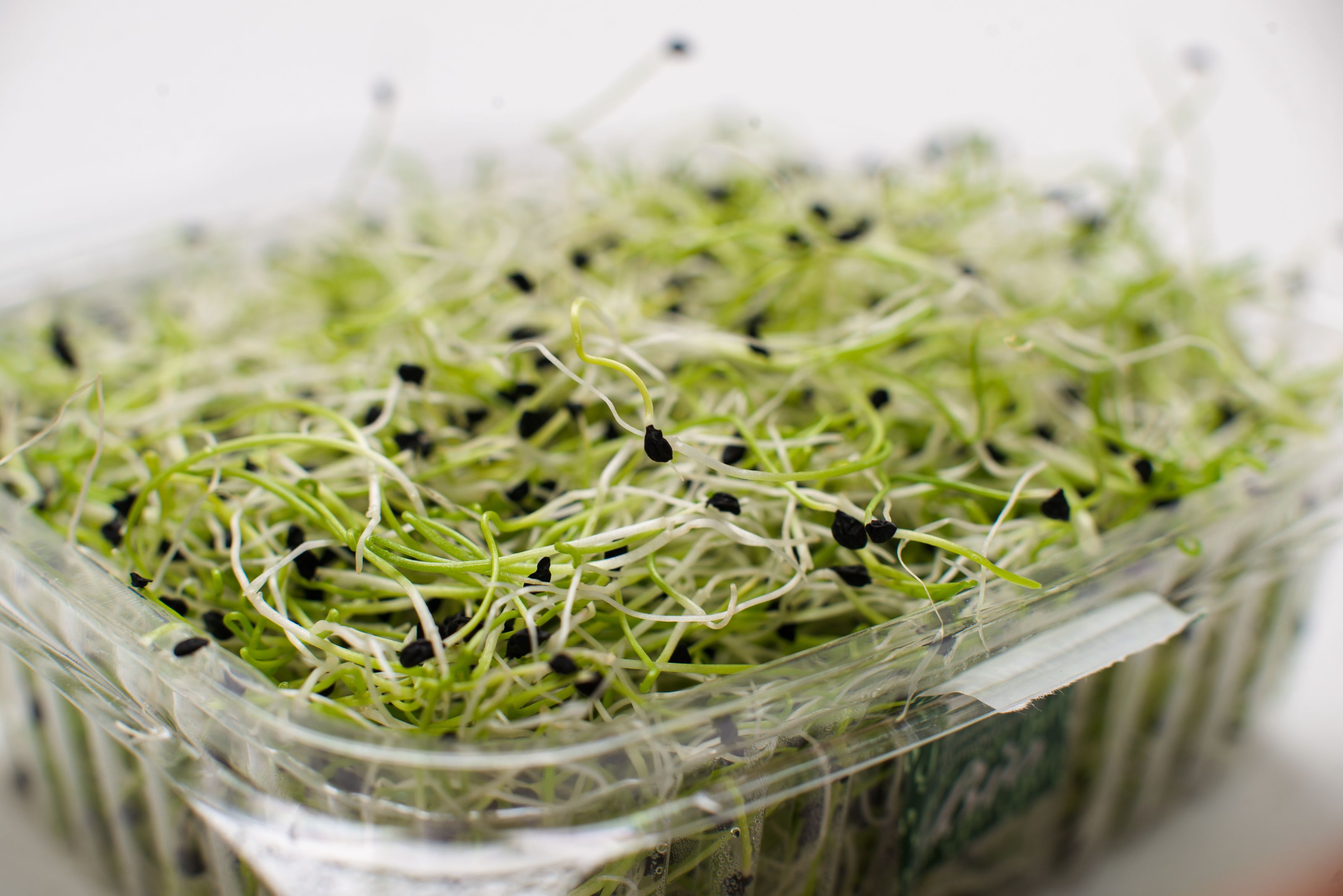
Alfalfa sprout
The "alfalfa" phytoestrogen seedling — saponins, high vitamin K, and Salmonella danger warning.
In 1 minute
What does it provide? A light, chlorophyll-rich sprout with vitamin K (≈ 30 µg/100 g), folate (≈ 36 µg), vitamin C (≈ 8 mg), small amounts of coumestrol (phytoestrogen), and saponins — protein- and calorie-modest (4 g protein, 23 kcal/100 g). NOT a complete food source — for salad, an aesthetic-nutrient supplement. Clinical evidence is minimal (Mölgaard 1987 modest LDL-lowering signal); the marketed "chlorophyll detox" is a lay myth.
How much? 1–2 handfuls (≈ 20–40 g) occasionally, in fresh salad, wrap, sandwich — NOT a daily staple food. Sprout at home only from third-party-tested, irradiated or heat-pasteurized seed; refrigerated max 5–7 days.
When to avoid? SLE / lupus and any active autoimmune disease — ABSOLUTE CONTRAINDICATION (canavanine — arginine analog — can induce SLE flare; Malinow 1981, Roberts 1983); pregnancy, breastfeeding, immunocompromised state, infant/child <5 years and elderly >65 (raw sprout-origin Salmonella and E. coli O157:H7 risk — FDA 1999/2009); warfarin (fluctuating vitamin K → INR instability); hormone-sensitive breast/endometrial tumor (theoretical coumestrol risk). Detailed contraindications in the dedicated section.
Alfalfa (Medicago sativa, in some languages "garden lucerne" or ancient name "alfalfa") is one of the oldest legumes in human animal feed — the Persians cultivated it around 1300 BCE. "Bean for the horse" has been a classic fodder in Europe since the 16th century. The modern sprouting tradition derives from East Asian practice; the 1970s West-American "natural nutrition" movement (Ann Wigmore and others) popularized the alfalfa sprout as a "chlorophyll bomb."
At the end of the 20th century, documented safety concerns emerged: canavanine (a structural arginine analog measurable in sprouts) according to Malinow (1981) induced SLE-like autoimmune symptoms in monkeys, and clinical cases (Roberts 1983) referenced alfalfa sprouts as a relapse factor in SLE activation. The 2000s FDA sprout warning (FDA Consumer Advisory 1999, renewed 2009) followed industrial clusters of E. coli O157:H7 and Salmonella contamination — alfalfa sprouts are considered one of the highest-risk food categories for immunocompromised, pregnant, child, and elderly populations.
🔬 Scientific Background
Alfalfa sprout nutritional value is modest: 100 g fresh sprouts ≈ 23 kcal, 4 g protein, 2 g carbohydrate, high vitamin K (30 µg), folate (36 µg), vitamin C (8 mg). The "complete food source" marketing claim is disproportionate — a small-mass supplement, not a main food.
Canavanine content presents a unique risk. Canavanine is a structural analog of arginine; mistakenly incorporated during protein synthesis it can lead to dysfunctional enzymes. Malinow's (1981, Science) classic primate study induced an SLE-like autoimmune syndrome with chronic alfalfa-sprout feeding. Clinical cases (Roberts 1983, Alcocer-Varela 1985) documented SLE activation or re-flare after alfalfa sprout consumption. Therefore SLE/lupus is the MAIN contraindication.
Coumestrol content (phytoestrogen) clinical significance is debated — at small amounts probably neutral; caution advised in hormone-sensitive tumor.
The microbiological safety question is the most important practical aspect. The high-humidity, lukewarm sprouting environment is ideal for Salmonella enterica (especially Newport, Saintpaul serotypes) and Shiga-toxin-producing E. coli (STEC, O157:H7) growth. The US CDC documented multiple large alfalfa-sprout-origin outbreaks (at least 22 between 1995–2009). The FDA expressly recommends PREGNANT, immunocompromised, infant, and elderly patients COMPLETELY AVOID SPROUTS (except cooked at high heat).
Vitamin K content requires a balanced intake pattern with warfarin sensitivity.
Clinical evidence is essentially minimal: small studies for lipid reduction (Mölgaard 1987) and epidemiology of legume-consumption-CVD reduction context — explicitly alfalfa-sprout-targeted human RCTs are sparse.
- + Lemon + olive salad: classic light matrix.
- + Avocado: fat-phytoestrogen bioavailability boost.
- + Other sprouts (broccoli, radish): mixed sprout mix — adding broccoli sprouts can elevate the evidence level.
- + Sourdough bread + herbs: light Mediterranean sandwich matrix.
- + Tofu + tahini: vegan protein-sprout matrix.
- Warfarin / coumarin (vitamin K content): fluctuating intake worsens INR stability — small dose consistent, large dose NO.
- SLE/lupus active flare: absolute contraindication (canavanine).
- Raw sprouts during antibiotic course: microbiome instability + heightened Salmonella infection risk.
- Raw sprouts during chemotherapy bone marrow suppression: absolute contraindication.
- Other high-canavanine sprouts (jack bean, sword bean): additive autoimmune stimulus.
- SLE / lupus / autoimmune disease active phase: ABSOLUTE CONTRAINDICATION (Malinow 1981; Roberts 1983).
- Pregnancy, breastfeeding: FDA recommends AVOIDANCE (Salmonella/E. coli + unknown phytoestrogen effect).
- Immunocompromised (chemotherapy, AIDS, transplant, chronic steroid): FDA explicitly AVOIDANCE (Salmonella, E. coli, Listeria).
- Infant, small child under 5 years: avoid (microbiological risk).
- Elderly 65+ immunosenescent: avoid raw sprouts.
- Hormone-sensitive tumor (breast, endometrium): coumestrol risk (theoretical).
- Hypothyroidism or goiter: small goitrogenic potential (low risk).
- Anticoagulant (warfarin): avoid fluctuating vitamin K intake.
- G6PD deficiency: theoretical hemolytic risk (favism matrix).
Daily serving: 1–2 handfuls (≈ 20–40 g) occasionally.
Preparation patterns:
1. Sprinkled raw on salad: classic matrix.
2. In sandwich fillings: as "chlorophyll decoration."
3. In a wrap (with avocado, hummus): Mediterranean/Levantine matrix.
4. In a smoothie (small amounts): chlorophyll concentrate.
Classic patterns:
- Classic "chlorophyll salad": alfalfa sprouts + spinach + avocado + lemon
- Hummus wrap with alfalfa sprouts: Levantine matrix
- Tofu wrap with sprouts + tahini: vegan protein matrix
- Cold side mix: sprout matrix raw, cold-served
Storage: refrigerated in an airtight container 5–7 days. Do NOT store at room temperature.
Home sprouting: in a sprouter jar for 4–6 days, rinse 2× daily with clean water, well-ventilated. Use only verifiably purchased, safety-checked (irradiated or heat-pasteurized) seed. Still avoided in patients and vulnerable populations.
What not to do: do NOT give raw alfalfa sprouts to pregnant women, immunocompromised, infants, elderly; do NOT consume during SLE flare; do NOT leave at room temperature for hours; do NOT rely on it as a main food source.