


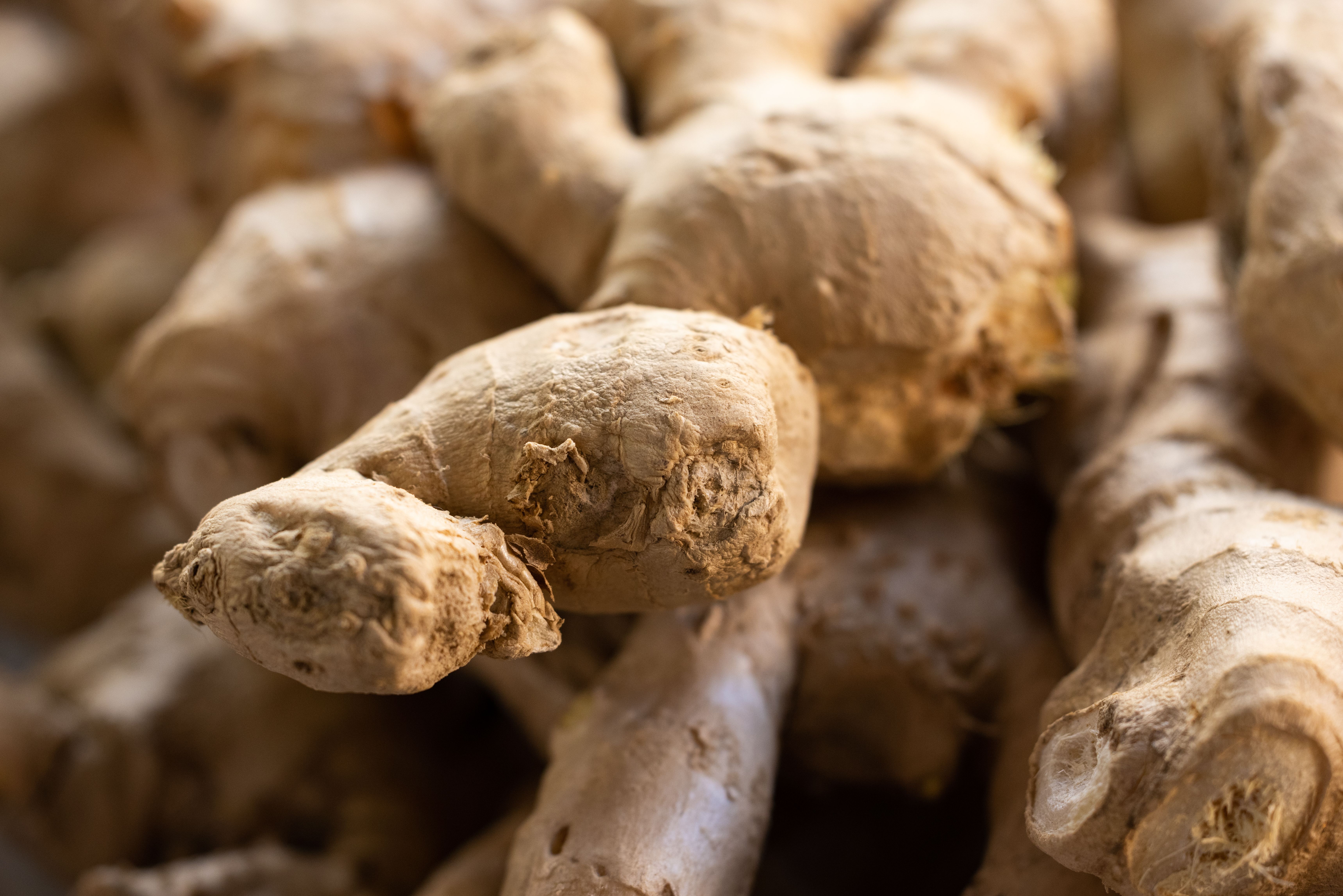
Ginger
The "sister rhizome" — gingerol, shogaol, and the best-documented antiemetic spice.
In 1 minute
What does it provide? Gingerols, shogaols, and zingerone — antiemetic, anti-inflammatory, motility-supporting bioactives in a single rhizome.
How much? In the kitchen, 1–4 g of freshly grated rhizome daily. For clinical purposes (pregnancy nausea, chemotherapy, OA) 0.5–1 g dried ginger powder 2–3×/day, max. 2.5 g.
When to avoid? Active gallstones, alongside anticoagulants in high doses, severe hyperemesis gravidarum as monotherapy, 2 weeks before planned surgery, in severe reflux flares.
Ginger has been used for more than three thousand years in South and East Asia — Confucius noted in the "Analects" that he never ate a meal without ginger, and Indian Ayurveda called it "viswabhesaj," "universal medicine." Maritime trade brought it west: through the Arabs it reached the Romans, where in Pliny's time it was already valued on par with pepper. In medieval Europe, it was sold at the price of a live lamb per pound, and at the court of Queen Elizabeth I, the colorful, human-shaped "gingerbread" was invented, considered a bearer of good luck for the new year.
From the early modern period, ginger was a recurring item in English medical books for seasickness and digestive complaints — this empirical basis led to the most robust antiemetic clinical trials of the 20th–21st centuries. Standardized ginger powder and capsule, after 1980, made possible the Cochrane-level randomized trials for pregnancy nausea, chemotherapy-induced nausea, and postoperative vomiting. Mechanism research meanwhile elucidated [6]-gingerol and [6]-shogaol's 5-HT3 receptor modulation and NF-κB anti-inflammatory pathway. (PubMed, EMA/HMPC)
🔬 Scientific Background
Ginger's antiemetic effect is based on the allosteric inhibition of the 5-HT3 receptor by gingerols and shogaols, and on cholinergic M3 modulation — exactly the pathway that ondansetron also targets. The effect is dose-dependent and relatively quick onset (30–60 min), so it is ideal for prevention of motion sickness.
The strongest human evidence is available for nausea and vomiting of pregnancy (NVP): based on Cochrane-level meta-analyses, ~1 g/day of dried ginger in mild-to-moderate NVP significantly reduces nausea intensity, while not increasing markers of fetal harm (PubMed, RCOG 2016). In hyperemesis gravidarum, however, it is not sufficient on its own.
In functional dyspepsia, 1.2 g of ginger powder speeds gastric emptying and enhances antral contraction. At the microbiome level, a 2024 shotgun metagenomic RCT (Nature/Sci Rep) showed selective taxonomic shifts (Akkermansia, Bacteroides, Ruminococcus) — small but measurable effect. Preclinical ginger-derived exosome-like nanoparticles (GELN) mark a promising but still translational area.
In large doses (≥ 4 g/day), weak antiplatelet/anticoagulant effects may appear — this explains the pre-surgery and warfarin interaction warnings.
- + Turmeric: classic "sister rhizome" combination — combined anti-inflammatory effect in osteoarthritis in several RCTs.
- + Lemon juice + honey: classic cold-easing trio — vitamin C is polyphenol-stabilizing, honey coats the mucous membrane.
- + Hot water, 5–10 min steep: gingerols are well water-soluble; heat treatment converts some of them to shogaol, which is more strongly anti-NVP.
- + Meal (with food): reduces the reflux/burning stomach sensation in sensitive individuals, and increases tolerability at higher doses.
- + Fiber-rich diet: some of the gingerols reach the colon → synergistic microbiome effect with fiber fermentation.
- + Acupuncture/P6 wrist acupressure (for NVP): clinically validated complementary effect.
- Anticoagulants (warfarin, DOAC, aspirin, clopidogrel): high-dose ginger adds additive bleeding risk — culinary amount is safe, clinical supplement to be avoided or under medical supervision.
- Diabetic medications (metformin, sulfonylureas, insulin) with high-dose ginger supplement: additive hypoglycemia risk.
- Antihypertensives + high-dose ginger: moderate blood-pressure-lowering synergy, monitoring advised.
- Strongly acidic medium + long heat exposure: gingerols are degradable — don't cook for 30+ minutes.
- On an empty stomach, high dose: reflux, gastric irritation in sensitive individuals.
- Planned surgery within 2 weeks: stop high-dose supplement.
- Active gallstones, cholangitis, bile-duct obstruction: ginger is choleretic — colic attack risk.
- Severe hyperemesis gravidarum: not sufficient on its own; medical/infusion treatment needed.
- Reflux/GERD flare: GI irritation possible; take with food.
- Active gastric ulcer: irritation at high doses.
- Planned surgery, dental intervention: stop the supplement 1–2 weeks beforehand.
- Bleeding diathesis, ITP, anticoagulant therapy: only under medical supervision.
- Infant < 1 year: concentrated forms to be avoided (also strong in taste).
- Zingiberaceae allergy: rare, but cross-reaction with turmeric, cardamom possible.
Daily serving
1–4 g fresh ginger rhizome or ≈ 0.5 g dried powder; for NVP, 1 g/day, divided into 2–3 servings.
Preparation pattern
- Peel washed rhizome with the edge of a teaspoon (gentler).
- Grate just before cooking/drinking — essential oils are volatile.
- Hot water tea: 1–2 cm of rhizome, 200 ml of water, 5–10 minutes steeping under a lid.
- In meat/fish marinade: grated fresh ginger + soy sauce + sesame oil, 30 minutes–1 hour.
Classic patterns
NVP protocol: 250 mg dried ginger powder in capsule, 4×/day, with food.
Ginger golden milk: turmeric + ginger + pepper + plant milk + ghee.
For motion sickness: 1 g of dried powder (capsule) 30–60 minutes before departure.
Pickled ginger (gari): thinly sliced fresh ginger + rice vinegar + sugar + salt — sushi accompaniment, digestion-supporting.
Storage and what to avoid
Storage: fresh rhizome in the fridge wrapped in paper for 3 weeks, frozen (grated, in cubes) for 6 months. Dried powder airtight, in a dark place.
What not to do: don't boil for 30+ minutes — gingerol loss. Don't arbitrarily combine clinical-dose supplements with warfarin.
References
[1] EMA/HMPC. European Union herbal monograph on Zingiber officinale Roscoe, rhizoma. 2024 (rev. 1).
[2] Viljoen E et al. A systematic review and meta-analysis of the effect and safety of ginger in the treatment of pregnancy-associated nausea and vomiting. Nutr J 2014;13:20.
[3] Wu KL et al. Effects of ginger on gastric emptying and motility in healthy humans. Eur J Gastroenterol Hepatol 2008;20(5):436–440.
[4] Bossi P et al. A randomized, double-blind, placebo-controlled, multicenter study of a ginger extract in the management of chemotherapy-induced nausea. Ann Oncol 2017;28(10):2547–2551.
[5] Royal College of Obstetricians and Gynaecologists. Green-top Guideline No. 69: The Management of Nausea and Vomiting of Pregnancy and Hyperemesis Gravidarum. 2016.
[6] Bartels EM et al. Efficacy and safety of ginger in osteoarthritis patients: a meta-analysis. Osteoarthritis Cartilage 2015;23(1):13–21.
[7] Lu Q et al. Ginger intake alters the gut microbiota: a randomized controlled trial. Sci Rep 2024.
[8] Mao QQ et al. Bioactive compounds and bioactivities of ginger (Zingiber officinale). Foods 2019;8(6):185.