


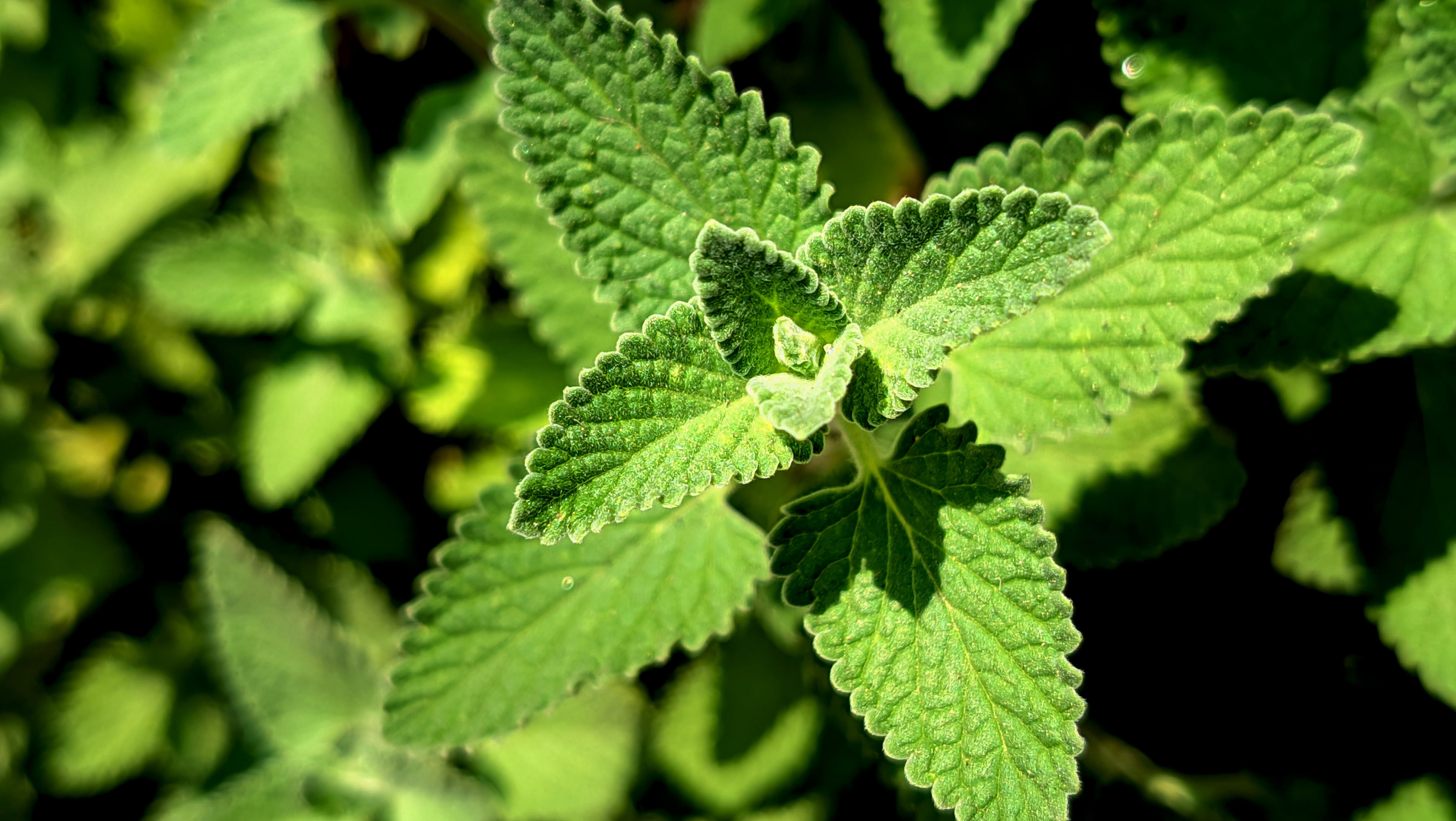
Mint
IBS support — menthol, peppermint oil capsule RCTs, and Cochrane-level evidence.
In 1 minute
What does it provide? Menthol (35–55% of essential oil), menthone, menthyl acetate, rosmarinic acid — IBS-symptom-reducing, antispasmodic, antimicrobial, antiemetic, and locally cooling.
How much? In the kitchen fresh mint 5–30 g/day, dried ½–1 tsp; for clinical use (IBS) enteric-coated peppermint oil capsule (0.2 ml = 187 mg/capsule), 1 capsule 3×/day (EMA, Cochrane).
When to avoid? GERD/reflux flare (menthol relaxes the lower esophageal sphincter), active gallstones, concentrated menthol on infants, high-dose essential oil in pregnancy.
Mint (Mentha spp.) has been a medicinal herb for over 2000 years — in Greek mythology, the underworld god Hades loved the nymph Minthe, who was trampled by his jealous wife Persephone, and Hades turned her into the mint plant for its life-evoking aroma. The classical Greek name "minthos" comes from there. Pliny and Dioscorides recommended it for digestion, headache, and topical cooling. Biblical writings (Luke 11:42) also mention the tithe of mint.
Peppermint (Mentha × piperita) is a natural hybrid of Mentha aquatica and Mentha spicata — first documented in 1696 by English botanist John Ray. The 1800s brought commercial cultivation in Europe and North America, and 20th-century pharmacy recognized peppermint oil as an official pharmacopoeial extract.
Clinical interest exploded with the 2007 Cappello meta-analysis: based on 8 RCTs, enteric-coated peppermint oil capsule significantly reduces IBS symptoms, with effectiveness similar to tricyclic antidepressants. The 2018 Khanna meta confirmed and expanded this — peppermint oil capsule is one of the best-researched "functional" digestive-supportive herbs. According to the 2016 Alammar meta, IBS symptoms decrease on average 39%. **(BMJ 2007, BMC Complement Altern Med 2018)
🔬 Scientific Background
Peppermint (Mentha × piperita) essential oil is 35–55% menthol-dominant, complemented by menthone (15–25%), menthyl acetate, 1,8-cineole, and menthofuran. Spearmint (Mentha spicata) is carvone-dominant (50–70%) and contains almost no menthol — so the two mints have clinically distinct profiles.
Menthol's multiple parallel mechanisms: TRPM8 receptor agonism (the cooling-sensation receptor), calcium channel inhibition (smooth muscle relaxation), 5-HT3 and 5-HT4 receptor modulation (antiemetic), and local anesthesia.
The most robust clinical evidence is in IBS support. Enteric-coated peppermint oil capsule (the capsule dissolves in the small intestine to avoid upper GI tract irritation) at 187 mg menthol three times daily shows NNT = 3 in meta-analysis (i.e., significant improvement in 1 of 3 patients). EMA/HMPC recognizes it under "well-established use" for IBS symptom reduction.
Functional dyspepsia: peppermint oil + caraway oil combination (an Iberogast component) showed symptom reduction in randomized trials.
Antimicrobial spectrum (in vitro): moderate — against Streptococcus mutans, Candida albicans, H. pylori. Explains the classic "mint candy for fresh breath" effect.
Anti-chemotherapy-induced nausea: small pilots and Cochrane-level reviews show peppermint inhalation is a moderate antiemetic adjunct.
GERD paradox: menthol relaxes the lower esophageal sphincter (LES) → worsens reflux. To be avoided in reflux patients.
At the microbiome level, small pilots have shown menthol-selective antimicrobial effects and commensal support.
- + Hot drink (tea, classic Moroccan mint tea): classic digestive support.
- + Yogurt, raita (Indian/Middle Eastern): classic Mediterranean matrix.
- + Chocolate (after-eight, classic): modern dessert.
- + Lamb, meat (Greek/Turkish): flavor harmony.
- + Lemon, lime, ginger (mojito): classic Cuban.
- + Peppermint oil capsule + Iberogast/caraway: IBS synergy.
- In GERD/reflux flare: menthol relaxes the LES, worsens reflux.
- Active gallstones: choleretic effect potentiates the colic risk.
- Concentrated menthol topically on infants: respiratory laryngospasm risk (FDA warning).
- CYP3A4 substrates + high-dose peppermint oil: theoretical absorption interference.
- Long boiling: essential oil evaporates.
- Absorption-weakening drugs + oil capsule: separate in time.
- GERD, Barrett's esophagus, reflux flare: menthol worsens.
- Active gallstones, cholangitis: choleretic.
- Concentrated menthol topically or internally on infants and small children: to be avoided.
- Pregnancy (high-dose essential oil): caution.
- Hiatal hernia: menthol may worsen.
- Lamiaceae allergy: cross-reaction.
- Severe liver disease: high-dose essential oil to be avoided.
- Asthma flare: rare but reported bronchospasm trigger.
Daily serving
Fresh mint 5–30 g (1 tbsp finely chopped); clinical use peppermint oil capsule 0.2 ml = 187 mg, 1 capsule 3×/day before meals.
Preparation pattern
- Fresh leaf: chop finely before serving — high heat ruins it.
- Tea: fresh 5–10 leaves + 200 ml hot water, 5–10 min standing.
- Pesto-like mint sauce: mint + olive oil + almonds + parmesan.
- Clinical capsule: enteric-coated peppermint oil, 30 min before meal.
Classic patterns
Moroccan mint tea: green tea + fresh mint + sugar — classic.
Greek tzatziki: yogurt + cucumber + mint + garlic + olive oil.
Cuban mojito: rum + fresh mint + lime + sugar + soda.
IBS protocol: peppermint oil capsule 1 capsule 3×/day before meals, 4 weeks.
Storage and what not to do
Storage: fresh mint "flower-style" in water, refrigerated 1 week; dried 1 year airtight in a dark place.
What not to do: don't combine peppermint oil capsule in a GERD flare; don't apply concentrated menthol to an infant's chest; don't cook fresh mint.
References
[1] Cappello G et al. Peppermint oil (Mintoil) in the treatment of irritable bowel syndrome: a prospective double blind placebo-controlled randomized trial. Dig Liver Dis 2007;39(6):530–536.
[2] Khanna R et al. Peppermint oil for the treatment of irritable bowel syndrome: a systematic review and meta-analysis. J Clin Gastroenterol 2014;48(6):505–512.
[3] Alammar N et al. The impact of peppermint oil on the irritable bowel syndrome: a meta-analysis. BMC Complement Altern Med 2019;19(1):21.
[4] EMA/HMPC. European Union herbal monograph on Mentha × piperita L., folium. 2020.
[5] Madisch A et al. Treatment of functional dyspepsia with a herbal preparation. Digestion 2004.
[6] FDA. Menthol — pediatric warning (laryngospasm).
[7] Ford AC et al. Effect of antidepressants and psychological therapies in irritable bowel syndrome: an updated systematic review and meta-analysis. Am J Gastroenterol 2019;114(1):21–39.