


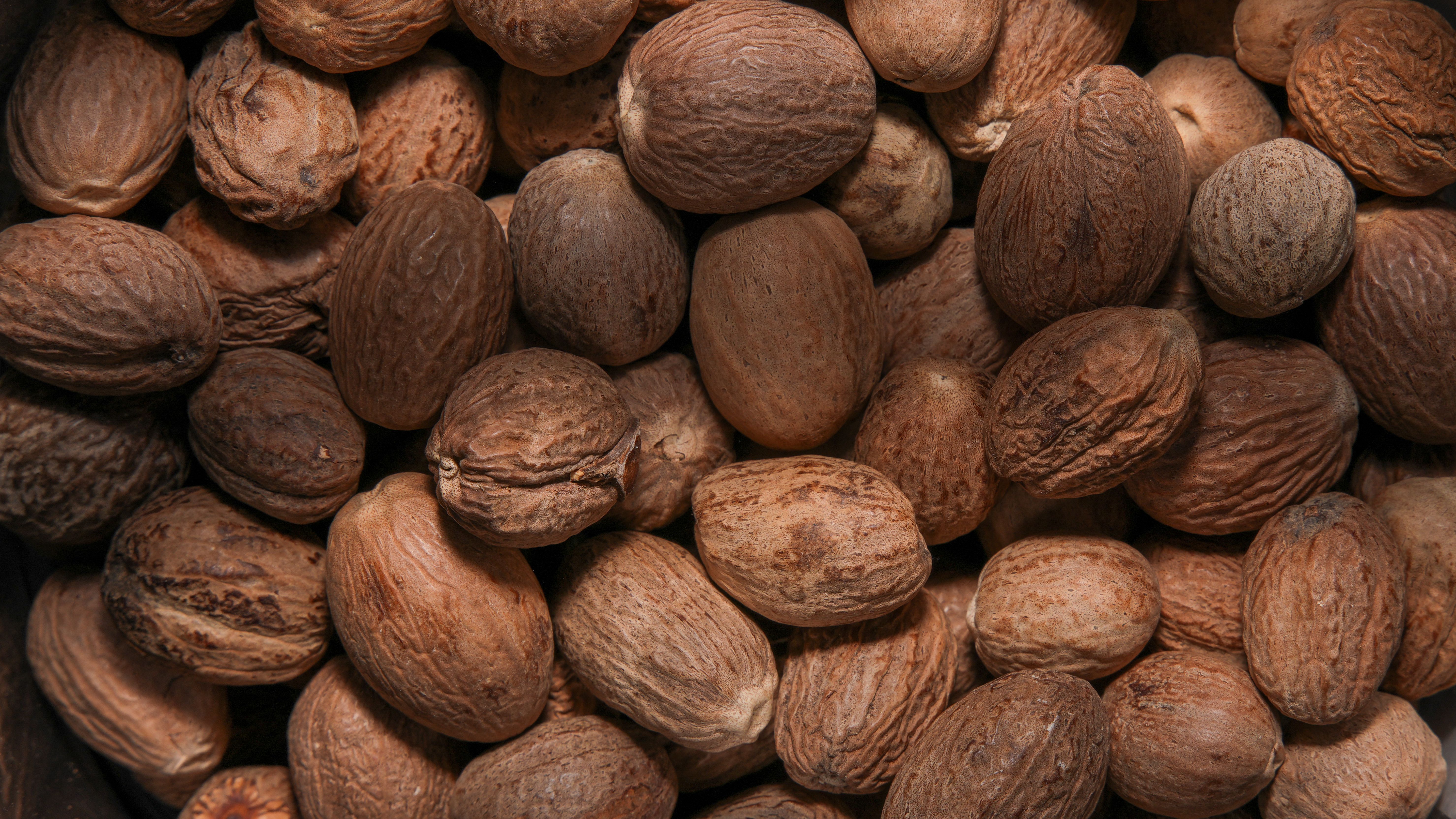
Nutmeg
The blood-soaked golden spice of the Banda Islands — aromatic in fine cooking, toxic at high doses.
In 1 minute
What does it provide? Aromatic essential oil terpenes (sabinene, α/β-pinene — digestive-supporting carminatives, antimicrobial in vitro) and small amounts of alkenylbenzenes (myristicin, elemicin — psychoactive and MAO-like molecules, toxic at high doses). Classic spice for béchamel, pumpkin pie, and gingerbread. Robust clinical RCT evidence is lacking — culinary use is aromatic, not therapeutic.
How much? EXCLUSIVELY in culinary amounts: ¼ tsp (≈ 0.5 g) freshly grated per dish, maximum 1–2 tsp total per week. Buy whole nuts and grate fresh with a microplane just before serving — the aroma is cleanest this way.
When to avoid? Recreational/high-dose intake (5–30 g ground nutmeg within 1–7 hours causes tachycardia, hallucination, mydriasis, rarely seizure — TikTok-challenge poisonings documented, NEVER); high doses in pregnancy (uterine-stimulant, abortifacient potential); MAO inhibitor treatment (phenelzine, tranylcypromine — myristicin interaction); psychiatric disorders (mania, psychosis) or epilepsy (seizure threshold lowered). Detailed condition-specific contraindications (liver/kidney disease, infants, surgery) in the dedicated section.
Nutmeg's history is a blood-soaked spice story: for centuries Indonesia's Banda Islands were the world's only source of Myristica fragrans, making it one of the highest-priced items of 16th–17th century spice monopolies. The Portuguese, then the Dutch acquired the Banda Islands after bloody battles; in 1621 the Dutch VOC essentially exterminated the island's original population to preserve the monopoly. In the 1667 Treaty of Breda, the Dutch traded British Run Island for New Amsterdam (today's New York) — they traded the source of high-value nutmeg for an island that today hosts Wall Street. Arabs already carried it to Europe along trade routes from the 5th–6th century, and at Queen Elizabeth I's English court nutmeg was more valuable than gold.
Because of the seed and the aril's (mace) sweet-spicy, warming profile, it remains a classic ingredient in both cooking and the liquor industry. From the turn of the 19th–20th century, steam-distilled essential oil and oleoresin became aromatic industrial raw materials, and phytochemistry mapped the monoterpene and alkenylbenzene fractions. From mid-20th century, more and more poisoning case reports appeared after recreational, high-dose consumption — and from the 2010s it has even surfaced as a "TikTok challenge." Modern toxicology identifies myristicin and related alkenylbenzenes as the main risk candidates; EU regulation has tightened on safrole and other alkenylbenzenes. (eur-lex.europa.eu, PMC)
🔬 Scientific Background
Nutmeg is the seed kernel of Myristica fragrans; mace is the aril surrounding the seed. The seed's essential oil consists of sabinene- and α/β-pinene-dominated monoterpenes, accompanied by the alkenylbenzenes myristicin and elemicin and small amounts of safrole. The fixed oil (trimyristin → myristic acid) is also a significant fraction. PMC
Clinical evidence is limited. Traditional use for digestive complaints and sleep disturbance — on ethnomedical basis, without robust RCT evidence. Concentrated essential oil is strongly antimicrobial in vitro (Gram+ and fungi), but oral systemic antimicrobial effects are not documented in humans.
Toxicology gives a VERY DIFFERENT picture. High-dose intake (5–30 g ground nutmeg, "recreational" use) within 1–7 hours can cause dizziness, nausea, dry mouth, mydriasis, agitation, hallucinations, tachycardia, and rarely seizures and rhabdomyolysis. PMC, acep.org Mechanism: oxidative bioactivation of myristicin and elemicin, MAO-like effect, and potentially an anticholinergic-like component. Based on 10-year toxicology reviews, severe outcomes are rare, symptoms resolve within 24–48 hours — but hospital admission is common. PMC
Safrole and other alkenylbenzenes are restricted under EU regulation due to genotoxic/carcinogenic risk — adding safrole as a food flavoring is forbidden; with natural occurrence there are limit values.
- + Milk-based desserts (rice or almond pudding, cream sauce): classic "eggnog," béchamel — freshly grated at serving.
- + Root vegetables (winter squash, carrot, sweet potato): roasted, in small amounts — sweet-spicy harmony.
- + Caramelized onion, baked apple: autumn-winter flavor profile.
- + Baked goods (gingerbread, baking): as part of a spice mix (cinnamon, ginger, clove).
- + Dutch erbsensoep, French béchamel: classic European culinary use.
- + Indonesian / Middle Eastern stews (nasi goreng, biriyani): in tiny amounts.
- MAO inhibitor treatment (phenelzine, tranylcypromine, moclobemide): myristicin's MAO-like effect can clash — to be avoided at high doses.
- Anticoagulant / antiplatelet: nutmeg oil has antithrombotic activity; clinical-dose oral oil to be avoided.
- Hepatotoxic medications (high-dose acetaminophen, methotrexate): theoretical additive liver stress at high doses.
- Psychotropic drugs (SSRI, antipsychotic): recreational high-dose nutmeg to be avoided — interaction, crisis.
- Tyramine-containing aged cheeses, fermented meats: if an MAO-inhibitor-like effect is theorized, caution.
- Concentrated essential oil for "aromatherapy" oral use: generally to be avoided — mucosal irritation, aspiration pneumonia risk.
- Pregnancy: high-dose nutmeg has emmenagogic and abortifacient potential — culinary amounts are safe; concentrated oil and large amounts are FORBIDDEN.
- Breastfeeding: avoid clinical doses.
- Infants and small children: small amounts in children's puddings are okay, but do NOT give concentrated nutmeg powder in larger amounts.
- Psychiatric disorders (psychosis, mania, severe anxiety): recreational use can worsen — TO BE AVOIDED.
- Active liver or kidney disease: high doses to be avoided.
- Epilepsy, seizure tendency: high-dose myristicin can provoke seizure.
- Before planned surgery: discontinue concentrated supplement 1 week before.
- Nutmeg allergy (rare): contraindication.
Daily serving
Culinary amount: ¼ tsp (≈ 0.5 g) freshly grated per dish. Maximum 1–2 tsp total per week. Concentrated essential oil orally is NOT recommended.
Preparation pattern
- Buy whole nutmeg seeds (not ground powder).
- Grate fresh with a microplane BEFORE SERVING or at the end of cooking.
- The essential oil aroma is most intense and clean this way.
Classic patterns
Béchamel sauce: freshly grated nutmeg at the end of the sauce — French haute cuisine staple.
Eggnog (American): egg yolk + milk + nutmeg + bourbon (alternative: alcohol-free).
Pumpkin pie, gingerbread: in an autumn spice mix (cinnamon, ginger, clove, nutmeg).
Dutch erbsensoep: split pea soup with nutmeg.
Creamed spinach: spinach + cream + nutmeg — classic side.
Storage
Whole seed: airtight jar, dark cool place 1–2 years. Ground: 6 months (aroma loss). Concentrated essential oil should NOT be stored for oral use.
What not to do
Do NOT add large amounts to a single dish. Do NOT use concentrated essential oil orally. Do NOT challenge children or teens to "courage tests" — toxic reaction likely. Avoid high doses in pregnancy.
References
[1] Stein U, Greyer H, Hentschel H. Nutmeg (myristicin) poisoning — report on a fatal case and a series of cases recorded by a poison information centre. Forensic Sci Int 2001;118(1):87–90.
[2] Demetriades AK et al. Low-cost, high-risk: accidental nutmeg intoxication. Emerg Med J 2005;22(3):223–225.
[3] Carstairs SD, Cantrell FL. The spice of life: an analysis of nutmeg exposures in California. Clin Toxicol 2011;49(3):177–180.
[4] EFSA. Risk assessment of allyl- and propenylbenzenes (myristicin, elemicin, safrole) in foods. EFSA Journal.
[5] EU Regulation 1334/2008 on flavourings in food (safrole and related compounds).
[6] American College of Emergency Physicians (ACEP). Nutmeg toxicity clinical review.
[7] Ehrenpreis JE et al. Nutmeg poisonings: a retrospective review of 10 years of reports to a poison control center. J Med Toxicol 2014;10(2):148–151.
[8] Milton G. Nathaniel's Nutmeg: How One Man's Courage Changed the Course of History. Sceptre 1999. (Historical monograph on the nutmeg trade and the role of the Banda Islands.)