


Other classic spices (sumac, bay leaf, dill, tarragon)
Four classic spices in a brief catalog — Middle Eastern sumac, Mediterranean bay leaf, Hungarian dill, French tarragon.
Other classic spices in 1 minute
This chapter presents four classic spices in a brief, compact format — each with limited human evidence that does not justify a standalone main chapter, but together they are valuable elements of Mediterranean–Middle Eastern–Hungarian culinary culture. Each detailed description follows the standard chapter structure in miniaturized form.
Origin: Middle East, Levant, eastern coast of the Mediterranean. One of the main components of the classic Lebanese "za'atar" blend. Ground berries of the tanner-tree family (Anacardiaceae) give a tangy-sour, lemony-flavored powder.
Bioactive profile: Hydrolyzable tannin (gallotannin) 5—15%, anthocyanins (cyanidin glucoside), quercetin, kaempferol, high vitamin C. The ORAC value is among the highest of all spices (Vyas 2024 Foods review).
Clinical evidence: Mohammadi Pour 2019 Phytother Res meta-analysis: sumac 3 g/day for 4—12 weeks — significant blood-sugar reduction (HbA1c −0.5%) in T2D patients. Shidfar 2014 J Res Med Sci showed lipid modulation.
Use: sprinkled on salad (classic "fattoush"), on hummus, on roasted meat, on eggplant. The natural alternative to lemon in eastern Mediterranean cuisine.
Microbiome aspect: indirect polyphenol-tannin matrix with Akkermansia/Lactobacillus support potentially, without human microbiome RCT evidence.
FODMAP: low. Contraindication: close relative of the toxic Rhus toxicodendron (poison ivy) — only from verified sources. Aspirin sensitivity (sumac contains salicylates).
Origin: Mediterranean. The classic "garni" bundle of Greek-Roman cuisine. An essential element of the French "bouquet garni" for soups and stews. Hungarian culinary classic.
Bioactive profile: 1,8-cineole (eucalyptol, 30—50% in the essential oil), linalool, sabinene, α-pinene; quercetin and kaempferol glycosides; fiber.
Clinical evidence: Khan 2009 Eur J Clin Nutr — diabetes RCT with 1—3 g bay leaf/day for 30 days: significant improvement in blood sugar, lipids, and insulin sensitivity in T2D patients. As a spice alone it is not a clinical dose; in capsule or tea form it is meaningful.
Use: for flavoring soups, stews, marinades — during cooking, before consuming the leaf is removed (bloating, allergen risk). The base spice of Hungarian goulash, paprikash, and sour soups.
Microbiome aspect: in vitro antimicrobial — moderate against Helicobacter pylori, Salmonella. Human microbiome RCT evidence is sparse.
FODMAP: green. Contraindication: the whole leaf is NOT eaten — sharp, hard, GI-obstruction risk (especially dangerous for children). Diabetes with insulin pump: bay-leaf tea/capsule can cause hypoglycemia — monitor drug dosing.
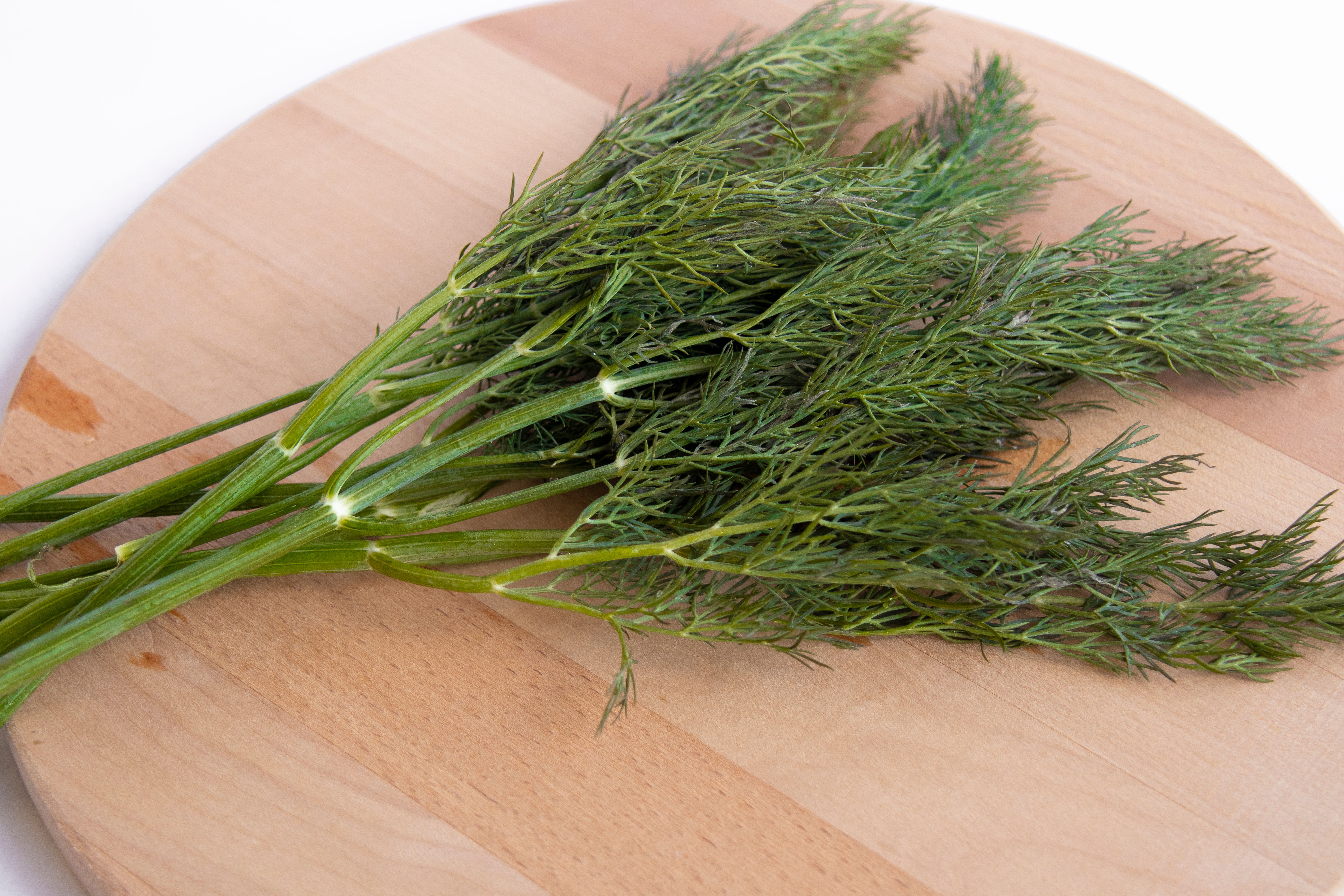
Origin: Mediterranean origin, but a classic element of Hungarian, Polish, Russian, and Scandinavian cuisines. The basis of the classic Hungarian "dill curd noodles" and "dill cucumber soup."
Bioactive profile: carvone and limonene (essential oil 60—80%), anethole, quercetin, kaempferol; vitamin A (beta-carotene), vitamin C, magnesium.
Clinical evidence: Sahib 2013 Asian Pac J Trop Biomed — dill extract (kapsa) brought lipid-profile improvement in a small human pilot. Hosseinzadeh 2002 J Ethnopharmacol documented preclinically the traditional antispasmodic claim. Clinical human RCT evidence is modest.
Use: in fresh salad, yogurt-tzatziki, with fish (classic Scandinavian "gravlax"), cucumber salad, fermented pickles. Long cooking removes its aroma — add at the END of cooking.
Microbiome aspect: indirect antimicrobial in vitro; no specific human evidence.
FODMAP: green. Contraindication: rare allergy (Apiaceae family cross-reactivity: celery, carrot, anise). High-dose essential-oil capsule to be avoided in pregnancy (uterotonic potential, weak evidence).
Origin: Central Asian origin, but an iconic member of the classic French "fines herbes" blend. In Hungarian cuisine — especially the Transylvanian and Upper Hungarian tradition — the basis of the classic "tarragon soup."
Bioactive profile: "French tarragon" (A. dracunculus sativa) has high estragole (60—80% of essential oil), high linalool. "Russian tarragon" (A. dracunculus inodora) has substantially lower estragole content, weaker flavor, safer. Quercetin, kaempferol, rutin in the polyphenol fraction.
Clinical evidence: Méndez-del Villar 2016 J Med Food — tarragon extract (Tarralin®) 1000 mg/day, 90 days, in prediabetic patients: significant improvement in blood sugar and insulin sensitivity. Clinical human evidence is at low dose, with few RCTs.
Use: chicken, fish, egg dishes, sauces (béarnaise!), salad dressings, classic "tarragon chicken soup." Fresh tarragon gives maximum aroma with brief cooking.
Microbiome aspect: no direct human evidence; moderate in vitro antimicrobial.
FODMAP: green. Contraindication — CRITICAL: estragole is genotoxic + carcinogenic in animal models (EFSA 2009 assessment). High-dose supplement long-term TO BE AVOIDED. Dietary spice amount (1—2 g fresh, 0.5 g dried) is safe. High-dose capsule to be avoided in pregnancy.
Sumac:
- Vyas N et al. Sumac (Rhus coriaria L.): a multi-bioactive food spice — review. Foods 2024;13(11):1675.
- Mohammadi Pour P et al. The clinical effects of Rhus coriaria (sumac) on metabolic biomarkers — meta-analysis. Phytother Res 2019;33(8):1900—1916.
- Shidfar F et al. The effects of Rhus coriaria L. (sumac) on lipid profile and inflammatory markers in patients with type 2 diabetes. J Res Med Sci 2014;19(10):933—938.
Bay leaf:
- Khan A et al. Bay leaves improve glucose and lipid profile of people with type 2 diabetes. Eur J Clin Nutr 2009;63(3):319—324. https://pubmed.ncbi.nlm.nih.gov/19177188/
- EMA/HMPC. Laurus nobilis L., folium — assessment report. 2017.
Dill:
- Sahib AS et al. Effects of Anethum graveolens on lipid profile in hypercholesterolemic patients. Asian Pac J Trop Biomed 2013;3(11):902—905.
- Jana S, Shekhawat GS. Anethum graveolens: an Indian traditional medicinal herb — review. Pharmacogn Rev 2010;4(8):179—184.
- EMA/HMPC. Anethum graveolens L., fructus — herbal monograph. 2015.
Tarragon:
- Méndez-del Villar M et al. Effect of Artemisia dracunculus on glycemic control in patients with type 2 diabetes — RCT. J Med Food 2016;19(5):484—490.
- EFSA. Compendium of botanicals reported to contain naturally occurring substances of possible concern for human health — estragole assessment. EFSA Journal 2009.
- EMA/HMPC. Artemisia dracunculus L., herba — herbal monograph (preliminary). 2018.
General:
- USDA FoodData Central — Sumac NDB #02038; Bay leaves NDB #02004; Dill NDB #02045; Tarragon NDB #02064.
- Monash University. Sumac, bay leaves, dill, tarragon — Low FODMAP serving guidance.