


Saffron
The "red gold" — crocin, safranal, and RCT-level evidence in depression and PMS.
In 1 minute
What does it provide? Crocin (water-soluble carotenoid glycoside — source of the red color; gut bacteria hydrolyze it to crocetin, which crosses the blood-brain barrier) and safranal (volatile monoterpene — source of the honey-like aroma, anxiolytic). Mechanism: serotonin reuptake inhibition, BDNF increase, neuroinflammation reduction. Akhondzadeh 2007 and Lopresti 2014 RCTs: fluoxetine-equivalent effect in mild-to-moderate depression (Hamilton score improvement).
How much? Culinary: 3–6 threads (≈ 15–30 mg) of stigma for a 2-person serving, infused 10–20 minutes in 60 °C water/milk. For clinical indication 28–30 mg/day standardized saffron extract (affron, Saffr'Activ) for 6–12 weeks, under medical consultation. Agha-Hosseini 2008 RCT: 30 mg/day for 2 menstrual cycles → significant PMS reduction. NEVER exceed 1.5 g/day — 5 g/day is toxic, 10 g/day potentially lethal (uterine bleeding, cerebral hemorrhage).
When to avoid? Pregnancy at therapeutic doses (uterotonic — miscarriage risk; culinary 1–2 threads are safe); bipolar disorder (mania induction); SSRI/SNRI/MAO inhibitor combination (serotonin syndrome); warfarin/DOAC/aspirin (bleeding risk); 2 weeks before surgery. Detailed contraindications in the condition-specific section.
Saffron is one of humanity's oldest and still the most expensive spice. Its origins are known from the Greek Aegean islands and Crete, where the Minoan frescoes of Knossos (1600–1500 BCE) depict women harvesting saffron; in ancient Persia (Khorasan province — still ≈ 90% of world production) it was used for textile dyeing, perfume, medicine, and cuisine. Following its use at the court of Darius I (father of Xerxes), it was listed by Avicenna (Ibn Sina, 10th–11th c.) in the Islamic Golden Age in his Canon (Al-Qānūn fī aṭ-Ṭibb) with multiple indications (depression, digestion). Avicenna's "Canon" (10th c.) mentions it as a remedy for depression, headache, and "heart grief" — modern clinical trials a thousand years later confirmed the same indication.
Saffron was one of the most important commodities of ancient Mediterranean and Silk Road trade: the Roman aristocracy scattered it in bathwater, bedding, and food; the 14th-century "saffron war" (Krocus-Krieg) near Basel occurred when a shipment of the spice was stolen — a 12-week conflict typical of medieval trade tensions. In Central Europe, Italian-influenced culinary saffron use appeared at the court of King Matthias (15th c.), but it never became a mass product. Modern clinical psychopharmacology research exploded with Akhondzadeh and Tehran colleagues' study series after 2001: their 2005 RCT showed 6 weeks of saffron extract (30 mg/day) gave depression reduction equivalent to fluoxetine (20 mg/day) in mild-to-moderate cases — small sample (n=40), but since then dozens of independent RCTs and the Tóth (2019) meta-analysis have reinforced it. (Akhondzadeh 2005; Lopresti 2014; Tóth 2019)
🔬 Scientific Background
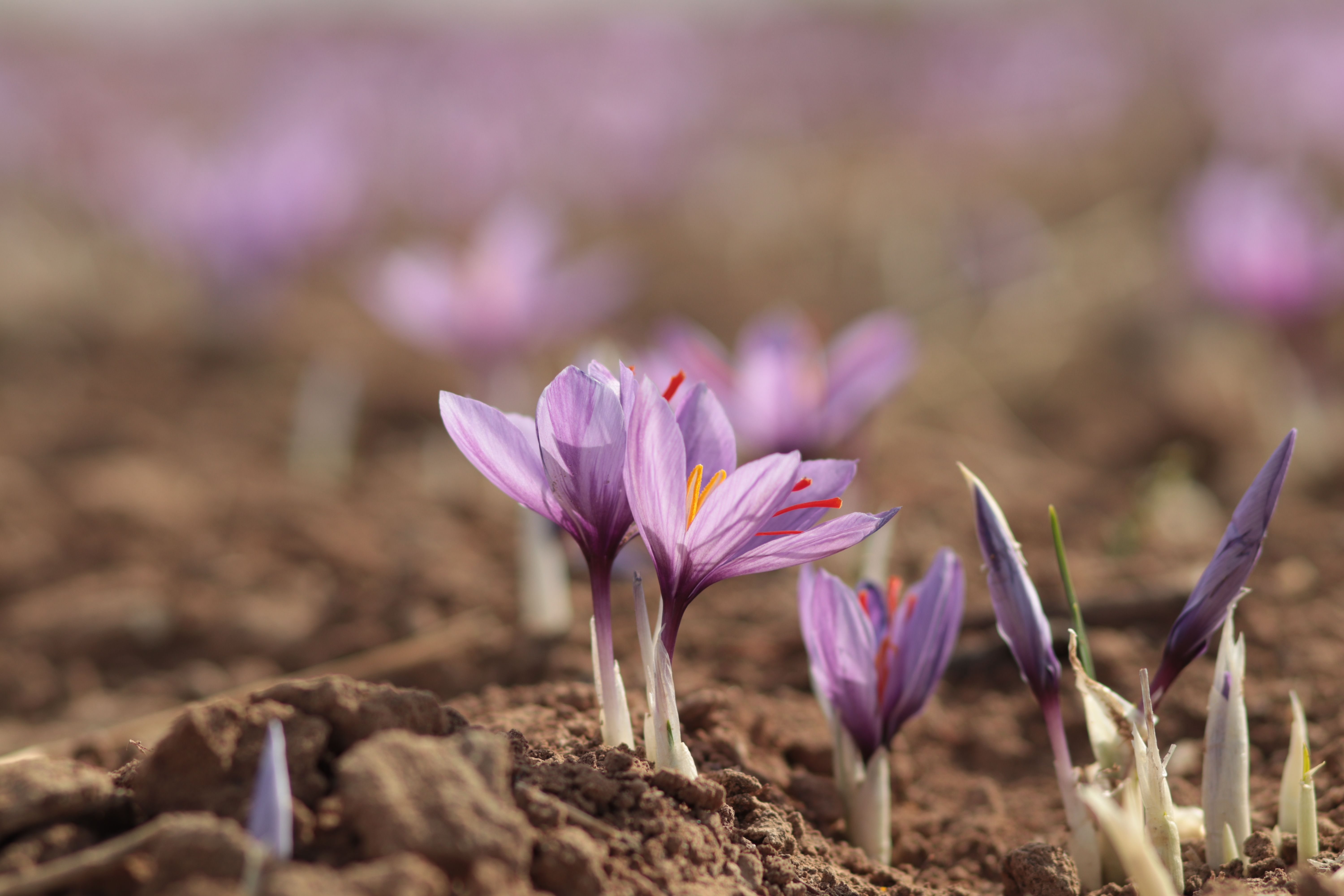
Saffron stigma (the three-branched red stigma among the Crocus sativus flower's reproductive parts) contains three main bioactive groups. Crocins (cis- and trans-) are water-soluble carotenoid glycosides — responsible for the deep red-orange color. Crocetin (the aglycone of crocin) is the true systemic active substance — crocin is partially hydrolyzed in the gut, mediated by the colonic microbiome, to crocetin, which then crosses the blood-brain barrier. Safranal is a volatile monoterpene responsible for the characteristic "honey-hay" aroma, and is itself anxiolytic in animal experiments.
Neuropsychiatric mechanisms: (1) serotonin reuptake inhibition (SSRI-like but weaker), (2) dopamine and noradrenaline modulation, (3) NMDA receptor modulation, (4) anti-inflammation in the central nervous system (cytokine reduction), (5) BDNF increase in animal models, (6) HPA-axis regulation (cortisol reduction).
Clinically, the depression evidence is the most robust. In Akhondzadeh and colleagues' four consecutive RCTs between 2004–2007 (totaling ≈ 200 patients), 30 mg/day standardized saffron extract over 6 weeks reduced the Hamilton depression score as much as fluoxetine 20 mg/day or imipramine 100 mg/day. Lopresti (2014, 2018) in Australia independently replicated this in mild-to-moderate depression — significant placebo-controlled effect. Tóth (2019) and Marx (2019) meta-analyses, based on 11–23 RCTs, uniformly found it effective in mild-to-moderate cases.
PMS and menopause: in the Agha-Hosseini (2008) RCT, 30 mg/day saffron extract over 2 menstrual cycles significantly reduced PMS symptoms versus placebo. Similar data for menopausal symptoms (Kashani 2018).
Cognitive function and Alzheimer's: Akhondzadeh's (2010) 22-week RCT showed 30 mg saffron extract had donepezil-equivalent effect in mild-to-moderate Alzheimer's — promising as adjuvant, not first-line monotherapy.
Eye health: crocetin and crocin are retina-protective — early human data are positive in age-related macular degeneration (AMD) and diabetic retinopathy (Falsini 2010).
At the microbiome level, crocin is hydrolyzed depending on colonic bacterial β-glucosidase activity — this is key to absorption. In dysbiotic states (after antibiotics, in IBD), saffron's clinical effect can decrease. Crocetin and its metabolites provide a prebiotic-like matrix — Bifidobacterium-increasing effects in animal data.
Toxicology: low dietary doses (a few threads/day) are completely safe. Up to 1.5 g/day no serious side effects are documented. 5 g/day is classified as toxic — nausea, vomiting, diarrhea, bleeding symptoms, yellow skin discoloration. 10–20 g/day is a potentially lethal dose (uterine bleeding, cerebral hemorrhage, multi-organ failure).
- + Warm water or milk for infusion: crocin is water-soluble — 10–20 minutes of warm (NOT hot) infusion extracts the active ingredient, gives intense yellow color and aroma.
- + Fat (extra virgin olive oil, butter, ghee): crocetin (aglycone) is fat-soluble — traditionally cooked in fatty matrices in Middle Eastern, Mediterranean, and Spanish cuisine (paella, biryani, risotto alla milanese).
- + High-quality protein (chicken, fish, lamb): classic flavor combinations, and the protein matrix slows absorption for even plasma levels.
- + Fiber-rich diet, fermented dairy: for gut microbiome health — crocin → crocetin conversion requires active β-glucosidase activity.
- + Conventional antidepressant treatment (SSRI, SNRI) — BUT only under medical supervision: in Lopresti (2018) augmentation trial, the combination was well tolerated and showed additive effect. Do NOT combine on your own (serotonin syndrome theoretical risk).
- + B-complex (especially B6, folate, B12): cofactors of serotonin synthesis, synergistic depression support.
- Self-combining with SSRI, SNRI, MAO inhibitor at clinical dose (≥ 30 mg/day extract): theoretical risk of serotonin syndrome. Combinable under medical supervision with frequent monitoring.
- Anticoagulants (warfarin, DOACs, aspirin, clopidogrel) + high-dose saffron: crocetin's mild antiplatelet and anticoagulant effects — additive bleeding risk. Culinary dose is safe.
- Bipolar disorder, risk of mania switch: theoretical, case reports exist with SSRI-equivalent agents — therapeutic dose to be avoided in bipolar.
- Antihypertensives (β-blocker, ACE inhibitor, calcium channel blocker) + high-dose saffron: additive blood pressure decrease, orthostatic dizziness.
- Sedative agents (benzodiazepines, Z-hypnotics, antihistamines): additive sedation.
- Chemotherapy (some cytostatics): saffron extract modulates tumor sensitivity in vitro and in animal data — oncologist consultation required for therapeutic dose.
- Other antidepressant herb (St. John's wort/Hypericum, SAMe): additive serotonergic effect.
- Pregnancy: ABSOLUTE contraindication at therapeutic dose. Safranal and crocetin are uterotonic (uterus-contracting) — historically used as an abortifacient. Uterine bleeding and miscarriage documented above 5 g/day. Culinary 1–2 saffron threads in meals are safe.
- Breastfeeding: therapeutic dose to be avoided, dietary dose OK.
- Bipolar disorder (especially mania tendency): theoretical risk of mania induction. Under psychiatrist supervision, or to be avoided.
- Severe hypotension, orthostatic syndrome: additive blood-pressure-lowering effect.
- Severe liver or kidney failure: dose reduction or avoidance in therapeutic form.
- 2 weeks before planned surgery: bleeding risk with clinical-dose extract.
- Iridaceae allergy (rare): cross-reactivity with the crocus family.
- Infants and small children: therapeutic dose not recommended. Minimal amount as a culinary flavoring is acceptable.
- Suspected adulterated product: real saffron is expensive (≥ EUR 5/g) — suspiciously cheap products (under EUR 1/g) are likely adulterated with turmeric, safflower (Carthamus tinctorius), or paper flowers. No clinical effect, allergen and contamination risk.
Daily serving (culinary): 3–6 stigma threads (≈ 15–30 mg) for a 1–2 person serving.
Daily dose (clinical, standardized extract): 28–30 mg/day, 6–12 weeks, with medical consultation.
Infusion base (key!): 6–8 stigma threads + 2–3 tbsp warm (NOT hot, ≈ 60 °C) water, milk, or stock. Let stand 10–20 min until the liquid is deep orange-red. Add THIS to the dish, NOT the dry threads directly.
Classic patterns:
1. Spanish paella: rice + seafood/chicken + saffron infusion + green peas + olive oil. The world-famous benchmark.
2. Risotto alla milanese: arborio rice + butter + saffron infusion + parmesan + bone stock. Italian classic, rich matrix.
3. Iranian "chelo" rice: basmati rice + melted butter + saffron milk. Khorasan tradition.
4. Indian biryani: basmati rice + lamb or chicken + saffron + cardamom + clove. Mughal heritage.
5. Fish soup modern version: classic Central European fish soup + 3–4 saffron threads from the infusion. Exciting contemporary variation.
6. Saffron milk (bedtime): 200 ml warm milk + 3–4 saffron threads + 1 tsp honey + pinch of cardamom. The Iranian "doodh" tradition, sleep- and mood-supporting.
Storage: airtight, dark, cool place (NOT refrigerator — humidity degrades it). Volatile compounds (especially safranal) are air-sensitive — avoid opened, long-stored product. Use within 2 years from fresh purchase.
Quality test at home: cold water for 5 min → deep yellow liquid + the thread itself stays red = genuine. If it colors instantly and the thread loses its red = likely fake (turmeric or dyed safflower).
What not to do: don't cook in too-hot (≥ 90 °C) oil — safranal evaporates. Don't store milk-liquid infusion beyond 24 hours. Don't combine clinical-dose extract with SSRI without medical supervision. Don't give in pregnancy at therapeutic dose.