


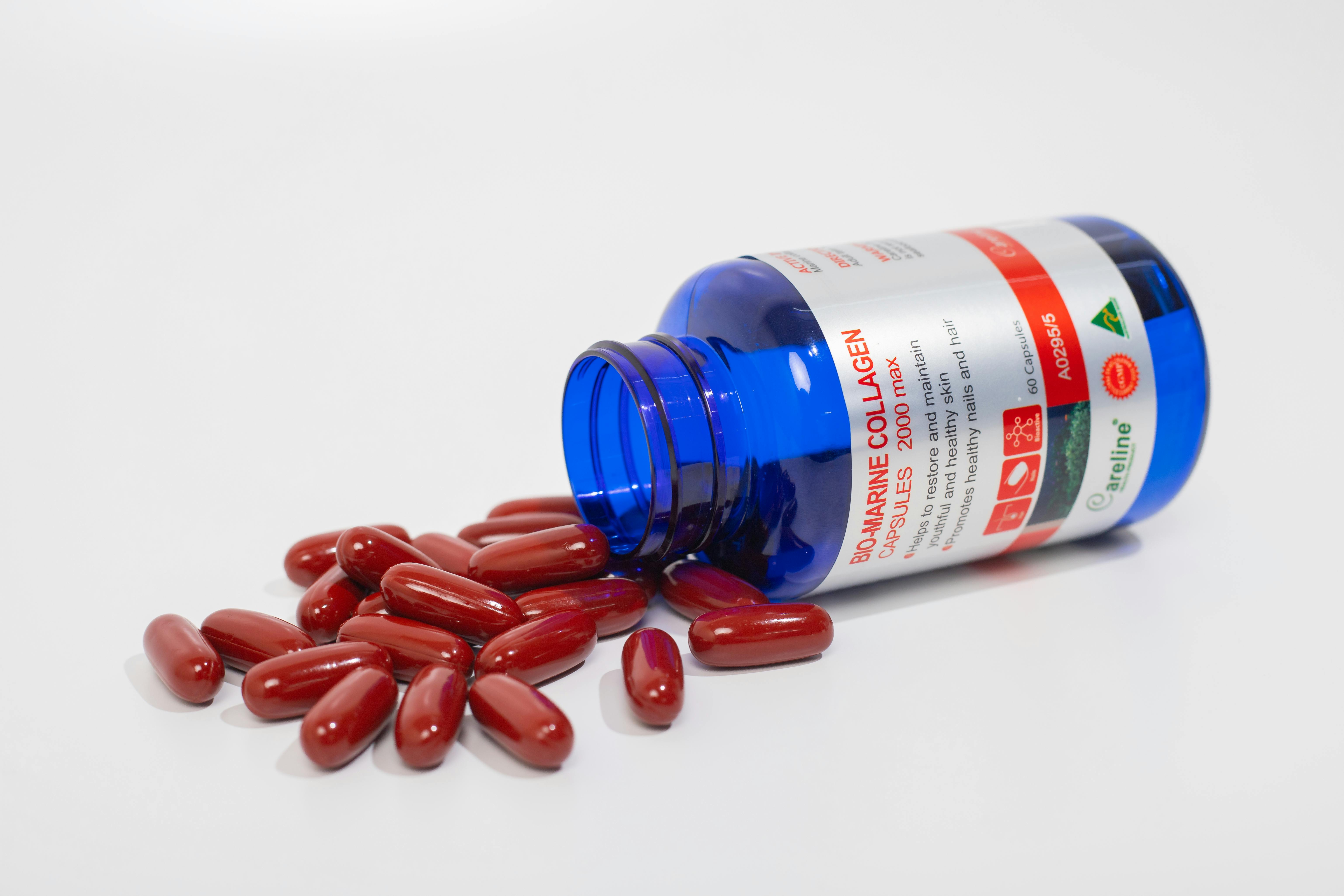
Hydrolyzed collagen (supplement)
The hydrolyzed peptide package — Type I, II, III collagen fractions and the joint-skin RCT evidence.
In 1 minute
What does it provide? Hydrolyzed (broken into small 2–10 kDa peptides) collagen with glycine (≈ 33%), proline (≈ 12%), and hydroxyproline (≈ 10%), plus small amounts of intact Pro-Hyp dipeptide — the latter acting as a signaling molecule to stimulate skin fibroblasts to produce collagen and hyaluronic acid (does NOT build directly into the skin). Proksch 2014 RCT: 2.5 g/day for 8 weeks improved skin elasticity. Konig 2018 RCT: 5 g/day for 1 year in postmenopausal women increased BMD.
How much? 10–15 g hydrolyzed collagen peptide per day for 8–12 weeks (clinical time horizon; 2 weeks is not enough). For skin, 2.5 g is already effective; for joints, 10 g minimum. Optimum: + 50 mg vitamin C (hydroxylation cofactor); 1 hour before exercise for athletes (Shaw 2017). Dissolves cold and hot.
When to avoid? Fish collagen + fish allergy (parvalbumin contamination — absolutely contraindicated); severe chronic kidney disease (CKD 4–5, dialysis — protein load); phenylketonuria (check amino acid profile); pregnancy/breastfeeding at high doses (sparse human data — bone broth acceptable, supplement not); active gout or histamine intolerance in sensitive individuals. Detailed contraindications in the dedicated section.
Collagen supplement science is relatively young — developing since the mid-20th century. In the 1950s, food-industry gelatin (unhydrolyzed collagen) was used in joint "cures," but peptide bioactivity in today's sense became known only when Japanese researchers (Iwai 2005) showed that after collagen peptide consumption Pro-Hyp dipeptide appears in human plasma — proving not all peptides break down to amino acids in the gut, and that small peptides may have signaling roles on fibroblasts. This discovery underpinned the industrial development of collagen peptide as a functional food ingredient.
In the 2010s, collagen became a star of wellness and "beauty from within" trends — "collagen creamer" mixed into coffee, smoothies, capsules exploded onto the market. Vital Proteins, NeoCell, and the German Gelita brands positioned it with major marketing budgets as a daily "anti-aging" ritual, and by the early 2020s the global collagen market reached multi-billion dollars. Clinical evidence meanwhile caught up: the Proksch 2014 skin elasticity RCT (Skin Pharmacol Physiol), the Choi 2019 meta-analysis, and the Bello-Oesser 2006 joint pain review confirmed a real (if modest) effect. Current advertising messages, however, are often overstretched: "rebuilds your skin's collagen" is a simplification — the effect is more an amino acid signal to fibroblasts, not direct substrate incorporation into the skin.
🔬 Scientific Background
Hydrolyzed collagen pharmacokinetics is well documented: most 2–10 kDa peptides break down to amino acids (Gly, Pro, Hyp) in the small intestine, but about 10–15% absorb as intact dipeptides (Pro-Hyp, Hyp-Gly), giving measurable plasma levels within 1–2 hours (Iwai 2005, Shigemura 2014). These dipeptides in vitro stimulate fibroblast hyaluronic acid and collagen synthesis, explaining the signaling mechanism hypothesis: NOT collagen peptide incorporation, but amino acid signaling to target cells.
Skin evidence is most robust. Proksch 2014 (Skin Pharmacol Physiol) 8-week, double-blind RCT showed 2.5 g hydrolyzed collagen peptide daily significantly improved skin elasticity in women aged 35–55 vs. placebo. Czajka et al. (2018, Nutr Res) with similar protocol confirmed hydration and wrinkle reduction. Choi 2019 (Nutrients) meta-analysis of 11 RCTs documented skin elasticity increase, hydration improvement, and wrinkle reduction, with moderate effect size.
On joint endpoints, Bello & Oesser 2006 (Curr Med Res Opin) systematic review showed 10 g hydrolyzed collagen/day in osteoarthritis patients achieves modest pain and stiffness reduction over 24 weeks. Kviatkovsky et al. (2019, Curr Sports Med Rep) in athlete joint complaints also found modest pain reduction. Clark KL 2008 (Curr Med Res Opin) in gelatin form with 24-week RCT showed similar results.
For bone, Konig 2018 (Nutrients) 1-year RCT in postmenopausal women showed 5 g collagen peptide/day significantly improved BMD at the femoral neck and spine. This is an interesting result, but limited to one cohort — replication needed. On the athlete ligament side, Shaw 2017 (Am J Clin Nutr) protocol with 15 g gelatin + 50 mg vitamin C 1 hour before exercise documented P1NP elevation, the collagen synthesis marker.
- + Vitamin C (75–100 mg or 1 orange/kiwi): required for hydroxyproline formation (collagen synthesis in fibroblasts). Shaw 2017 protocol recommends this 1 hour before exercise.
- + Copper, zinc, silicon (dietary or multi): cofactors for collagen cross-link formation (lysyl oxidase).
- + Morning coffee or smoothie matrix: collagen peptide is tasteless, dissolves well hot and cold, and already-hydrolyzed peptides are heat-stable (hot coffee does NOT break them).
- + 1 hour before exercise 10–15 g + 50 mg vitamin C: ligament support for athletes (Shaw 2017).
- + Hyaluronic acid supplement (50–100 mg/day): skin hydration synergistic endpoint.
- + Long-term, continuous regimen (8–12 weeks): clinical trial time horizon — 2 weeks not enough.
- + Complete protein source (meat, fish, egg, legumes) in the diet: because collagen ITSELF is NOT a complete protein.
- Iron supplementation at the same time: collagen peptide matrix may theoretically slow iron absorption — 2-hour separation recommended (practical effect small, but cautious).
- High purine intake (red meat + beer + collagen regimen): collagen is glycine-rich, but total protein load matters in gout.
- UC II (undenatured) collagen simultaneously with hydrolyzed collagen regimen: different mechanism (immune tolerance vs. substrate signal) — taken together not additive; dose confusion.
- Concurrent daily >15 g collagen + low tryptophan/cysteine intake: collagen is tryptophan-free; long-term "collagen monotherapy" can cause serotonin precursor deficiency.
- Fish collagen + known fish allergy: allergic reaction risk from parvalbumin contamination.
- High-dose collagen + severe CKD: protein load on kidneys.
- "Vegan collagen" products (just precursors) marketed as equivalent: vegan "collagen" is actually glycine, proline, vitamin C, zinc, copper — NOT collagen, just a building-block mix.
- Fish collagen + fish allergy: contraindicated.
- Beef/pork collagen in strict vegan/kosher/halal diet: avoid — choose fish collagen or alternative.
- Severe chronic kidney disease (CKD 4–5, dialysis): high protein load on kidneys, medical consultation.
- Phenylketonuria: check amino acid profile.
- Pregnancy, breastfeeding: sparse human data on high-dose collagen supplement; culinary bone broth acceptable, high dose not recommended.
- Histamine intolerance (especially fish collagen): rare but reported symptom.
- Unproven "anti-aging" expectation within 2 weeks: clinically documented effect appears after 8–12 weeks.
- Active gastric ulcer, severe GERD: the powder matrix may stress stomach in some sensitive individuals.
Daily serving: 10–15 g hydrolyzed collagen peptide powder (typically 1 large scoop or 1–2 sticks), 8–12 weeks continuously.
Intake patterns:
- Morning coffee/tea: 10 g collagen powder stirred in — tasteless, soluble.
- Smoothie: banana + berries + plant milk + 10 g collagen + 50 mg vitamin C (kiwi or ½ orange).
- Yogurt/cottage cheese: stirred in, + berries.
- 1 hour before exercise: 15 g gelatin/collagen + 50 mg vitamin C (Shaw 2017 ligament protocol).
- Salad dressing, soup: post-stirred in, dissolves better cold.
Label selection criteria:
- Source: beef (Type I + III), fish (Type I, smaller peptide, better absorption), chicken cartilage (Type II — UC II or hydrolyzed).
- Molecular weight: 2–5 kDa is the optimal industrial value.
- Pure peptide or "collagen complex": the latter often contains hyaluronic acid, biotin, vitamin C, but is more expensive — pure peptide often better value.
- Fish collagen is the kosher/halal or pescatarian alternative; avoid in fish allergy.
Storage: powder in closed, dark, cool place stable for 2 years. After opening, airtight.
What not to do: don't expect results in 2 weeks; don't combine 3 collagen products simultaneously; don't replace total protein intake with it.