


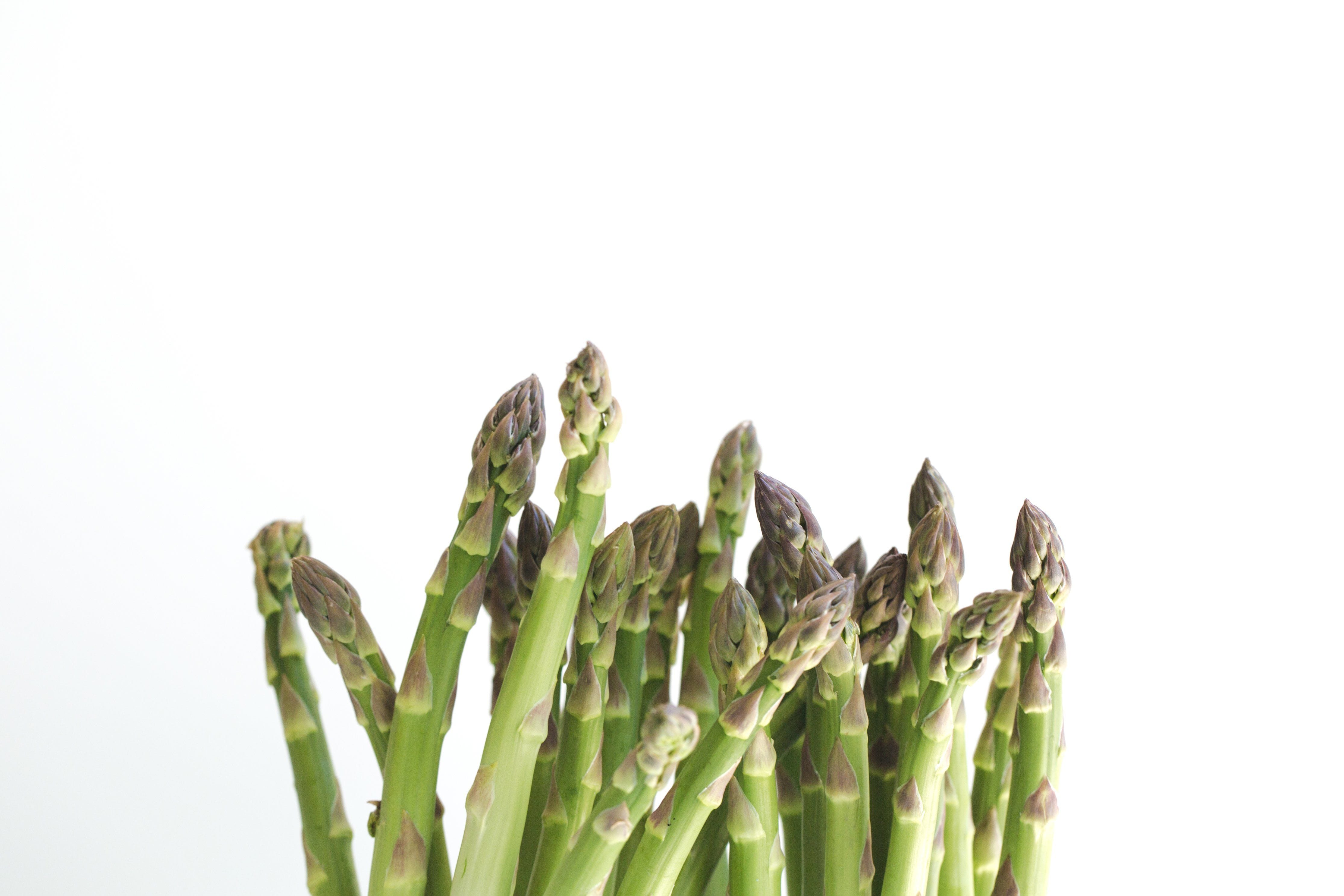
Asparagus
Queen of spring — inulin-type fructan and polyphenol, in spear and root alike.
In 1 minute
What does it provide? Inulin-type fructans (ITF — soluble, bifidogenic prebiotic fiber from the β-2,1 + β-2,6 branched "neo-series") and polyphenols (rutin, quercetin glycosides). RCT evidence: 2.5–5 g ITF/day already produces a Bifidobacterium increase, 5–10 g/day SCFA production and stool quality improvement — asparagus falls into this fraction. Asparagusic acid has mild diuretic effect.
How much? 6–8 spears (≈ 80–100 g) 2–3×/week during spring season (March–June). For IBS reintroduction, ≈ 12 g (⅔ spear). Short (4–6 min) steaming preserves ITF; 15+ min boiling with discarded liquid dramatically reduces it.
When to avoid? IBS elimination phase (first 4–6 weeks, high fructan), active gout attack and uncontrolled hyperuricemia (moderate purine), CKD 4–5 stage (potassium + purine load), with diuretics (furosemide, hydrochlorothiazide) or spironolactone (additive diuresis, electrolyte shift), lithium therapy (serum level rise).
Asparagus was highly valued in the ancient Mediterranean world: both Greek and Roman sources mention it, and in the Roman kitchen it was a seasonal delicacy served at wealthier households' tables in spring. The well-known imperial saying "velocius quam asparagi conquantur" ("faster than asparagus cooks") is attributed to Augustus — the general-turned-first-emperor used it to urge his soldiers, and the phrase reveals much about how evident the vegetable's quick preparation was at the time. Apicius's Roman cookbook preserves a specific asparagus recipe, and Pliny describes plantations surrounding the Ravenna Bay, where reportedly three common asparagus heads weighed one Roman pound. (Food Republic)
From late antiquity to the Renaissance it again spread more widely in Europe — monastery gardens preserved the cultivation tradition, and 16th–17th century botanical works discuss it in detail. In France, Louis XIV bestowed the title "vegetable of kings and king of vegetables" upon it, and in the Sun King's gardens, heated greenhouses cultivated it year-round for him. Modern cultivation of common green and foil-covered white asparagus varieties became industrial in Europe and North America in the 19th–20th centuries; today's German and Dutch asparagus seasons remain a gastronomic highlight of spring. (Food Republic)
🔬 Scientific Background
Asparagus's storage carbohydrates in both roots and spears are inulin-type fructans (ITF). The "neo-series" asparagus fructans have a special structure (β-2,1 + β-2,6 branching) and ferment well in the colon. According to the ISAPP 2017 prebiotic consensus, ITF is the best-documented prebiotic substrate class.
In human RCTs, ITF intake produces a bifidogenic effect from as little as 2.5–5 g/day (Bifidobacterium ratio increase), 5–10 g/day SCFA production and stool quality improvement, and ≥ 12 g/day reaches the EFSA-recognized "normal defecation maintenance" effect. Asparagus fructans belong to this class.
The polyphenol fraction (rutin, quercetin glycosides, caffeic acid derivatives) further strengthens microbiota activity: in vitro fermentation induced SCFA increase and Lactobacillus activity. Asparagus also has mild diuretic effects due to its asparagine, aspartic acid, and asparagusic acid content, and causes the classic "smelly urine" phenomenon depending on individual olfactory receptor polymorphisms.
- + Extra-virgin olive oil + lemon: classic Mediterranean pairing, polyphenol stabilization.
- + Egg (soft-boiled, poached): protein + choline + ITF — satiating, fiber-carrying meal.
- + Live cultures (yogurt, kefir): synbiotic principle — ITF + Bifidobacterium synergy.
- + Fiber-diverse side (oats, barley β-glucan, RS3 potato salad): broader SCFA profile.
- + Gentle heat (brief steaming or pan sautéing): maximizes ITF and polyphenol retention.
- Long vinegar pickling (pH ≤ 4, ≥ 60 °C, 30+ min): ITF hydrolysis — fructose forms, prebiotic yield decreases.
- Gout medication titration phase: moderate purine content — flare risk with large amounts.
- Iron supplementation + large polyphenol intake: time separation (≥ 2 hours).
- Lithium therapy: diuretic effect may theoretically raise lithium levels — medical supervision.
- Long boiling with discarded cooking water: ITF is water-soluble — return the liquid to soup/sauce.
- IBS elimination phase (FODMAP): avoid in the first 4–6 weeks; ⅔ spear for reintroduction.
- Gout (active attack, hyperuricemia trigger): moderate purine content — restraint.
- Severe kidney disease (CKD 4–5): potassium and purine load.
- Aldosterone antagonists (spironolactone): diuretic synergy, electrolyte monitoring.
- Diuretic users (furosemide, hydrochlorothiazide): additive diuresis with dehydration risk.
- Infant under 12 months: fibrous structure poses choking risk.
- Asparagus allergy (rare, IgE-mediated): avoidance.
Daily/weekly serving
Fresh asparagus: 6–8 spears (≈ 80–100 g) 2–3×/week during spring season (March–June).
Preparation pattern
- Bend the spear until it breaks — it snaps where it stops being woody.
- Green asparagus: no peeling needed. White asparagus: peel the lower 2/3.
- Steam 4–6 min (green) / 8–12 min (white); or pan sauté in oil 5–7 min.
- It's done when easily pierced with a knife but still crisp.
Classic patterns
Asparagus al pomodoro: brief sauté + tomato purée + Parmesan.
With hollandaise (classic): steamed asparagus + emulsified egg yolk/butter/lemon — classic plating for white asparagus.
Risotto agli asparagi: asparagus greens into risotto base + cooking liquid reincorporated.
Grilled + olive-lemon: green asparagus grilled 3–4 min, olive oil-lemon zest dressing.
Storage
Fresh: standing in water (like a bouquet in a vase) refrigerated 4–5 days. Cooked: refrigerated 2–3 days. Frozen: after blanching 8–10 months.
What not to do
Don't cook 15+ min — ITF loss and you get mush. Don't pickle in vinegar 30+ min. Don't cut the spear before cooking — water penetrates the cells and it becomes watery.
References
[1] Gibson GR et al. The International Scientific Association for Probiotics and Prebiotics (ISAPP) consensus statement on the definition and scope of prebiotics. Nat Rev Gastroenterol Hepatol 2017;14(8):491–502.
[2] EFSA NDA Panel. Scientific Opinion on chicory inulin and maintenance of normal defecation. EFSA Journal 2015;13(1):3951.
[3] Roberfroid M. Prebiotics: the concept revisited. J Nutr 2007;137(3 Suppl 2):830S–837S.
[4] Wang M et al. Bifidogenic effect of inulin-type fructans: a systematic review. Br J Nutr 2019.
[5] Sun W et al. Asparagus polysaccharides: structure and biological activity review. Food Chem 2022.
[6] Monash University. Asparagus FODMAP content. Monash FODMAP database.
[7] Mitchell SC. Food idiosyncrasies: beetroot and asparagus. Drug Metab Dispos 2001;29(4 Pt 2):539–543.
[8] Apicius. De re coquinaria. Liber III (Cepuros).