


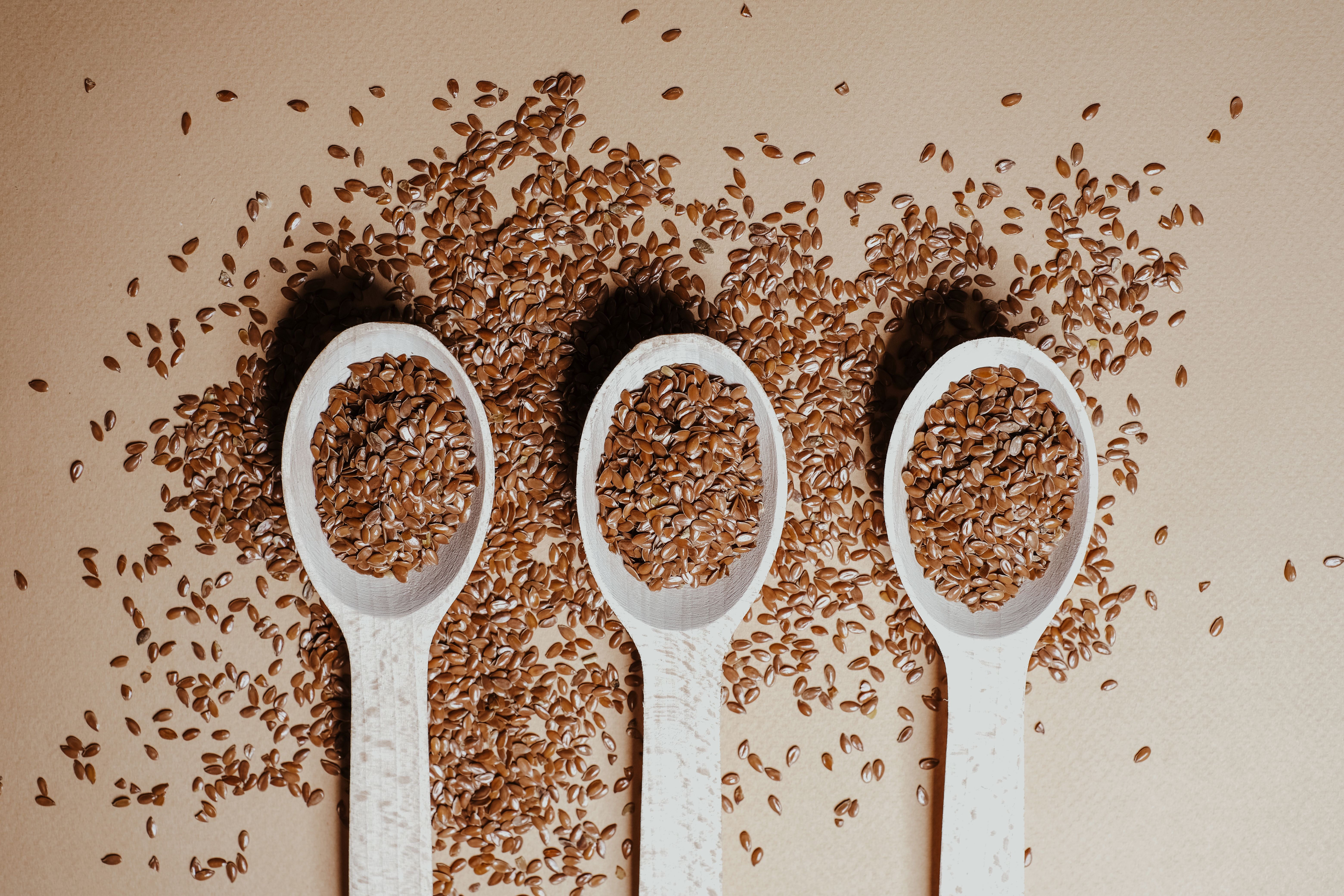
Flaxseed
The cloth of Egyptian mummies — mucilage fiber, lignans (SDG → enterolignans), and plant ω-3 in a single seed; six times stronger when ground.
In 1 minute
What does it provide? Mucilage fiber, lignans (mainly SDG → enterodiol and enterolactone by microbiota), α-linolenic acid (ALA, ω-3), and high insoluble fiber — a "prebiotic + postbiotic" dual matrix.
How much? 1–2 tbsp/day (≈ 10–20 g) FRESHLY GROUND. RCT protocols showed benefit with 10–30 g/day.
When to avoid? Whole-seed consumption (passes through unchanged!), anticoagulants + high ALA intake, hormone-sensitive tumor (ER+ breast cancer) — relatively, acute bowel obstruction, lignan goal during antibiotic course (temporarily weaker).
IMPORTANT: Whole flaxseed passes through the gut ALMOST ENTIRELY UNCHANGED! MUST BE GROUND.
Flax is among the earliest domesticated crops: linen made of flax fiber was widespread already in prehistory, and 30,000-year-old wild-flax fiber remains were described from Georgia's Dzudzuana Cave in the Upper Paleolithic layer — among the world's earliest known plant fiber thread remains. In ancient Egypt, linen was the material of priestly clothing and mummy wrappings; pictorial and material finds prove the species' cultural-historical importance. The shrouds that preserved the pharaohs' bodies forever were made from the very fabric whose seed we know today as the source of linseed oil — Egyptians revered flax as a sacred plant. Hippocrates also recommended it as medicine for abdominal complaints.
The Latin name of the species, usitatissimum, refers to the fact that it is "most useful" — the Linum seed served simultaneously as food (oil and meal) and textile fiber. Starting from the Mediterranean and the Fertile Crescent, flax spread across Europe by the Bronze Age and then to Asia; Charlemagne's 9th-century decree (Capitulare de villis) specifically ordered flax cultivation on royal estates, in part for its health effects. Until the 20th century, linen was one of the main sources of cheap and durable textiles; from the 1990s, the ALA, lignan, and fiber benefits sparked new scientific interest. Canada's Saskatchewan is today the world's leading flaxseed growing region — from where a significant portion of the entire global ALA market originates. **(PubMed, Wikipedia)
🔬 Scientific Background
Flaxseed's bioactive matrix rests on three pillars. Mucilage: soluble mucilage fiber (neutral arabinoxylan + acidic RG-I-type pectin) ≈ 8 g/100 g — forms a gel in contact with water, stool-softening + fermentable substrate. Lignans: flaxseed is BY FAR the highest lignan source in the human diet (≈ 300–370 mg SDG/100 g, 800× more than the next-highest source). SDG (secoisolariciresinol-diglucoside) is itself inactive; the colonic microbiome (especially Peptostreptococcus, Clostridium scindens, Eggerthella lenta) converts it into enterodiol and then enterolactone — these are the actual phytoestrogen-active metabolites. ALA: ≈ 23 g/100 g — one of the highest plant ω-3 sources.
Clinical evidence is strong in three areas. Constipation: several RCTs (Soltanian 2018, Khalesi 2015) show that ground flaxseed is more effective in constipation than psyllium and lactulose — defecation frequency and stool consistency are better. Insulin sensitivity and microbiome: Brahe 2015's 6-week RCT in postmenopausal obese women with 10 g/day flaxseed mucilage showed significant insulin sensitivity improvement and microbiota composition change (relative abundance of 33 species modified). Blood pressure and LDL: several meta-analyses (Khalesi 2015) show that flaxseed reduces systolic and diastolic blood pressure, LDL cholesterol, and CRP.
CRITICAL: Per Kuijsten 2005 RCT, GROUND flaxseed gives a 2–4× higher enterolignan response in plasma than whole seed. Antibiotic courses shake up the lignan-converting bacteria — enterolactone levels can be lower for months afterward.
- + GRIND FRESH! Flaxseed flash-ground in a coffee grinder has 2–4× higher bioavailability (lignan + ALA).
- + Plenty of fluid (≥ 200 ml/1 tbsp): mucilage only works hydrated — stool softening and buffering effect.
- + Yogurt/kefir + berries: synbiotic pattern — live culture supports lignan-converting bacteria.
- + Oatmeal or whole-grain muesli: β-glucan + mucilage synergy.
- + Cold use (smoothie, salad dressing): ALA preservation.
- + Soaking (overnight gel): maximum mucilage yield, especially good for constipation.
- + 1–3 months after antibiotic course: regular flaxseed intake supports the rebuilding of lignan converters.
- Fluid restriction + large flaxseed intake: mucilage without water can cause constipation, rarely obstruction.
- Anticoagulants (warfarin, DOAC) + large ALA intake (> 30 g/day): theoretical bleeding risk — culinary amounts safe.
- High heat, long baking (≥ 180 °C, 20+ minutes): ALA oxidation, lignan loss. Gentle use.
- Medications + large amount of mucilage at the same time: gel may bind active ingredients — time separation (≥ 2 hours). Especially levothyroxine, iron, antibiotics.
- Raw/unripe seed: cyanogenic glycoside (HCN release) — not a problem with ripe, commercial-quality flaxseed.
- Too large dose (> 5 tbsp/day): GI symptoms, HCN exposure may rise.
- Acute bowel obstruction, severe bowel stricture: to be avoided — viscous gel can cause obstruction.
- Hormone-sensitive tumor (ER+ breast cancer, prostate): lignans have weak phytoestrogen effects. Clinical data tend to show a BENEFICIAL effect (Lowcock 2013 reduced breast cancer risk), BUT consult a doctor during active chemotherapy.
- During tamoxifen or aromatase-inhibitor therapy: theoretical interaction with phytoestrogens — coordinate with oncologist.
- Anticoagulant therapy + intentional high flaxseed intake: medical consultation.
- During antibiotic course (for lignan goal): may give temporarily weaker enterolactone response — 1–3 months regeneration needed after the course.
- Infant (under 1 year): small amount can be given soaked; increased caution due to HCN sensitivity.
- 1–2 weeks before planned surgery: discontinue high-dose supplement-level flaxseed.
- Active diverticulitis flare: to be avoided, safe in remission.
- Chronic kidney disease: moderately high potassium — dose control.
Daily serving
1–2 tbsp (≈ 10–20 g) FRESHLY ground flaxseed. With plenty of fluid!
Preparation pattern
- Freshly ground: 5–10 seconds in a coffee grinder → immediately added to yogurt, oatmeal, smoothie.
- Soaked (overnight gel): 1 tbsp whole + 100 ml water, in the fridge overnight → just stir in the morning.
- Into baking (bread, muffins): ground into the dough mixture, at gentle heat.
Classic patterns
Breakfast oatmeal: rolled oats + 1 tbsp freshly ground flaxseed + berries + kefir drizzle.
Flaxseed pudding: 1 tbsp whole flaxseed + 150 ml plant milk + cinnamon + minimal honey → overnight.
Egg substitute (vegan baking): 1 tbsp ground flaxseed + 3 tbsp water → 5 minutes → replaces 1 egg.
Salad dressing: linseed oil + vinegar + Dijon mustard + freshly ground flaxseed sprinkled on top.
Flax bread: whole-grain flour + 2 tbsp ground flaxseed + water + yeast → high fiber + lignan.
Storage
Whole flaxseed: in an airtight jar, in a cool dark place — 1–2 years. Ground flaxseed: airtight in fridge, max 1 month (but prefer fresh grinding). Linseed oil: in a dark bottle, refrigerated, max 3 months.
What not to do
Don't eat whole (passes through unchanged). Don't store ground seed at room temperature. Don't bake above 180 °C for 30+ minutes. Don't mix with medications at the same time.
References
[1] Kuijsten A et al. The relative bioavailability of enterolignans in humans is enhanced by milling and crushing of flaxseed. J Nutr 2005;135(12):2812–2816.
[2] Brahe LK et al. Dietary modulation of the gut microbiota — a randomised controlled trial in obese postmenopausal women. Br J Nutr 2015;114(3):406–417.
[3] Soltanian N, Janghorbani M. A randomized trial of the effects of flaxseed to manage constipation, weight, glycemia, and lipids in constipated patients with type 2 diabetes. Nutr Metab (Lond) 2018;15:36.
[4] Khalesi S et al. Flaxseed consumption may reduce blood pressure: a systematic review and meta-analysis of controlled trials. J Nutr 2015;145(4):758–765.
[5] Lowcock EC et al. Consumption of flaxseed, a rich source of lignans, is associated with reduced breast cancer risk. Cancer Causes Control 2013;24(4):813–816.
[6] Schrenk D et al. (EFSA Panel CONTAM). Evaluation of the health risks related to the presence of cyanogenic glycosides in foods other than raw apricot kernels. EFSA Journal 2019;17(4):e05662.
[7] Adolphe JL et al. Health effects with consumption of the flax lignan secoisolariciresinol diglucoside. Br J Nutr 2010;103(7):929–938.
[8] Monash University. High and Low FODMAP foods. Monash FODMAP database.