


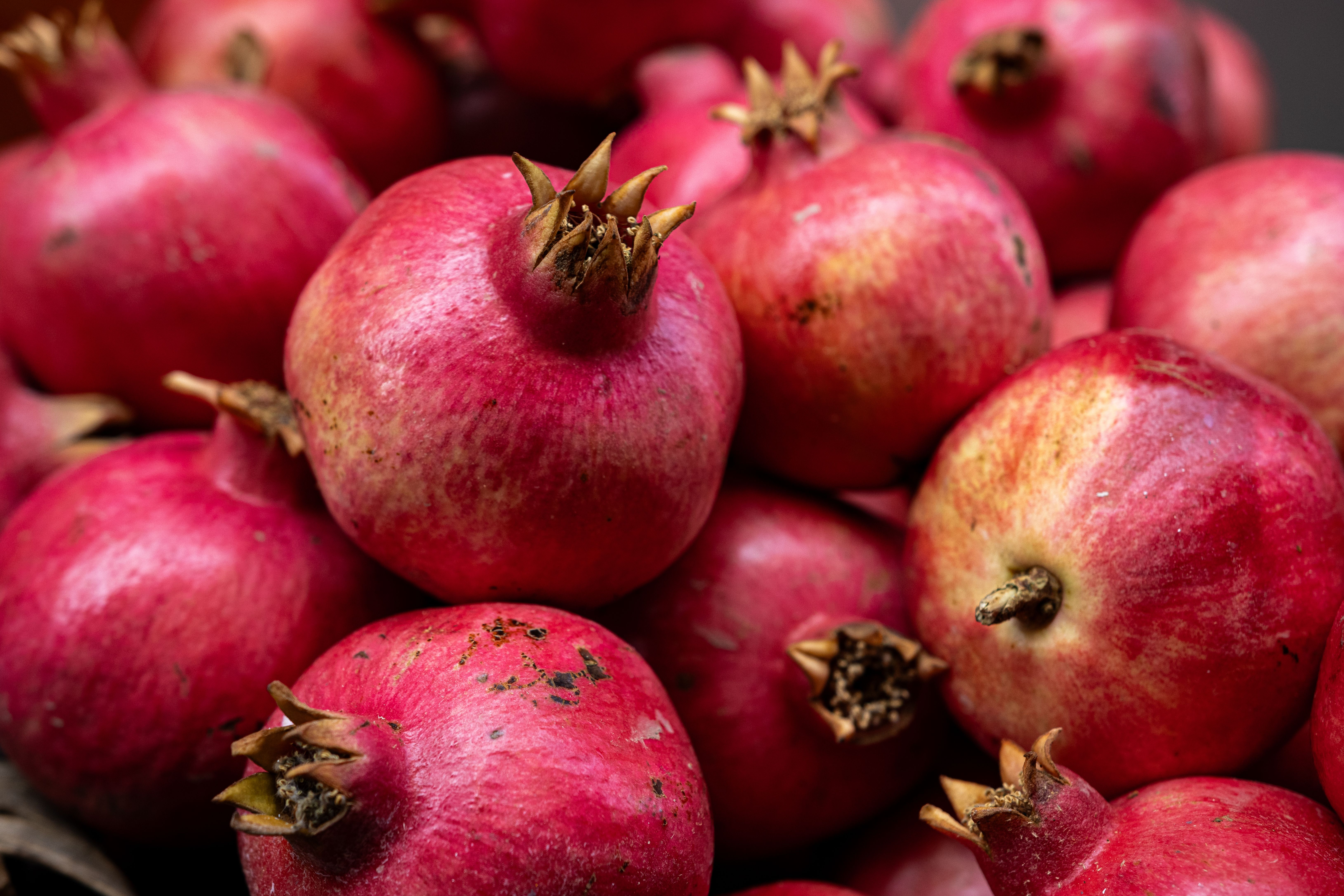
Pomegranate
Behind the Persephone-like seeds lies a microbiome trick: ellagitannins → urolithin-A, if your bacteria are right.
In 1 minute
What does it provide? Ellagitannins (punicalagin, punicalin — gut bacteria, especially the Gordonibacter genus, convert them to urolithin-A, which induces mitophagy and supports muscle energetics), anthocyanins (delphinidin and cyanidin pigments, microbiome-positive polyphenols), and fiber. About 10% of the population is "UM-0" metabotype — does not produce urolithin. RCT evidence: Pawełkiewicz 2024, 200 ml juice + inulin daily → more significant urolithin elevation, SCFA increase.
How much? Arils of ½–1 medium fruit (≈ 80–150 g) or 200–250 ml 100% fibrous juice/day. As a punicalagin extract, 250–1000 mg/day in studies. Grenadine syrup is sugary, polyphenol-poor — does not substitute.
When to avoid? Warfarin/DOAC treatment (CYP3A4 inhibition, INR fluctuation), with CYP3A4/2D6 substrates (some statins, immunosuppressants, antidepressants — medical consultation), ACE inhibitor + large dose (additive hypotension), calcium-oxalate kidney-stone tendency (moderate oxalate), infant under 1 year (seed aspiration), aphthous stomatitis or after dental procedure (tannin sting), Lythraceae allergy.
Pomegranate's homeland is today's Iran, Afghanistan, and the foothill belt of North India, where wild Punica granatum bushes already served as a blessed fruit in the Bronze Age. Archaeologists have found pomegranate seeds in Jordan, in the layers of ancient Jericho, and in Tutankhamun's tomb chamber (c. 1325 BCE) — the young pharaoh's silver pomegranate vase is still a favorite find of the Cairo Museum. Phoenician traders brought it to Carthage — from which the Roman name "malum punicum" (Punic apple) comes, and from which the "granat" family took root in the entire Indo-European vocabulary. Pliny already distinguished dozens of varieties, including "apyrenat," meaning seedless.
The fruit stood at the symbolic center of every ancient culture: in Greek mythology, Persephone ate seven pomegranate seeds in the underworld and thereby bound herself to Hades for the winter months; in Hebrew tradition, the number of 613 mitzvot was associated with the pomegranate's seed count. Early Byzantine craftsmen carved the tops of temple domes in pomegranate shapes as symbols of fertility and majesty. The Moors brought it with them to the Iberian Peninsula: the Andalusian city of Granada took its name and coat of arms from this fruit. Today it is grown not only in the Mediterranean, the Caucasus, and South Asia, but worldwide, and its earlier "superfruit" status in modern nutrition has been brought back into public awareness by punicalagin and urolithin research.
🔬 Scientific Background
Pomegranate's key bioactives are the hydrolyzable tannins: punicalagin and punicalin concentrate in the peel, the edible aril (seed coat) is of moderate content, and juice is variety- and technology-dependent. In the small intestine, ellagitannins hydrolyze to ellagic acid, which on its own only absorbs to a limited extent — the key step happens in the colon: the enzymes of Gordonibacter urolithinfaciens, G. pamelaeae, and Ellagibacter isourolithinifaciens convert it to urolithins (urolithin-A, B, C, D).
Urolithin-A is the clinically most significant metabolite: it induces mitophagy (removal of damaged mitochondria), and in small human RCTs (Andreux 2019) improved markers of muscle energetics (NAD+/ATP). People are classified by urolithin "metabotypes": UM-A (produce only urolithin-A, ≈ 70%), UM-B (urolithin-A + B + isourolithin, ≈ 20%), UM-0 (non-producers, ≈ 10%). Older populations and dysbiotic microbiomes are more often UM-0.
The González-Sarrías 2017 human RCT with 4 weeks of a punicalagin-rich extract showed elevation of SCFA-producing bacteria (Faecalibacterium, Roseburia) and plasma propionate increase. Xia 2024's human RCT with 200 ml/day of pomegranate juice + inulin combination produced more significant microbiome change and urolithin elevation than juice alone — confirming the polyphenol × prebiotic fiber synergy.
- + Prebiotic fiber (inulin/FOS, Jerusalem artichoke, chicory, onion): synergy documented in human RCTs for urolithin and SCFA production.
- + Yogurt, kefir: live culture + polyphenol — synbiotic breakfast.
- + Whole grains (AXOS, β-glucan): broader fermentation activity.
- + Olive oil, walnut, almond: fat aids polyphenol absorption, antioxidant synergy.
- + Fibrous juice vs. clarified juice: fibrous or cloudy juice retains more polyphenols and fiber.
- + Arils (seed coats) + meat/salad: chew the seeds, otherwise the coat is indigestible.
- Warfarin, DOACs: theoretical CYP3A4 inhibition and bleeding-enhancing effect — strict INR monitoring, clinical-dose supplements to be avoided.
- CYP3A4/CYP2D6 substrates (some statins, immunosuppressants, antidepressants): in vitro CYP inhibition — for sustained intake of clinical-dose juice/extract, medical consultation.
- ACE inhibitors (enalapril, lisinopril) + high dose: moderate blood-pressure-lowering effect — hypotension monitoring.
- Iron supplementation together: tannins can chelate non-heme iron — ≥ 2-hour separation.
- Sugary pomegranate syrup/"grenadine": concentrated sugar, little polyphenol — does not substitute.
- Prolonged high-heat cooking: anthocyanins break down — short heat or raw is more favorable.
- Warfarin or DOAC treatment: before introducing clinical-dose supplement/concentrated juice, INR monitoring and medical consultation.
- Severe hypotension tendency, hypotensive medications: blood-pressure-lowering effect can be additive.
- Active aphthous stomatitis, dental procedure: tannins and acids can sting.
- Lythraceae allergy: rare, but cross-reactivity with other family members possible.
- Infant (under 1 year): the seeds are an aspiration risk — sieved juice in moderate amounts.
- Kidney stones, on a high-oxalate diet: juice oxalate content is moderate — moderate the serving.
- Sustained uncontrolled diabetes: juice's glycemic effect is not negligible — as part of a meal.
- Coronary artery disease on medication: generally neutral or positive evidence, but consult regarding drug interaction.
Daily serving
Arils of ½–1 medium pomegranate (≈ 80–150 g) or 200–250 ml 100% fibrous/cloudy juice.
Preparation pattern
- Cut in half (in a bowl of water to avoid splashing).
- Tap out the arils from the back with a wooden spoon — fast method.
- Eat the arils raw or on salad, yogurt, muesli.
Classic patterns
Middle Eastern tabbouleh + arils: bulgur + parsley + mint + pomegranate arils + olive oil + lemon.
Yemeni "rummaniyya": lentil + eggplant + pomegranate syrup (molasses) — fermentation synergy.
Breakfast yogurt bowl: plain yogurt + arils + walnut + honey — synbiotic.
Salad topping: mixed greens + feta + walnut + arils + olive oil-balsamic vinegar dressing.
Fibrous juice: 250 ml 100% fibrous pomegranate juice (unsweetened, not from concentrate) in the morning or with a meal.
Storage
Whole pomegranate in fridge 1–2 months. Arils in fridge 5–7 days, frozen 6 months. Fresh juice in fridge 3–4 days, frozen 2–3 months.
What not to do
Don't cook long at high heat (anthocyanins break down). Don't choose sweetened "pomegranate juice cocktail" instead of 100% fibrous. Don't overdo it if you're on warfarin. Don't replace whole fruit with grenadine syrup.
References
[1] González-Sarrías A et al. Clustering of pomegranate ETs-metabolising enterotypes in humans. Mol Nutr Food Res 2017;61(5):1600830.
[2] Espín JC, García-Conesa MT, Tomás-Barberán FA. Nutraceuticals: facts and fiction. Phytochemistry 2007;68(22-24):2986-3008.
[3] Xia H, Zhang Y, Zhang Y et al. Pomegranate juice supplemented with inulin modulates gut microbiota and promotes the production of microbiota-associated metabolites in overweight/obese individuals: a randomized, double-blind, placebo-controlled trial. J Agric Food Chem 2024;72(15):8472-8484.
[4] Andreux PA et al. The mitophagy activator urolithin A is safe and induces a molecular signature of improved mitochondrial and cellular health in humans. Nat Metab 2019;1(6):595-603.
[5] Tomás-Barberán FA et al. Urolithins, the rescue of "old" metabolites to understand a "new" concept. Mol Nutr Food Res 2017;61(1):1500901.
[6] Cerdá B et al. Identification of urolithin A as a metabolite produced by human colon microflora from ellagic acid. Eur J Nutr 2005;44(8):491-499.
[7] Selma MV et al. The gut microbiota metabolism of pomegranate or walnut ETs yields urolithins. Food Funct 2014;5(8):1779-1784.
[8] Larrosa M et al. Anti-inflammatory properties of a pomegranate extract and its metabolite urolithin-A. Mol Nutr Food Res 2010;54(3):311-322.
[9] Monash University. High and Low FODMAP foods. Monash FODMAP database.