


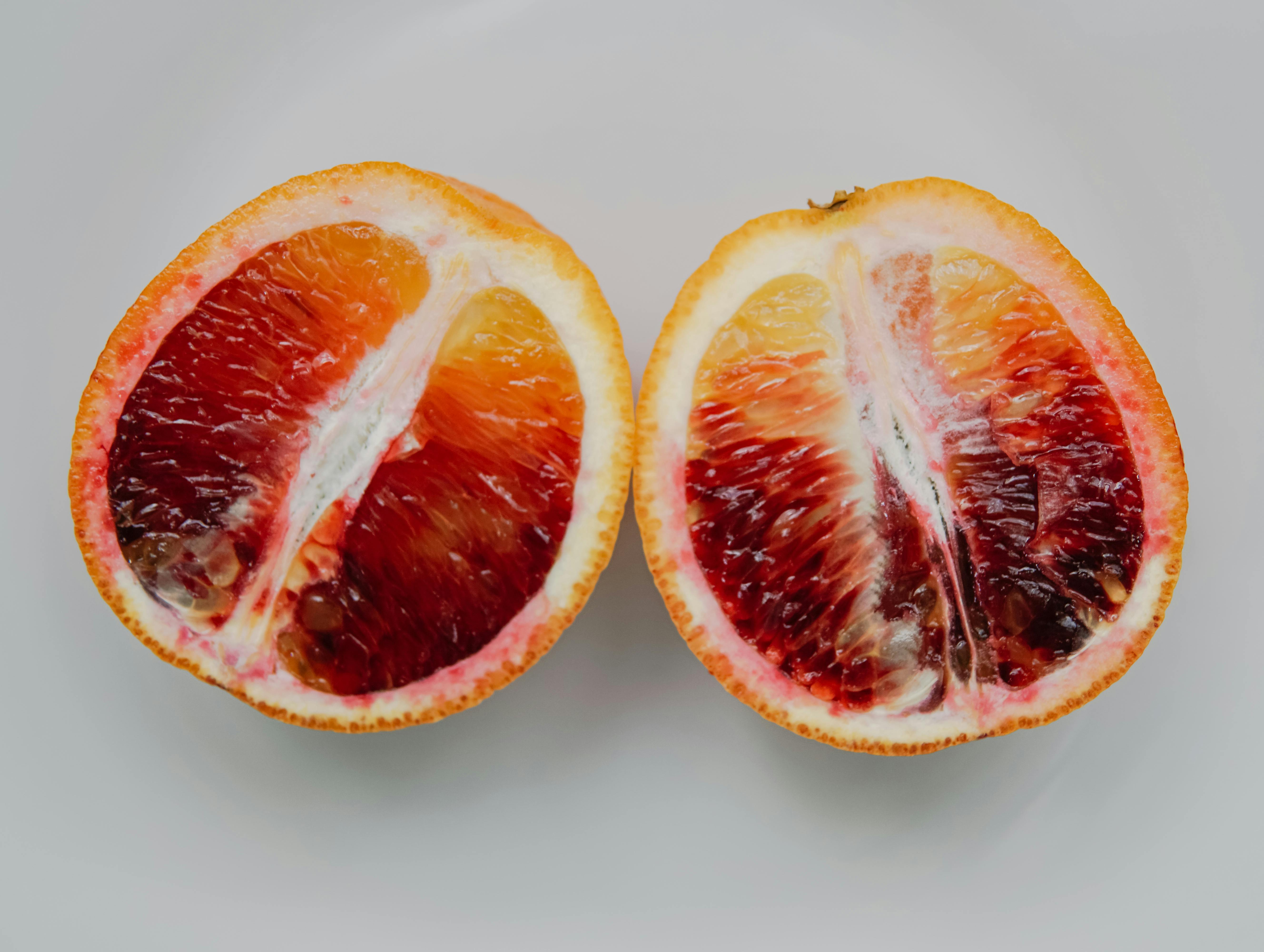
Citrus (orange, blood orange)
Treasures of the Renaissance orangerie — hesperidin, naringin, and a CYP3A4 trap worth knowing.
In 1 minute
What does it provide? Flavanones (hesperidin and narirutin — citrus-specific polyphenols, endothelial and vascular wall supportive), pectin, vitamin C (≈ 53 mg/100 g), carotenoids — the peel, albedo (white part), and membranes are polyphenol-rich.
How much? 1 medium orange (≈ 130 g) per day or 200 ml fresh juice with a meal. Hesperidin supplement: 200–500 mg/day.
When to avoid? Grapefruit/bitter orange with CYP3A4-substrate medications (separately calcium channel blockers — e.g., amlodipine — and separately statins — e.g., simvastatin, atorvastatin — are affected); acute reflux flare; citrus allergy. (Sweet orange is NOT a CYP3A4 inhibitor.)
The orange's origin is rooted in the South China–Northeast India–Myanmar region, where Chinese historical texts from as early as the 4th–3rd century BCE mention a similar fruit under the name "kan-ju," meaning golden apple. According to modern genomic analyses, sweet orange (Citrus sinensis) is not a botanical accident but came from a deliberate or accidental cross of two ancestral parent types, mandarin (C. reticulata) and pomelo (C. maxima) — and this hybrid still "backcrosses" with its parent species today. The bitter orange (C. aurantium) was brought to Sicily and Spain by Arabs already in the 9th–10th centuries, while sweet orange only arrived at the end of the 15th century on Portuguese trader ships.
In Renaissance Europe, the orange became a symbol of luxury: the Medici family (Cosimo I) built the world's first large-scale greenhouse "limonaia" at Villa di Castello in Florence in the 1550s to protect their valuable citrus from winter frost, and centuries-old specimens survived the winter in Louis XIV's "Orangerie" at Versailles. Blood orange (Tarocco, Moro, Sanguinello) is a Sicilian mutation — anthocyanin-rich, requiring cool nights — and even today only fully develops at the foot of Mount Etna. James Lind's famous 1747 citrus scurvy experiment on the HMS Salisbury also launched the medical career of citrus fruits. From the 19th–20th centuries Florida and São Paulo became the engines of global production, and citrus has become one of the world's most important fruit industries.
🔬 Scientific Background
Orange's main polyphenols are the flavanones: hesperidin (hesperetin-7-O-rutinoside) and narirutin (naringenin-7-O-rutinoside) — glycoside forms that absorb poorly in the small intestine. The key step happens in the colon: the microbiota deglycosylates them to the aglycones (hesperetin, naringenin), then breaks them down into smaller phenolic acids. This "enzyme-distributed" bioavailability explains why the clinical effect is person-dependent.
The clinical human RCT evidence is strongest on cardiovascular endpoints: Morand 2011 RCT — 500 ml orange juice/day for 4 weeks → endothelial function (FMD) improvement, diastolic blood pressure reduction. The HESPER-HEALTH protocol (Constans 2015) is a series of standardized hesperidin studies — with endothelial + microbiome endpoints. Blood-orange juice (Buscemi 2012 human RCT) gave anthocyanin-additive significant endothelial function (FMD) improvement and inflammation marker (hsCRP) reduction in metabolic syndrome patients.
At the microbiome level, Pereira-Caro 2014's human PK study showed that the plasma appearance of colonic metabolites of flavanones (hesperetin-, naringenin glucuronides) after 250 ml orange juice clearly indicates microbial deglycosylation. The microbiota breaks down flavanone glycosides in the colon into phenolic acids, and in vitro RCTs have shown elevation of Roseburia/Eubacterium (butyrate-producing) taxa.
Clinical trap — the CYP3A4–grapefruit–bitter orange interaction: the furanocoumarins (bergamottin, 6',7'-DHB) of grapefruit (Citrus paradisi) and bitter orange (C. aurantium) are irreversible CYP3A4 inhibitors — interacting with more than 85 medications. Sweet orange (C. sinensis) does NOT belong here — this is the most common clinical misunderstanding.
- + Whole fruit with membrane (pith): hesperidin is more concentrated in the albedo/membrane fraction than in the flesh.
- + Spinach, kale: vitamin C + non-heme iron — improved iron absorption.
- + Olive oil, walnut: fat aids carotenoid and polyphenol absorption.
- + Yogurt, kefir: flavanone × live culture synergy.
- + Whole grain (AXOS): broader fermentation activity.
- + Fresh, flavored with zest: small amount of hesperidin concentrate.
- Grapefruit/bitter orange + statins, calcium channel blockers, immunosuppressants, sildenafil: CYP3A4 inhibition with dangerous interactions. Sweet orange is safe.
- Iron supplementation - polyphenol chelation: flavanones don't substantially chelate, but tea tannin does — orange juice pairing with iron is positive (improves vitamin C absorption).
- Chronic aspirin use + high orange juice intake: theoretical gastritis aggravation, clinically not critical.
- Sugary orange juice concentrate: glycemic bomb, polyphenol-poor — fresh is recommended.
- Urinary pH-raising medications (some antibiotics): citrus alkalizes the urine — rarely a problem.
- Acid-sensitive on an empty stomach: more tolerable with a meal.
- GERD/reflux flare, acute gastritis: acid content may provoke — more tolerable at the end of a meal.
- Aphthous stomatitis, freshly extracted tooth: acid sting.
- Kidney stones, oxalate restriction: moderate oxalate — moderate serving.
- Citrus allergy (rare): to be avoided, with known cross-reactivity with quince, fruit LTP.
- Tooth enamel sensitivity: don't brush teeth for 30 minutes after eating an orange (softened enamel).
- Migraine trigger sensitivity (citrus): in a small minority, orange may provoke.
- Diabetes uncontrolled long-term, orange juice consumption: gives a glycemic peak — whole fruit is better.
- In diabetes: whole orange is better than juice (fiber moderates the peak).
Daily serving
1 medium orange (≈ 130 g) whole — or 200 ml freshly squeezed juice with a meal.
Preparation pattern
- Wash thoroughly, especially if using the zest.
- Peeled, segmented: eat with the white membrane — more hesperidin.
- Fresh squeezed juice: drink immediately or within 24 hours; not pasteurized concentrate.
- Zest: in small amounts for pastry, salad, fish.
Classic patterns
Classic breakfast: 1 orange + oatmeal + walnut + coffee.
Blood-orange-pine-nut salad: blood-orange segments + pine nuts + arugula + olive oil — anthocyanin × polyphenol.
Mediterranean fish with orange sauce: baked cod + orange juice + garlic + parsley.
Moroccan "tagine" with orange-blossom water: chicken + olives + preserved lemon + orange.
Traditional "suprema": orange segments (without the white membrane) — as an appetizer, in salad.
Storage
In a cool pantry 1–2 weeks, in fridge 3–4 weeks. Fresh juice in fridge 24–48 hours. Zest frozen 6 months. Dried (candied or dried): 6–12 months.
What not to do
Don't brush teeth for 30 minutes after orange. Don't choose concentrate instead of fresh. Don't discard the albedo (hesperidin source). Don't combine with grapefruit if you take a CYP3A4-substrate medication.
References
[1] Morand C et al. Hesperidin contributes to the vascular protective effects of orange juice: a randomized crossover study in healthy volunteers. Am J Clin Nutr 2011;93(1):73-80.
[2] Constans J et al. HESPER-HEALTH protocol: hesperidin and cardiovascular health. Eur J Clin Nutr 2015;69(6):737-742.
[3] Buscemi S et al. Effects of red orange juice intake on endothelial function and inflammatory markers. Am J Clin Nutr 2012;95(5):1089-1095.
[4] Pereira-Caro G et al. Orange juice (poly)phenols are highly bioavailable in humans. Am J Clin Nutr 2014;100(5):1378-1384.
[5] Tomás-Barberán FA, Andrés-Lacueva C. Polyphenols and health: current state and progress. J Agric Food Chem 2012;60(36):8773-8775.
[6] Bailey DG et al. Grapefruit-medication interactions: forbidden fruit or avoidable consequences? CMAJ 2013;185(4):309-316.
[7] Wu T et al. Hesperidin gut microbiota interactions: a review. Crit Rev Food Sci Nutr 2020;60(8):1339-1353.
[8] Lind J. A Treatise of the Scurvy. Edinburgh: Sands, Murray & Cochran, 1753.
[9] Monash University. High and Low FODMAP foods — orange portion.