

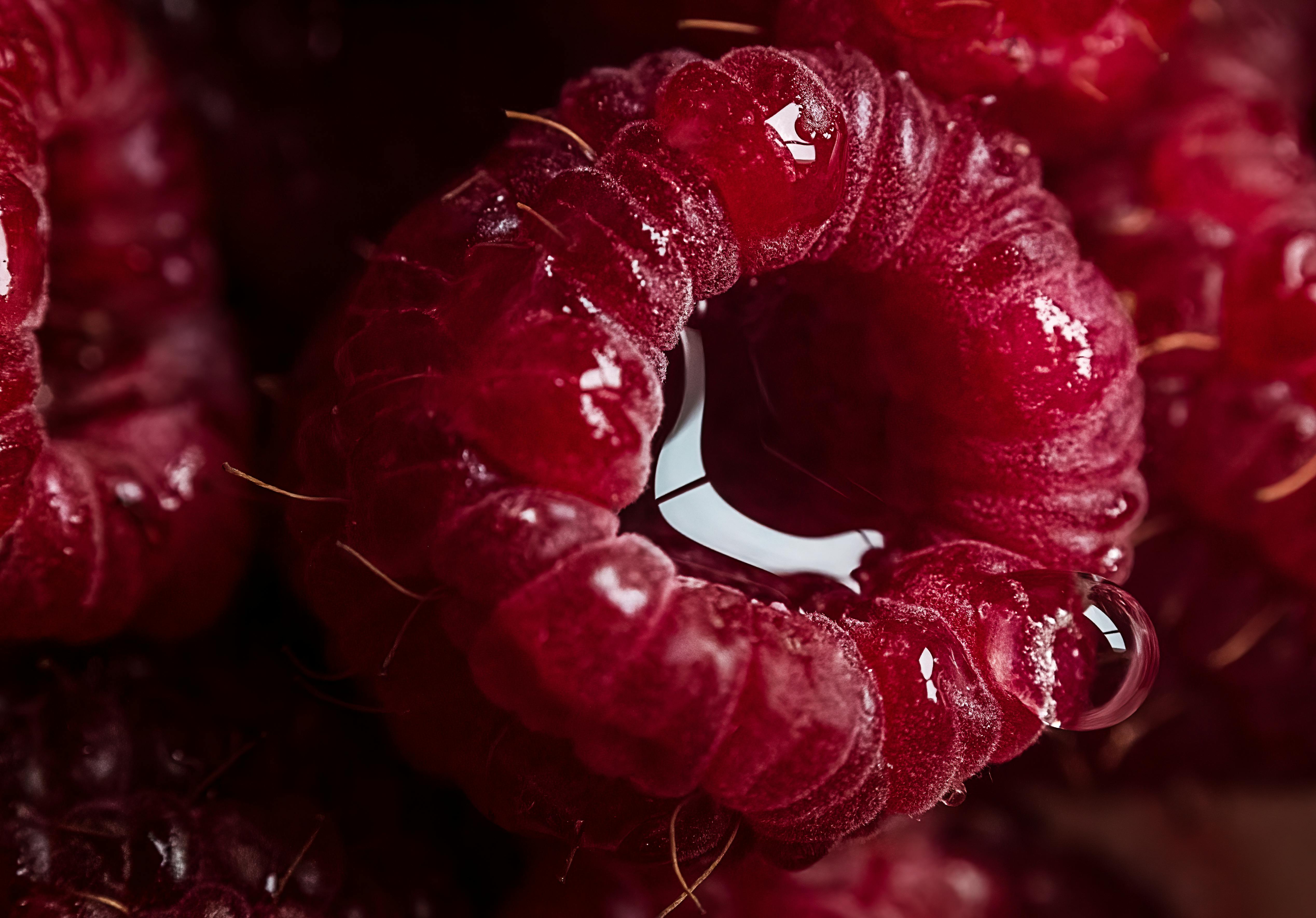
Raspberry
The sacred fruit of Mount Ida — ellagic acid, seed fiber, and gut flora improvement documented in prediabetes.
In 1 minute
What does it provide? Ellagitannins (sanguiin H-6, lambertianin C), ellagic acid, anthocyanins (cyanidin-3-sophoroside, -glucoside, -sambubioside), pectin and seed fiber (≈ 6 g/100 g), and small amounts of raspberry ketone — a fermentable matrix for urolithin and SCFA production.
How much? Daily 60–125 g fresh or frozen raspberry. In a clinical prediabetes RCT, 125 g "fresh-equivalent" (RRB).
When to avoid? Rosaceae allergy (OAS), nickel sensitivity, aspirin sensitivity, severe diverticulitis flare (seeds are a concern).
The botanical name of raspberry — idaeus — preserves the image of a mythical place: according to Greek tradition, the raspberry grew on Mount Ida near Troy, where the gods rested. In Ovid's Metamorphoses, raspberry was originally white, and the wounded blood of Ida, Zeus's nymph nurse, stained the fruit red forever. Pliny in his Naturalis Historia mentions it as "Idaean bramble"; sources indicate that Pompey brought it to Italy from the regions around Troy as a Roman cultivated variant.
Medieval monastic herbal schools — particularly Hildegard von Bingen's 12th-century notes — gave raspberry leaf and root decoction in the months before childbirth, citing its astringent action — the "raspberry leaf tea" tradition lives on today in the practice of many midwives. The 16th–17th-century English and French gardening literature describes separate wild and cultivated varieties; John Parkinson's 1629 "Paradisi in Sole" specifically mentions red and white raspberry cultivars. In the 1900s, Canadian and Scottish breeding launched the series of modern large-fruited cultivars; Glen Ample (1995) and Tulameen are leading worldwide varieties today. An interesting note: the raspberry seed is one of the greatest archaeobotanical survivors — 5,000-year-old seed remains have been found at Scandinavian settlements.
🔬 Scientific Background
Raspberry has the highest ellagitannin content among berries: sanguiin H-6 and lambertianin C are the principal dimer/trimer forms. They are partially hydrolyzed to ellagic acid in the small intestine, then converted by colonic microbiota to urolithins — the same UM-A/UM-B/UM-0 metabotype system applies as with pomegranate and strawberry. The anthocyanin profile is cyanidin-dominant (versus the pelargonidin dominance of strawberry).
The standout pillar of clinical human evidence is the Xiao 2019 randomized crossover trial in prediabetic adults: 4 weeks of 125 g daily "fresh-equivalent" raspberry (RRB) → microbiome modulation, a ≈ 4× increase in Bifidobacterium proportion when combined with FOS (8 g/day), reduction of Ruminococcus gnavus, and moderation of plasma glucose and insulin resistance. Ludwig 2015 mapped the excretion pathways of anthocyanin and ellagitannin metabolites after 300 g of raspberry in a human PK study.
The seed fiber and pomace of raspberry (seed + skin byproduct) are also valuable — in vitro human fecal fermentation shows SCFA elevation and a bifidogenic effect. Raspberry ketones are present in small amounts, but the concentrated form in "fat-burner" supplements is predominantly synthetic, and clinical evidence for a weight-loss effect is lacking.
- + FOS/inulin (Jerusalem artichoke, chicory, alliums): synergy on Bifidobacterium documented in human RCT.
- + Yogurt, kefir: synbiotic synergy — live culture + polyphenol/fiber.
- + Oat β-glucan: dual fiber matrix.
- + Dark chocolate (70%+): classic dessert polyphenol synergy.
- + Flaxseed (lignans): polyphenol crossover, inflammation reduction.
- + Nuts: fat + polyphenol absorption.
- Sweetened raspberry syrup, jam as a fiber source: concentrated sugar.
- Whipped cream in large amounts: partial polyphenol block (casein).
- Iron supplementation simultaneously with polyphenol-rich raspberry: ≥ 2-hour separation.
- Long, high-heat cooking: anthocyanin loss.
- Chronic aspirin/NSAID use + huge raspberry servings: salicylate additivity (clinically minor).
- Lactobacillus-fermented raspberry syrup overdosed in FODMAP-sensitive individuals: small portion fine, too much causes bloating.
- Rosaceae allergy (apple, pear, strawberry): cross-reactivity possible.
- Birch pollen allergy, OAS: small symptom cluster.
- Nickel allergy (systemic): moderate Ni content.
- Severe acute diverticulitis flare: seeds to be avoided in acute phase.
- Aspirin sensitivity: moderate salicylate.
- Active aphthous stomatitis: acid may sting.
- Infant (under 8–10 months): allergen sensitivity, introduce in small portions.
- Kidney stones, oxalate restriction: moderate oxalate — 100–150 g/day is safe.
- Raspberry leaf tea during pregnancy: cautious beyond the 3rd trimester as well; clinical consensus is mixed.
- Strong histamine sensitivity: may rarely cause problems (raspberry is a moderate histamine releaser).
Daily serving
60–125 g fresh or frozen raspberry. IBS-sensitive: 60 g (≈ 30 berries) — low-FODMAP portion.
Preparation pattern
- Wash gently (very soft fruit).
- Raw: as a snack, on salad, on yogurt, in muesli.
- Frozen: in smoothies, quick compote.
- Pureed, sieved (seedless): for sauce, parfait — though the seed fiber is lost this way.
Classic patterns
Classic breakfast: oatmeal + raspberry + walnut + flaxseed.
Raspberry-chocolate dessert: 70% dark chocolate + raspberry + almond flakes.
Raspberry-rhubarb compote: brief heat (10 minutes) without sweetener.
"Frangipane" almond cake with raspberry: brief baking (180 °C, 30 minutes) — anthocyanin loss moderate.
Smoothie: raspberry + yogurt + oats + flaxseed.
Raspberry soup (Scandinavian): raspberry + water + a little honey + cream — cold, summery.
Storage
Fresh refrigerated 1–2 days (spoils quickly). Frozen (unwashed, spread out for freezing) 8–12 months. Dried 6 months.
What not to do
Don't pre-wash for storage (rapid spoilage). Don't cook for a long time at high heat. Don't choose sweetened syrup over fresh. Don't overdo it during a diverticulitis flare.
References
[1] Xiao D et al. Red raspberries supplementation modifies microbial composition and metabolism in prediabetic adults. J Berry Res 2019;9(2):243-256.
[2] Ludwig IA et al. New insights into the bioavailability of red raspberry anthocyanins and ellagitannins. Free Radic Biol Med 2015;89:758-769.
[3] Burton-Freeman BM et al. Red raspberries and their bioactive polyphenols: cardiometabolic and neuronal health links. Adv Nutr 2016;7(1):44-65.
[4] Mazur SP et al. Quality and chemical composition of ten red raspberry cultivars. Food Chem 2014;160:233-240.
[5] McDougall GJ et al. Anthocyanins from red wine — their stability under simulated gastrointestinal digestion. Phytochemistry 2005;66(21):2540-2548.
[6] Tomás-Barberán FA et al. Urolithins, the rescue of "old" metabolites. Mol Nutr Food Res 2017;61(1):1500901.
[7] Bobinaitė R et al. Phenolic compounds and antioxidant activities of raspberry cultivars. Food Chem 2012;132(3):1495-1501.
[8] Monash University. Raspberry — low FODMAP portion 60 g.
[9] Holton TR. The case for raspberry ketones in weight loss — a critical review. Obes Rev 2017;18(2):237-249.