
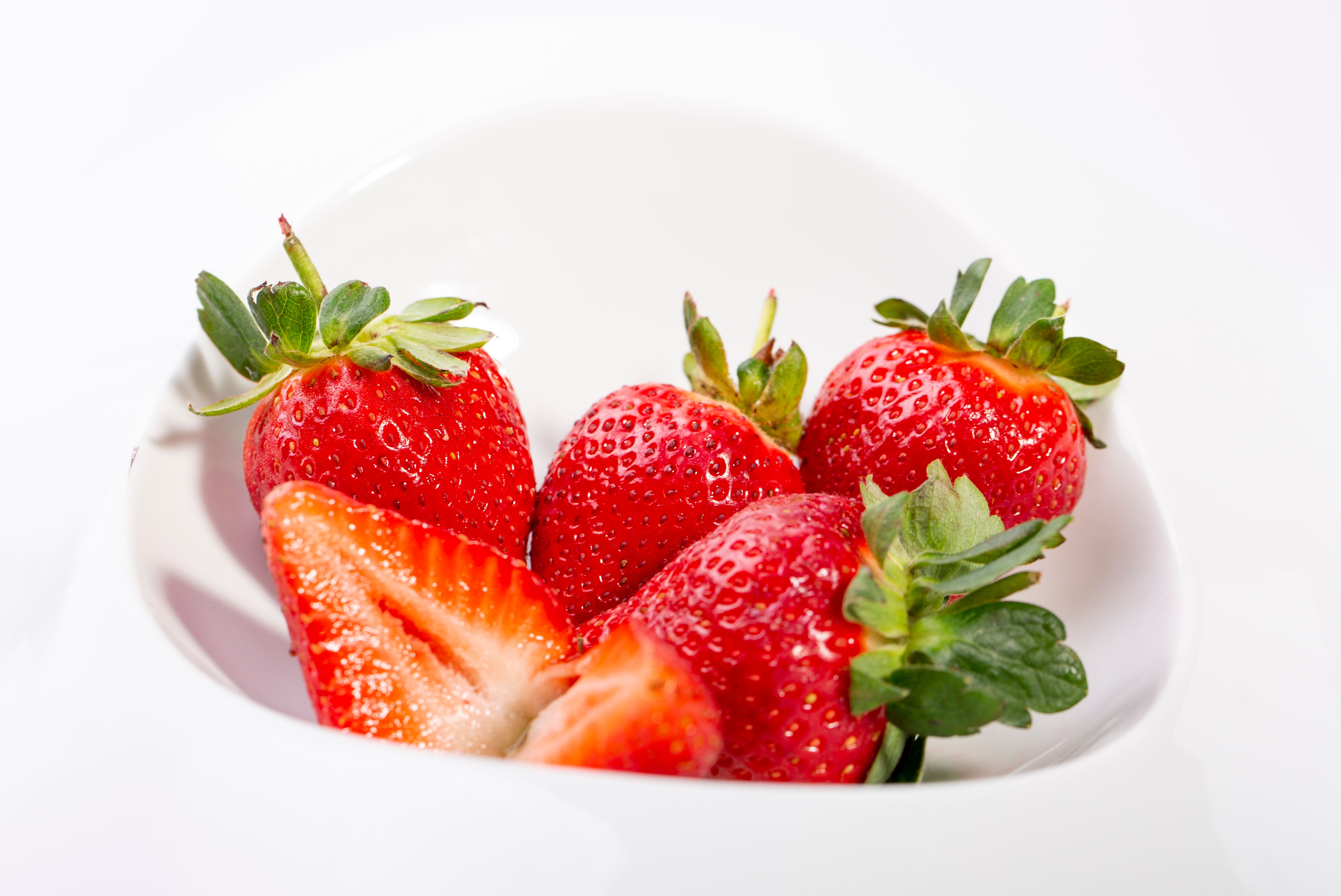
Strawberry
18th-century botanical serendipity — pelargonidin anthocyanin and ellagitannins in a single summer berry.
In 1 minute
What does it provide? Anthocyanins (predominantly pelargonidin-3-O-glucoside), ellagitannins → urolithin-A (microbiota-dependent), vitamin C (≈ 59 mg/100 g, higher than lemon), pectin, and small amounts of manganese plus folate.
How much? Daily ≈ 100–150 g (≈ 7–10 medium berries) — fresh or frozen. IBS-low FODMAP: 65 g.
When to avoid? Rosaceae allergy (OAS — birch pollen cross-reactivity), nickel allergy (strawberry has high Ni content), aspirin sensitivity (moderate salicylate).
The Romans already knew the wild woodland strawberry (Fragaria vesca) — Pliny called it "fragum," and Ovid considered it a symbol of the Golden Age — yet today's strawberry, the garden strawberry, owes its existence to an 18th-century accident. In 1714, Amédée-François Frézier, a French military engineer who had come to Chile on a Spanish reconnaissance mission, brought home five small "frutilla" plants (Fragaria chiloensis) on the long ocean voyage across the continent. Planted in Brest, Brittany, the all-female mother plants would never have borne fruit had the Virginia strawberry (F. virginiana) not also moved into the garden at the same time — the spontaneous cross between the two species produced F. × ananassa, the ancestor of today's strawberry.
The young botanist Antoine Nicolas Duchesne published his monograph "Histoire naturelle des fraisiers" on the new species in 1766 (at age 18) — the work remains a classic exemplar of botanical literature. The modern cradle of the strawberry was 19th-century England — the Keen's Seedling and Wilson cultivars were born here — and from there it spread around the world. An interesting linguistic twist: the Hungarian word "eper" originally referred to the mulberry tree's fruit (Morus) and only later shifted meaning to Fragaria — which is why the word "szamóca" is also accurate. Today strawberry is the world's most widely grown berry, and accelerated breeding programs have produced several hundred cultivars.
🔬 Scientific Background
The bioactive matrix of strawberry is unusual: the main anthocyanin is pelargonidin-3-O-glucoside (the principal carrier of the red color) — in contrast to the cyanidin- or delphinidin-dominance of most berries. Ellagitannins (particularly sanguiin H-6) are partially hydrolyzed to ellagic acid in the small intestine, then converted by the colonic microbiota to urolithins (urolithin-A, B) — the same metabotype system applies as with pomegranate (UM-A, UM-B, UM-0).
The best pillars of clinical human evidence: (1) Park 2022 RCT — 6-week freeze-dried strawberry powder 26 g/day → elevation of "health-associated" bacteria (Roseburia, Akkermansia). (2) Sandhu 2018 human pilot — 10-week strawberry-based diet in older adults → microbiome diversity increase. (3) Lee 2018 human PK study showed that heat-treated strawberry puree produces urolithins similarly to fresh strawberry — processing does not drastically degrade the ellagitannin → urolithin conversion.
Older studies with ellagitannin-rich berry mixes (strawberry + raspberry + blueberry; Puupponen-Pimiä 2013) showed significant lipid and inflammation marker reductions. The urolithin response is strongly metabotype-dependent.
- + Yogurt, kefir (classic "strawberry yogurt"): synbiotic synergy.
- + Oat β-glucan (strawberry yogurt + oats): dual fiber matrix.
- + Spinach, kale: vitamin C + non-heme iron absorption boost.
- + Nuts (almonds, walnuts): fat + polyphenol absorption enhancement.
- + Prebiotic fiber (inulin/FOS): polyphenol × fiber for broader urolithin enhancement.
- + Dark chocolate (70%+): classic polyphenol synergy in dessert.
- Heavy cream in large amounts: milk protein (casein) partially blocks polyphenol absorption — small portions are fine, "strawberries and cream" excess is not.
- Sweetened strawberry jam as a fiber source: concentrated sugar, not equivalent.
- Iron supplementation simultaneously with polyphenol-rich strawberry: slight chelation — ≥ 2-hour separation (though strawberry's vitamin C content actually helps iron absorption meaningfully).
- Long, high-heat cooking: anthocyanin loss.
- Extended storage at room temperature: rapid spoilage, polyphenol loss.
- Massive quantities alongside chronic aspirin use: additive effect due to salicylate content (minor clinical significance).
- Rosaceae allergy (apple, pear, peach, almond): cross-reactivity (Fra a 1 analogous to Mal d 1).
- Birch pollen allergy, OAS: classic "birch-fruit syndrome."
- Nickel allergy (systemic): strawberry is high in nickel (≈ 0.5–1 mg/kg) — a symptom trigger for Ni-sensitive individuals.
- Aspirin/salicylate sensitivity: moderate salicylate content — symptomatic for sensitive individuals.
- Kidney stones, calcium-oxalate tendency: moderate oxalate content — 100–150 g/day is safe.
- Active aphthous stomatitis: acid may sting.
- Infant (under 4–6 months): possible allergen sensitivity — introduce in small portions.
- Strawberry allergy, history of strawberry anaphylaxis: do not consume.
- Active stomatitis in histamine-sensitive individuals: moderate histamine releaser.
Daily serving
100–150 g fresh or frozen strawberry (≈ 7–10 medium berries). IBS-sensitive: 65 g (≈ 5 medium).
Preparation pattern
- Thorough washing (due to pesticide sensitivity).
- Raw: as a snack, on salad, in muesli, on yogurt.
- Frozen: in smoothies, baked goods — anthocyanin content holds up well.
- Brief-heat puree: for compote, parfait — with lemon juice.
Classic patterns
Breakfast yogurt bowl: plain yogurt + strawberry + oats + almonds + chia.
"Eton mess" (improvised): strawberry + yogurt + meringue pieces + mint — Anglican dessert.
Strawberry-arugula salad: arugula + strawberry + walnut + feta + balsamic vinegar + olive oil.
Smoothie: strawberry + spinach + banana + lime + ice.
Strawberry-rhubarb compote: brief heat (15 minutes) — low-sugar dessert.
Storage
Fresh in refrigerator 2–3 days (spoils quickly). Frozen (unwashed, prepared for freezing): 6–8 months. Dried: 6 months. Strawberry jam: open jar refrigerated 3–4 weeks.
What not to do
Don't pre-wash for storage (spoils faster). Don't cook for a long time at high heat (anthocyanin loss). Don't choose sweetened jam over fresh/frozen. Don't overdo it if you are nickel- or salicylate-sensitive.
References
[1] Park E et al. Strawberry consumption modulates gut microbiota: a 6-week randomized controlled trial in obese adults. Nutrients 2022;14(13):2787.
[2] Sandhu KV et al. Feasibility of a 10-week strawberry-rich intervention in older adults: gut microbiota and cognitive endpoints. J Nutr Sci 2018;7:e18.
[3] Henning SM et al. Pomegranate ellagitannins stimulate the growth of Akkermansia muciniphila in vivo (as a metabotype-mechanism exemplar). Anaerobe 2017;43:56-60. — strawberry-specific PK alternative: Lee S et al. Food Funct 2018;9(6):3214-3223.
[4] Puupponen-Pimiä R et al. Berry phenolics: antimicrobial properties and mechanisms of action against severe human pathogens. Nutr Cancer 2013;65(suppl):20-26.
[5] Hannum SM. Potential impact of strawberries on human health: a review of the science. Crit Rev Food Sci Nutr 2004;44(1):1-17.
[6] Basu A et al. Strawberries decrease atherosclerotic markers in subjects with metabolic syndrome. Nutr Res 2010;30(7):462-469.
[7] Giampieri F et al. The strawberry: composition, nutritional quality, and impact on human health. Nutrition 2012;28(1):9-19.
[8] Tomás-Barberán FA et al. Urolithins, the rescue of "old" metabolites. Mol Nutr Food Res 2017;61(1):1500901.
[9] Monash University. Strawberry — low FODMAP portion 65 g.