
Turkey Tail Mushroom
The oncology adjuvant of PSK/PSP — Trametes versicolor clinical trials and the "rainbow-feathered" pattern.
In 1 minute
What does it provide? The most-researched mushroom product in the world — PSK (Krestin) was for decades the Japanese oncology standard adjuvant alongside chemotherapy for colon and gastric cancer. The immunomodulating β-glucan-protein complexes modulate NK-cell activity, macrophage function, and Treg/Th17 balance.
How much? As a supplement, 1000–3000 mg standardized PSP or PSK extract daily, with meals, typically in 3–6 month courses. As an oncology adjuvant, under medical supervision.
When to avoid? Active autoimmune flare, immunosuppressant therapy, after organ transplantation, certain stages of chemotherapy (oncologist consultation mandatory).
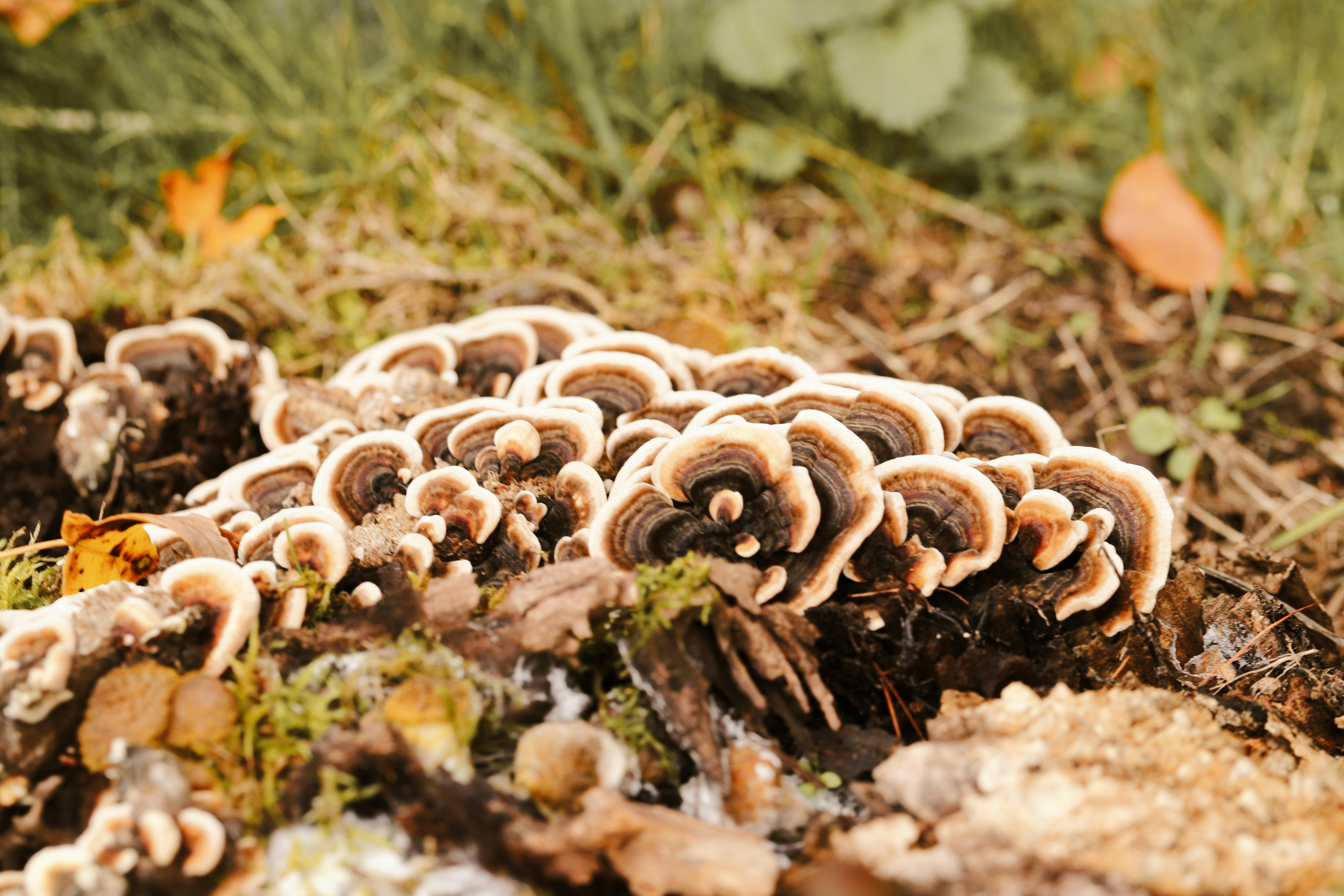
The turkey tail mushroom (Japanese: "kawaratake" — riverbank mushroom; Chinese: "yun zhi" — cloud mushroom) is one of the world's most geographically widespread mushrooms — in Europe, Asia, and North America the striped-colored, fan-shaped fruiting body is common on dead-wood stumps. Chinese Tang-dynasty (618–907) healing tradition mentions it with the indication "qi-strengthening, spleen-supporting" in the Bencao Gangmu (1578) herbal. Japanese mountain monks used it in the yamabushi tradition as an energy enhancer during long retreats.
The modern era began in 1965, when a Japanese chemical engineer, Toshiro Kobayashi, observed that his neighbor in the industrial chemically polluted zone, who suffered from cancer, felt well after regularly drinking turkey tail mushroom decoction. As a result, Kureha Chemical Industry (today Kureha Corp.) set out to isolate the active ingredient. In 1970 Tsukagoshi and team isolated PSK (Polysaccharide-K, "Krestin"), a β-1,3/1,6-glucan-protein complex linked to a β-1,4 main chain. In 1977, the Japanese Ministry of Health licensed PSK (trade name: Krestin®) as an oncology adjuvant — making Krestin the world's first officially approved mushroom-product oncology adjuvant. By the 1980s it reached annual sales of hundreds of millions of dollars and was included in Japan's national health insurance.
The clinical evidence is robust: Sakamoto et al.'s 2006 meta-analysis (8 RCTs, 8009 colon cancer patients) showed a 9% absolute survival improvement at 5-year follow-up with PSK adjuvant alongside chemotherapy. Oba et al. 2007 (gastric cancer, 8 RCTs) showed similar results. At the same time, from the 2010s PSK use in Japan also declined — with the emergence of modern targeted therapies and immunotherapy (PD-1/PD-L1 inhibitors), its clinical role is relative. The Chinese PSP (Polysaccharopeptide, Yang and Yunyu group, 1983, Shanghai School) is a similar-profile product with slightly different β-glucan/protein ratio. (PubMed, Cochrane, Cancer Treat Rev)
🔬 Scientific Background
PSK and PSP are β-glucan-protein conjugates (PSK: ~100 kDa, 25–38% protein, with β-1,4 main chain and β-1,3/1,6 branching). Upon reaching the gut, the Peyer's patch dendritic cells and macrophages identify them via dectin-1 and TLR-2 receptors and induce a TH1-directed cytokine response (IL-12, IFN-γ, TNF-α). This activates natural killer (NK) cell cytotoxicity, pushes tumor-associated macrophages from M2 toward M1 polarization, and shifts the Treg/Th17 balance in an antitumor direction.
Detailed oncology human evidence: - Colon cancer: Sakamoto 2006 meta-analysis (8 RCTs, 8009 patients, 5-year follow-up) → 9% absolute survival improvement chemotherapy + PSK vs. chemotherapy (HR 0.71; 95% CI 0.55–0.90). - Gastric cancer: Oba 2007 meta-analysis (8 RCTs) → modest but significant 5-year survival increase. - Breast cancer: Iino 1995 (914 patients) → 5-year recurrence-free survival improvement in stage II-III breast cancer with PSK + tamoxifen as adjuvant. - Lung cancer: several Japanese RCTs with modest results. - Ovarian cancer: smaller RCTs with positive but heterogeneous results.
The 2012 Eliza et al. systematic review (Recent Pat Inflamm Allergy Drug Discov) concluded: "PSK adjuvant alongside chemotherapy in colon cancer provides significant survival improvement, evidence level moderate." This is the highest clinical evidence available for a mushroom bioactive (no direct Cochrane review has yet been performed).
Immunology: In Standish's 2008 US pilot, breast cancer patients received PSK extract for 6 weeks — NK-cell activity and CD8+/CD4+ ratio improved dose-dependently. Wong 2005 (Hong Kong, COPD pilot) PSP capsule improved lung function and fatigue scores.
At the microbiome level, Pallav's 2014 human pilot in healthy adults showed significant Bifidobacterium increase and Clostridium decrease with 8 weeks of turkey tail extract — so turkey tail has a dual effect: direct immune-cell receptor stimulation + prebiotic microbiome modulation.
- + Vitamin C (lemon, peppers, kiwi): synergistic NK-cell activation, better β-glucan absorption.
- + Vitamin D (fatty fish, sunlight, supplement): immune-complementary effect, both modulate Treg/Th17 balance.
- + Other immunomodulating mushrooms (maitake, reishi, shiitake): different β-glucan profile → broader immune response spectrum.
- + Polyphenol-rich diet (green tea, blueberry, pomegranate): antioxidant + immune synergy.
- + Probiotic (kefir, yogurt, fermented vegetables): the prebiotic effect of turkey tail meets live bacteria.
- + High-fiber diet: the β-glucan microbiome activation is more fully expressed together.
- + Zinc (pumpkin seeds, beef): NK-cell function cofactor.
- + With meals: always with food, because in the presence of gastric acid the β-glucan-protein complex is more stable with the acid-buffering effect of food.
- Immunosuppressants (tacrolimus, ciclosporin, chronic corticosteroids): opposite pharmacology — avoid after organ transplantation.
- Certain chemotherapy agents (cisplatin, doxorubicin) — timing! In oncology protocols, PSK was generally given between chemotherapy cycles, not simultaneously. Oncologist consultation is mandatory for timing.
- Anticoagulants (warfarin, DOACs) at high doses: moderate antiaggregant effect with high-dose supplements.
- Active bleeding disorder: avoid.
- CYP3A4 inducers/inhibitors: modest in vitro effect, clinically rarely relevant.
- 2 weeks after live virus vaccine: theoretical immune-activation interaction — wait 2 weeks.
- Capsule on empty stomach: moderate stomach irritation.
- Active autoimmune disease (SLE, RA, MS, Crohn's) flare: the immunomodulation may be counterproductive in autoimmune contexts.
- After organ transplantation: absolute contraindication for supplement doses.
- Around bone marrow transplant: rejection risk.
- Active sepsis, severe acute infection: immune hyperreaction risk.
- During acute leukemia induction chemotherapy: oncologist consultation mandatory.
- 2 weeks after live virus vaccine (BCG, MMR, yellow fever): theoretical interaction.
- Pregnancy: human safety data missing — avoid.
- Bleeding predisposition: due to moderate antiaggregant effect.
- Chronic lung disease (COPD, asthma) flare: rarely reported airway reaction (powder inhalation — capsule is safe).
Serving: 1–3 g standardized turkey tail extract (PSP or PSK) daily, with meals. As an oncology adjuvant, the Japanese protocol is 3 g/day, in 3–6 month courses. For simple preventive use, 1 g/day extract or tea brewed from 5–10 g dried fruiting body.
Preparation (traditional Chinese/Japanese):
1. Place 5–10 g of dried, thinly sliced turkey tail into 1 liter of water.
2. Simmer on low heat for 60–90 minutes under a lid (so β-glucans leach out).
3. Strain; consume the liquid warm or chilled, flavored with honey or ginger.
4. The remaining mushroom can be re-boiled 1–2 more times; then compost.
Classic patterns:
- Turkey tail tea (Chinese style) — simple daily decoction, naturally flavored (mildly earthy, barely bitter).
- Chinese "yun zhi" soup base — on a bone broth base, 4–5 hours cooked with turkey tail and ginger.
- PSP/PSK capsule — with meals, morning dosing.
- Turkey tail powder in smoothies — 1 tsp in the morning, fruit + plant milk.
Traditional Chinese "immune broth": bone + turkey tail + reishi + cordyceps + ginger + jujube, 4–6 hours slow cooking — many traditional Chinese families prepare it every week.
Storage: Dried fruiting body in an airtight jar, in a dark, cool place, stable for 2 years. Powder 1 year. Liquid extract in fridge 6 months. Capsules 24 months.
What not to do: Don't cook in aluminum cookware. Don't consume on an empty stomach at high doses. Don't combine on chemotherapy days without medical advice. Do NOT collect under sprayed trees or in industrially polluted zones (turkey tail distinctly accumulates heavy metals!).