
Turmeric
The bitter yellow root — curcuminoids, microbiome, and clinical reality.
In 1 minute
What does it provide? Curcuminoids (hydrophobic polyphenols — the source of the yellow color) and essential-oil terpenes. Curcumin's plasma absorption by itself is < 1%, so most of the effect is mediated by the colonic microbiome (which converts it to tetrahydrocurcumin and phenolic acids); it increases the proportion of Faecalibacterium prausnitzii and Bifidobacterium. Robust human RCT evidence: knee osteoarthritis pain reduction (Daily 2016 meta-analysis), maintenance of remission in ulcerative colitis alongside 5-ASA (Hanai 2006), NAFLD liver enzyme improvement.
How much? In the kitchen: ½–1 tsp (≈ 1–3 g) freshly ground rhizome/day, with a pinch of black pepper (piperine → 20× bioavailability increase, Shoba 1998) and fat (olive, ghee, coconut). Clinical supplement: 250–1000 mg curcuminoid/day, phospholipid or nano formulation.
When to avoid? Gallstone/bile duct obstruction/active cholangitis (choleretic effect — EMA contraindication); active hepatitis or unexplained liver enzyme elevation (Italian pharmacovigilance 2018–2019: cluster of cholestatic hepatitis from piperine-containing supplements); anticoagulant therapy (warfarin/DOAC/clopidogrel — additive bleeding); 2 weeks before planned surgery (clinical-dose supplement). Detailed condition-specific contraindications (CYP3A4 interaction, pregnancy, iron deficiency) are in the detailed section.
Turmeric has been part of South Asian cuisine and medicinal tradition for more than 2,000 years: Indian Ayurveda regards it as a sacred spice under the name "haridra," and a foundational element of every Hindu wedding is the "haldi" ceremony, in which the bride's and groom's bodies are anointed with turmeric paste as a symbol of purification and fertility. Marco Polo described it as "Indian saffron" in his chronicle in the 13th century, and in the colonial era it became known worldwide with the global spread of "curry powder." Active-substance research began in 1815, when Vogel and Pelletier first isolated curcumin's yellow pigment, and Milobedzka clarified the chemical structure in 1910.
From the mid-20th century, curcumin research exploded: after the description of NF-κB inhibition, COX modulation, and antioxidant activity, several thousand publications examined it in clinical indications. European regulation (EMA/HMPC) limits medicinal claims to traditional digestive indications, but it has become one of the world's most popular dietary supplements. The Italian pharmacovigilance of 2018–2019, however, gave a warning sign: after high-dose curcumin supplements taken in combination with piperine (black pepper), a cluster of cholestatic hepatitis cases was registered — the "more = better" approach is therefore not safe. **(fitoterapia.net, cot.food.gov.uk)
🔬 Scientific Background
Curcuminoids are hydrophobic polyphenols whose plasma absorption alone is very poor (< 1%). The majority of the intake passes through the small intestine intact, and the colonic microbiome converts it — to tetrahydrocurcumin, dihydrocurcumin, and smaller phenolic acids. This explains why the relationship between systemic plasma level and clinical effect is weak, yet gut barrier and inflammation markers still change: most of the effect operates within the colon, via the microbiota.
The most stable human evidence is available for osteoarthritis (knee, hand), maintenance of ulcerative colitis (adjunctive to 5-ASA), and NAFLD, with moderate effect size. Bioavailability is dramatically increased by piperine (≈ 2000% exposure increase, Shoba 1998) and by phospholipid formulations (≈ 30× plasma level, Cuomo 2011).
At the microbiome level, human data show that regular curcumin consumption increases the proportions of Faecalibacterium prausnitzii and Bifidobacterium, while reducing the proportion of opportunistic Enterobacteriaceae. The effect strongly depends on baseline microbiota composition.
- + Black pepper (piperine): about 20× bioavailability increase in a classic human study. In the kitchen, ¼ tsp of freshly ground pepper to 1 tsp of turmeric. With clinical-dose supplements, caution (interaction, hepatotoxicity).
- + Healthy fat (extra virgin olive oil, coconut fat, ghee): curcumin is fat-soluble — consumption together increases its bioavailability. The Indian "tarka" (spice crackled in oil) tradition exploits exactly this.
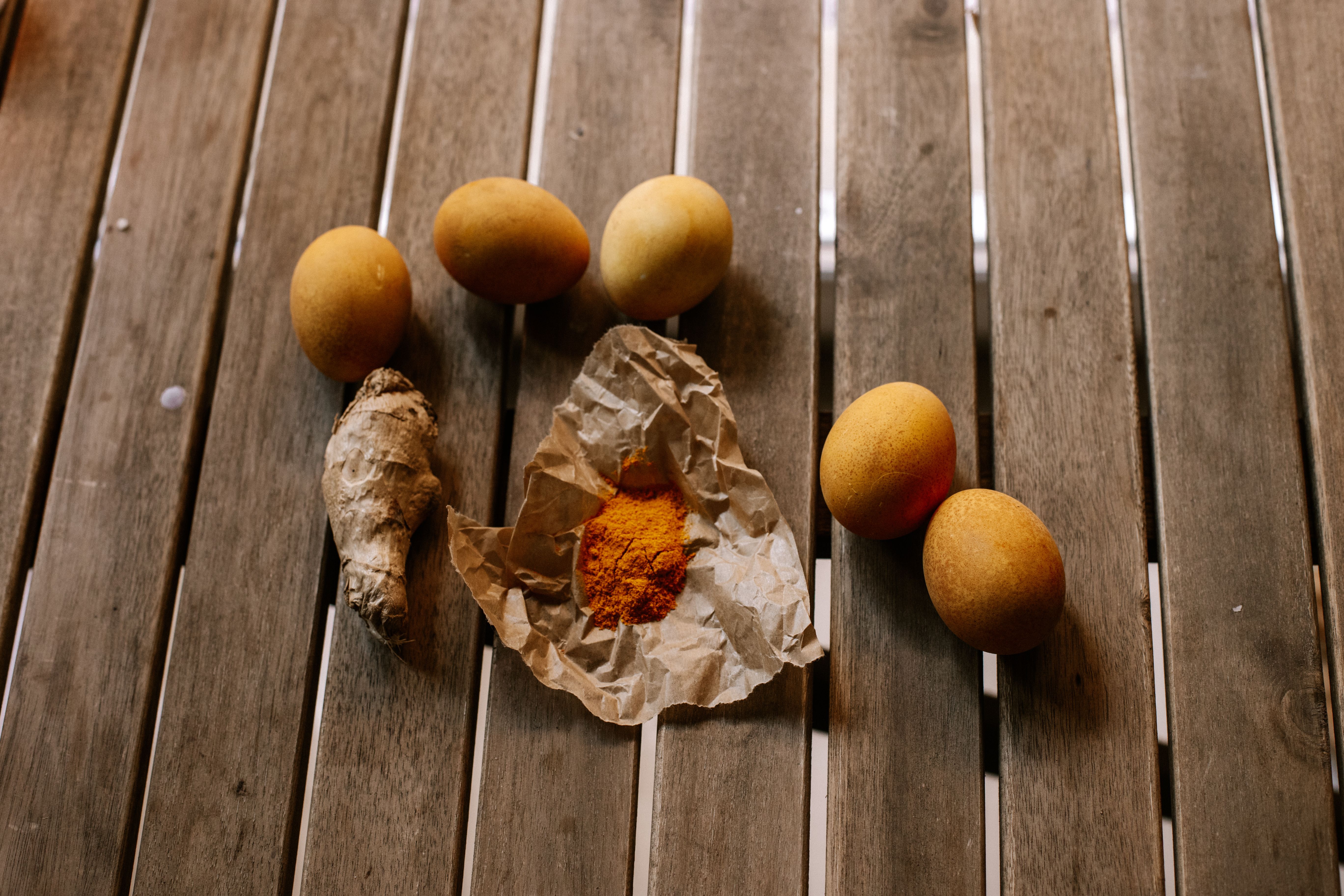
- + Ginger: combined protective effect in osteoarthritis (several RCTs). The combination of the two rhizomes is the basis of the classic "golden milk."
- + Fiber-rich diet (legumes, whole grains, vegetables): most of the curcumin reaches the colon → fiber fermentation + curcumin metabolism = synergistic microbiome effect.
- + Yogurt/kefir (live cultures): support for the bacteria involved in curcumin metabolism.
- + Vitamin C-rich matrix (lemon, tomato): antioxidant synergy, polyphenol stabilization.
- Anticoagulants (warfarin, DOACs — apixaban, rivaroxaban, dabigatran, edoxaban; aspirin, clopidogrel): curcumin is antiplatelet and weakly anticoagulant — additive bleeding risk. Clinical-dose supplement to be avoided; culinary amount is safe.
- CYP3A4 substrates combined with piperine (statins, calcium-channel blockers, immunosuppressants — tacrolimus, cyclosporine; some antiretrovirals): piperine is a CYP3A4 inhibitor — drug level elevation possible.
- Iron supplementation: curcumin has chelating activity (Fe³⁺ binding) — separate the turmeric supplement and iron supplementation in time (≥ 2 hours).
- Hepatotoxic medications (paracetamol in high doses, methotrexate, isoniazid, amiodarone, statin) + high-dose curcumin supplement: additive hepatic stress.
- NSAIDs in high doses + curcumin: GI bleeding risk together.
- On an empty stomach, high-dose supplement: gastric irritation, reflux.
- Gallstone, active bile duct disease, cholangitis, bile duct obstruction: curcumin is choleretic (bile-flow-enhancing) → risk of colic attack, pain. The EMA monograph contraindicates it.
- Active hepatitis, unexplained liver enzyme elevation: Italian pharmacovigilance (2018–2019) documented a cluster of cholestatic hepatitis alongside piperine-containing supplements. In case of jaundice, dark urine, itching, immediate discontinuation and medical visit.
- Pregnancy (high dose): uterine-stimulating and emmenagogue potential in animal experiments. Culinary dose is safe; clinical-dose supplement not recommended.
- Breastfeeding: little human data on supplement doses; culinary amount acceptable.
- 2 weeks before planned surgery: stop high-dose supplement (bleeding risk).
- Kidney stone, particularly predisposition to calcium oxalate stones: turmeric's oxalate content is moderate-to-high; clinical-dose supplement to be avoided.
- Active gastric ulcer, reflux disease flare: GI irritation possible at high doses.
- Iron-deficiency anemia under treatment: curcumin can chelate iron.
- Asteraceae/Zingiberaceae allergy: rare, but cross-reactivity possible.
Daily serving
½–1 teaspoon (≈ 1–3 g) of freshly ground turmeric rhizome.
Preparation pattern
- In a hot pan, 1 tbsp oil (olive/coconut/ghee), 30 seconds.
- ½–1 tsp turmeric + ¼ tsp freshly ground black pepper → 20–30 sec crackling.
- Add to vegetables/legumes/meat toward the end of cooking (NOT at the beginning — long, high-temperature heating degrades curcuminoids).
Classic patterns
Dal: red lentils + turmeric + ginger + pepper + ghee — the best-documented, "every ingredient synergistic" pattern.
Golden milk: plant milk (coconut, almond) + turmeric + pepper + ginger + a little honey — evening, warming, before bed.
Yellow curry: turmeric + coconut milk + vegetables + bean — gluten- and dairy-free base.
Turmeric rice: ½ tsp turmeric in the cooking water of long-grain rice — simple daily fiber+polyphenol combination.
Storage and what to avoid
Storage: in an airtight glass jar, in a dark place — curcuminoids are light-sensitive. Fresh rhizome in the fridge max. 2 weeks; frozen 6 months.
What not to do: don't overcook (≥ 100 °C, 30+ minutes) — curcuminoid loss. Don't arbitrarily combine clinical-dose curcumin supplements with piperine.
References
[1] EMA/HMPC. Community herbal monograph on Curcuma longa L., rhizoma. 2018 (rev. 1).
[2] Shoba G et al. Influence of piperine on the pharmacokinetics of curcumin in animals and human volunteers. Planta Medica 1998;64(4):353–356.
[3] Cuomo J et al. Comparative absorption of a standardized curcuminoid mixture and its lecithin formulation. J Nat Prod 2011;74(4):664–669.
[4] Daily JW et al. Efficacy of turmeric extracts and curcumin for alleviating the symptoms of joint arthritis: a systematic review and meta-analysis. J Med Food 2016;19(8):717–729.
[5] Hanai H et al. Curcumin maintenance therapy for ulcerative colitis. Clin Gastroenterol Hepatol 2006;4(12):1502–1506.
[6] Ebrahimzadeh A et al. Curcumin in NAFLD: meta-analysis of randomized controlled trials. Phytother Res 2025.
[7] Italian National Institute of Health (ISS). Hepatitis from curcumin/piperine supplements — pharmacovigilance report 2020.
[8] Scazzocchio B et al. Interaction between gut microbiota and curcumin: a new key of understanding for the health effects of curcumin. Nutrients 2020;12(9):2499.
[9] EFSA. Refined exposure assessment for curcumin (E100). EFSA Journal 2014.