


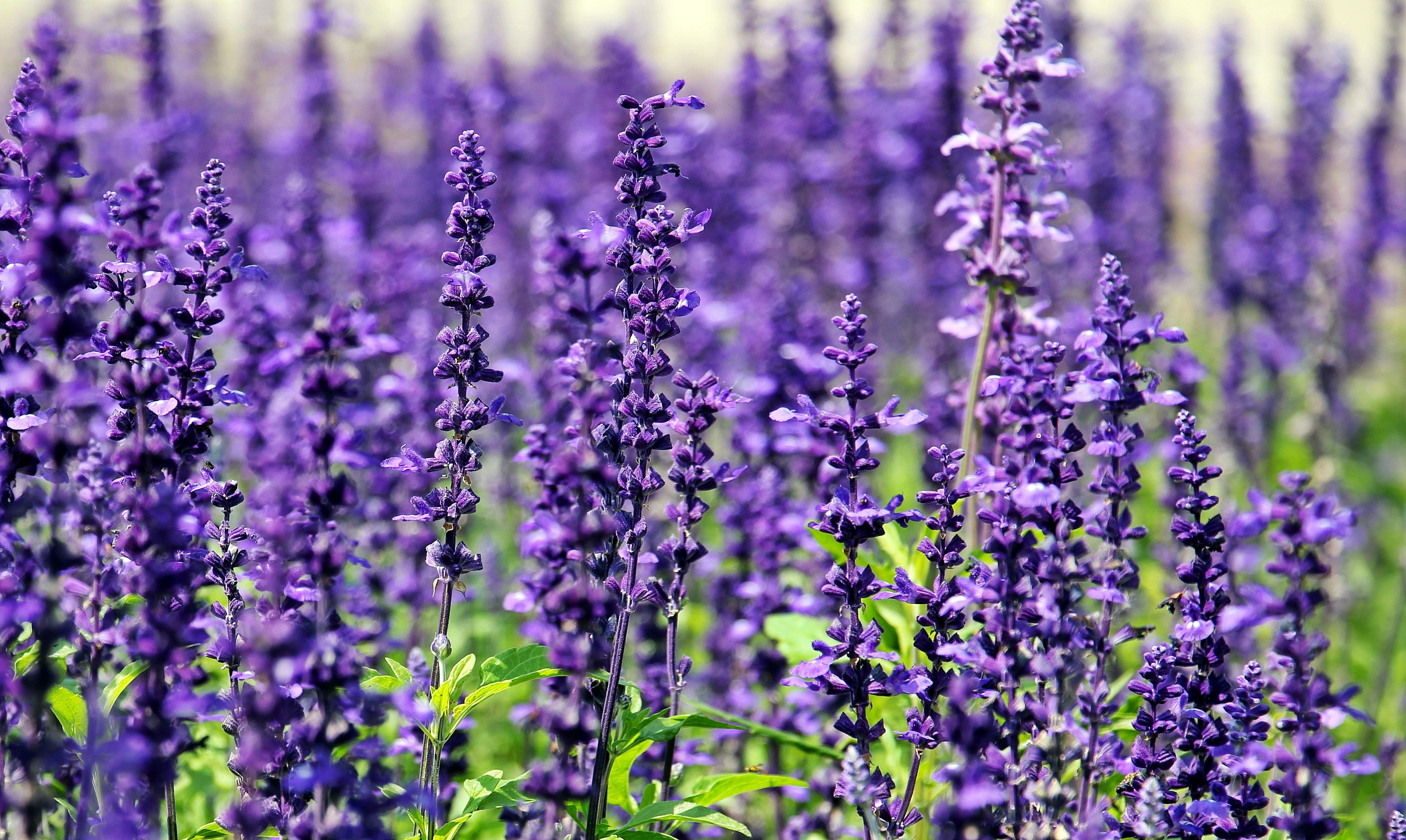
Lavender
Silexan — linalool, anxiety-reducing RCTs, and the spice face of the Provence perfume.
In 1 minute
What does it provide? Linalool (30–40% of essential oil), linalyl acetate (35–45%), 1,8-cineole, β-caryophyllene — anxiolytic, sleep-supporting, antimicrobial, locally wound-healing, and aromatherapy-relevant.
How much? In the kitchen 1–3 g dried flower per day (¼–½ tsp for delicate flavor, baking or crème brûlée); for clinical use Silexan (standardized oral lavender essential oil capsule) 80 mg/day (EMA).
When to avoid? Pregnancy with high-dose essential oil; long repeated topical use in prepubertal boys (suspected endocrine disruption); Lamiaceae allergy; high-dose essential oil alongside anticoagulants.
Lavender (Lavandula angustifolia) is a shrub native to the western Mediterranean coast — the iconic flower of the Provence fields. Its name comes from the Latin "lavare" ("to wash"), as it was used as a scenting bath additive in classical Roman thermae. Pliny and Dioscorides recommended it for digestion, headache, and topical wound healing. It was a main ingredient of the classic "four thieves vinegar" (Vinaigre des Quatre Voleurs, used during 14th-century plague epidemics).
In medieval European monastery gardens (Hildegard von Bingen), lavender was among the ten most important medicinal herbs — for sleep support, respiratory complaints, and topical wound healing. The classic "Hungarian Queen's Water" (Aqua Reginae Hungariae, 14th c.) was a lavender + rosemary alcohol extract. Commercial cultivation in Provence began in the late 19th century — perfumery-grade (Grasse, France) lavender oil is a global standard.
Clinical interest exploded with the Silexan (standardized Lavandula angustifolia essential oil capsule, 80 mg/day) RCT series. Kasper 2010 RCT in generalized anxiety disorder (GAD) showed Silexan vs. placebo significant improvement; Kasper 2014 RCT confirmed non-inferiority to paroxetine (SSRI). Cochrane-level reviews position Silexan as the classic herbal anxiolytic. EMA/HMPC recognizes it under "well-established use" for anxiety treatment. In Moss 2003 aromatherapy RCT, lavender scent significantly improved memory and reduced anxiety. **(EMA 2018, Phytomedicine 2010)
🔬 Scientific Background
Lavender (Lavandula angustifolia) essential oil contains 30–40% linalool, 35–45% linalyl acetate, 1,8-cineole, β-caryophyllene, and lavandulyl acetate. Linalool is the main pharmacological actor — GABA(A) receptor positive modulation, glutamate receptor inhibition, and activation of central nervous system anxiety-reducing pathways.
Clinical evidence for anxiety reduction is among the strongest for herbal medicines. In Kasper 2010 GAD RCT (n=221), 80 mg Silexan/day over 10 weeks significantly reduced the Hamilton Anxiety Rating Scale. The Kasper 2014 non-inferiority RCT showed Silexan 160 mg/day = paroxetine 20 mg/day result, with fewer side effects. The Möller, Volz, Dienel, Schläfke, Kasper 2017 meta-analysis in subthreshold anxiety disorder also confirmed significant, clinically relevant anxiolytic effects (3 RCTs, 80 mg/day Silexan, 10 weeks).
Sleep support: the Lillehei 2015 RCT showed Silexan and aromatherapy lavender scent improved sleep parameters.
Aromatherapy: the Moss 2003 RCT, lavender-scented test room reduced cognitive performance but improved mood and calmness.
Topical/wound healing: traditional, with limited evidence.
Antimicrobial spectrum (in vitro): moderate.
At the microbiome level, the adaptogen-like HPA-axis modulation indirectly moderates microbiome stress response.
Endocrine disruption controversy: Henley 2007 reported cases of gynecomastia after topical tea tree + lavender oil use in prepubertal boys. The evidence is limited but warrants caution — Silexan (oral, standardized) has not shown this concern.
Safety: well tolerated at culinary amounts and in the clinical Silexan protocol. High-dose essential oil internally can cause GI irritation. Undiluted on skin causes contact irritation.
- + Honey, lemon, strawberry (baking): classic dessert synergy.
- + Tea (chamomile, lemon balm, linden): sleep-supporting tea mix.
- + Rosemary, thyme, oregano (herbes de Provence): synergy.
- + Hungarian Queen's Water: lavender + rosemary alcohol extract.
- + Crème brûlée, ice cream, panna cotta: modern dessert.
- + Aromatherapy diffuser + reading/sleep: classic.
- CNS depressants (benzodiazepines, opioids) + Silexan: additive effect.
- Anticoagulants + high-dose essential oil: theoretical bleeding risk.
- Prolonged topical use in prepubertal boys: suspected endocrine disruption.
- Long boiling: essential oil evaporates.
- Concentrated essential oil on infants: to be avoided.
- With iron: may chelate: separate in time.
- Pregnancy (high-dose essential oil): caution.
- Prolonged topical use in prepubertal boys: gynecomastia risk (Henley 2007).
- Lamiaceae allergy: cross-reaction.
- Concentrated essential oil on infants and small children: to be avoided.
- Planned surgery within 2 weeks: discontinue Silexan supplement.
- Severe depression: NOT for SSRI replacement (only adjunct under medical supervision).
- Active gastric ulcer: concentrated essential oil irritates.
- Undiluted on skin: contact sensitivity.
Daily serving
For culinary use ¼–½ tsp dried flower in baked recipes; clinical Silexan 80 mg/day (1 capsule) morning or evening.
Preparation pattern
- Dried flower: crumble into dessert batter (crème brûlée, panna cotta).
- Tea: 1 tsp dried flower + 200 ml hot water, 10 min standing.
- Aromatherapy diffuser: 3–5 drops essential oil per 100 ml water.
- Silexan capsule: 80 mg orally, with food.
Classic patterns
Provençal crème brûlée: egg + milk + sugar + dried lavender flower.
Lavender tea: 1 tsp dried flower + 200 ml hot water, 10 min, honey.
Herbes de Provence: rosemary + thyme + oregano + marjoram + lavender.
Aromatherapy sleep protocol: 3 drops lavender oil in a diffuser 30 min before bedtime.
Storage and what not to do
Storage: dried flower 1 year airtight in a dark place; essential oil 2 years in a dark glass bottle.
What not to do: don't apply concentrated essential oil topically for long periods to infants; don't combine Silexan with benzodiazepines on your own; don't boil at high heat for long.
References
[1] Kasper S et al. Silexan, an orally administered Lavandula oil preparation, is effective in the treatment of "subsyndromal" anxiety disorder. Int Clin Psychopharmacol 2010;25(5):277–287.
[2] Kasper S et al. Lavender oil preparation Silexan is effective in generalized anxiety disorder — a randomized, double-blind comparison to placebo and paroxetine. Int J Neuropsychopharmacol 2014;17(6):859–869.
[3] Kasper S et al. Efficacy of orally administered Silexan in patients with anxiety-related restlessness and disturbed sleep — a randomized, placebo-controlled trial. Eur Neuropsychopharmacol 2015;25(11):1960–1967.
[4] Moss M et al. Aromas of rosemary and lavender essential oils differentially affect cognition and mood in healthy adults. Int J Neurosci 2003.
[5] EMA/HMPC. European Union herbal monograph on Lavandula angustifolia Mill., aetheroleum. 2012.
[6] Henley DV et al. Prepubertal gynecomastia linked to lavender and tea tree oils. N Engl J Med 2007;356(5):479–485.
[7] Lillehei AS et al. Effect of inhaled lavender and sleep hygiene on self-reported sleep issues. J Altern Complement Med 2015;21(7):430–438.