


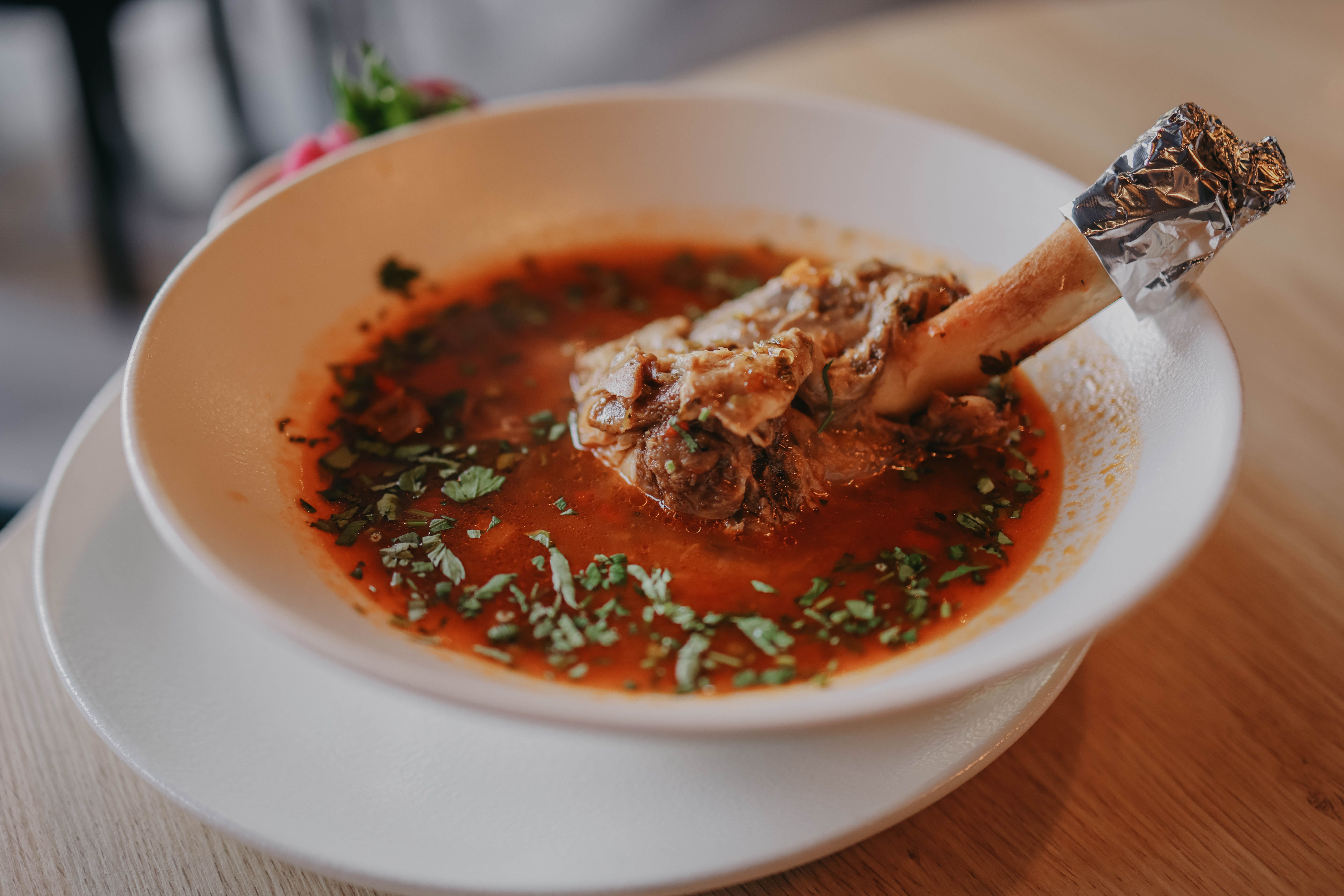
Bone broth
The "bone broth" renaissance — glycine, proline, hydroxyproline for collagen synthesis and the paleo tradition.
In 1 minute
What does it provide? Gelatin and collagen amino acids (glycine, proline, hydroxyproline — building blocks of connective tissue and cartilage; Pro-Hyp dipeptide plasma appearance measurable within 1–2 hours), glutamine (food for intestinal epithelial cells), small amounts of minerals (Ca, Mg, P), and in the case of chicken soup, neutrophil-chemotaxis-reducing fractions (Rennard 2000, Chest — the cold mechanism of classic "Jewish penicillin").
How much? 200–300 ml concentrated bone broth daily or 3–4 servings per week. A serving ≈ 4–8 g glycine-proline-hydroxyproline substrate. Yamadera 2007: 3 g glycine before bed improves sleep quality. Shaw 2017: 200 ml + 50 mg vitamin C after exercise raised the collagen synthesis marker (P1NP) in athletes. Optimal cooking: 12–24 hours for beef, 6–10 hours for chicken.
When to avoid? Histamine intolerance, mastocytosis (long cooking accumulates histamine and tyramine); MAO inhibitor / RIMA / linezolid treatment (hypertensive crisis); CKD 3–5 kidney disease (phosphorus, potassium, protein load); strict low-sodium diet / uncontrolled hypertension (1 serving can be 800–1200 mg Na); cooking beyond 24 hours of industrial/unknown-origin bones (lead leaching, Monro 2013). Detailed contraindications in the dedicated section.
Bone broth is not a new trend: it is found in every major culinary culture. The classic French haute cuisine is built on fond (beef-shank- and bone-based stock), elevated by Auguste Escoffier in Le Guide Culinaire (1903) to a "building block" of modern cuisine — without fond there is "no cooking," he wrote. In Jewish cuisine, chicken soup ("Jüdische Penicillin," "Jewish penicillin") is the Sabbath table and traditional disease-prevention drink; Maimonides in his 12th-century medical treatises already mentions it as a supplemental treatment for cold and asthma. In Central European cuisine, meat broth and bone broth (beef shank, beef bones, chicken or hen with root vegetables, long-cooked) is the traditional Sunday lunch and sick-bed drink — the maternal wisdom that "broth fixes anything that is a cold" is essentially shared across the entire Carpathian Basin.
Korean seolleongtang (beef bone broth cooked milky-white) and Vietnamese phở are also hour-long bone extracts; Japanese tonkotsu ramen boils pork bones for hours until cartilage releases its collagen. The 21st-century "bone broth comeback" started in the American paleo and functional food movement: around 2014–2015, New York bone broth bars (e.g., Brodo, Marco Canora) popularized it as a "gut-healing" drink; Sally Fallon's Nourishing Traditions (1999) book and Kellyann Petrucci's Bone Broth Diet (2015) made it a wellness-trend protagonist. Clinical research is much quieter than the marketing: nobody disputes the collagen and glycine content, but human RCT evidence for the "leaky gut heals from it" thesis is currently weak.
🔬 Scientific Background
Bone broth is a gelatin-rich matrix from thermal denaturation of collagen. During 8–24 hours of acetic-acid-supported cooking, Type I (bone, skin, tendon) and Type II (hyaline cartilage) collagen leach from bones and cartilage, converting to water-soluble gelatin, providing glycine-proline-hydroxyproline and Pro-Hyp-type dipeptides. Pro-Hyp dipeptide plasma appearance per human data is measurable within 1–2 hours of consumption and shows in vitro fibroblast stimulation (Iwai 2005, Shigemura 2014). Glycine itself is a bioactive amino acid: NMDA receptor modulation, glutathione synthesis (cysteine precursor), and the sleep-quality improvement from blood glycine elevation (Yamadera 2007, 3 g before bedtime) are well documented.
The "leaky gut" cure thesis is partly built on glutamine and partly on collagen substrate. Glutamine's role in maintaining gut integrity in pathological states (critical illness, chemotherapy mucositis) is proven (Wischmeyer 2008), but typical home bone broth is a variable and low-dose glutamine source — a simple 250 ml serving rarely reaches a clinical dose. The 2017 Tang group (followed by Wu 2017, Tang 2024) animal evidence suggests collagen peptides strengthen tight junction protein expression and reduce gut permeability — human confirmation is still pending.
One of the best-documented classic human evidence is chicken soup's cold-symptom-reducing effect: Rennard 2000 (Chest) showed chicken soup inhibited neutrophil chemotaxis in vitro — this may explain the clinical observation that hot, salty soup eases upper respiratory symptoms. A 2024 metabolomic pilot (Mar-Solís) documented collagen peptide amino acid elevation in plasma but without clinical relevance. Heavy metal perspective: Monro 2013 (Med Hypotheses) raised attention to lead leaching with long cooking, but Hsu 2017 declared this quantitatively debated — under home conditions, with good-quality bones, the content usually does not reach toxic levels.
- + Root vegetables (carrot, celery, parsley, onion): classic Central European meat broth matrix — polyphenols, prebiotic fiber (inulin from onion), aroma.
- + Apple cider vinegar (1–2 tbsp/10 L water): traditional step at the start of cooking — helps collagen and mineral extraction; final pH is neutral.
- + Fresh ginger, turmeric, black pepper: Asian-style "golden broth" — polyphenol synergy and mild anti-inflammatory effect.
- + Fresh herbs (parsley, dill) at serving: vitamin C and essential oil layer compensating for long cooking.
- + 1–2 hours before bedtime 200 ml concentrated bone broth: the ~3 g glycine intake may have a modest sleep-promoting effect (Yamadera 2007).
- + Sport recovery: 200 ml + 50 mg vitamin C after exercise (Shaw 2017 protocol): collagen synthesis marker (P1NP) increase in athletes — ligament support.
- + Miso or tamari at serving: umami depth and small-dose live fermentation (only NOT boiling).
- MAO inhibitor treatment (classic MAO-i, RIMA, isoniazid, linezolid): long-cooked bone broth and especially aged bone broth accumulate tyramine and histamine — hypertensive crisis risk.
- Histamine intolerance still symptomatic despite antihistamines: 12–24-hour cooking releases diamine oxidase substrates (histamine, tyramine) — headache, flush, palpitation.
- High-sodium diet from other sources (processed food, cheese): one bone broth serving can add 800–1200 mg sodium — addition with hypertension risk.
- High-dose collagen supplement + bone broth simultaneously: no benefit, excessive amino acid load on kidneys.
- Alcohol and bone broth "detox" regimen: marketing regimens suggest the two together "clean the liver" — no evidence, and clinical value of glycine/glutamine supplementation alongside alcohol is unknown.
- Cheap, unknown-source industrial bones + 24+ hour cooking: accumulated lead risk (Monro 2013).
- Phosphorus-restricted chronic kidney disease daily regimen: phosphorus leaching burdens kidneys.
- Histamine intolerance, mastocytosis: long-cooked bone broth is a histamine-releaser — to be avoided.
- MAO inhibitor and RIMA treatment: tyramine accumulation → hypertensive crisis risk.
- Active gout, hyperuricemia: bone broth has moderate purine content (collagen is purine-poor, but meat/marrow is not); to be avoided during flare-up.
- Chronic kidney disease (CKD 3–5): phosphorus, potassium, and protein load; medical consultation needed.
- Poorly controlled hypertension, strict low-sodium diet: don't salt, or skip it.
- Pregnancy from low-quality source: only from verified source due to lead and heavy metal concerns.
- Kidney stones, calcium oxalate stone tendency: collagen-derived hydroxyproline partly metabolizes to oxalate — high consumption contraindicated.
- Active gastric ulcer: the dense, salty, glutamate-rich broth can irritate.
- Severe fish allergy: fish bone broth contraindicated.
Daily serving: 200–300 ml concentrated bone broth, or 3–4 servings per week.
Classic Central European meat broth / bone broth recipe (4 liters):
1. 1–1.5 kg beef shank, beef bones (marrow, cartilage), optionally poultry feet/wings — in abundant, cold water.
2. Add 1–2 tablespoons apple cider vinegar — let rest 30 min (promotes collagen and mineral leaching).
3. Bring to a boil, skim; add root vegetables (carrot, parsnip, celery, onion).
4. Keep at boiling point for 8–24 hours (beef) or 6–10 hours (poultry) — low heat, in a covered pot.
5. Salt only at the end — max 500 mg sodium per serving (250 ml).
6. Parsley, dill only at serving (essential oil preservation, vitamin C).
Cold gelling test: if the broth becomes solid or elastic gel when chilled, gelatin content is high (good collagen extraction). If it stays liquid, there's little cartilage/skin — add more collagen-rich parts.
Storage: refrigerated 4 days, frozen 3 months (can be portioned as ice cubes). Use enameled, glass, or stainless steel pots — avoid aluminum for long acidic cooking.
What not to do: don't cook beyond 24 hours (bitter taste, histamine, lead risk). Don't use unknown-source industrial bones. Don't salt at the start of cooking.