
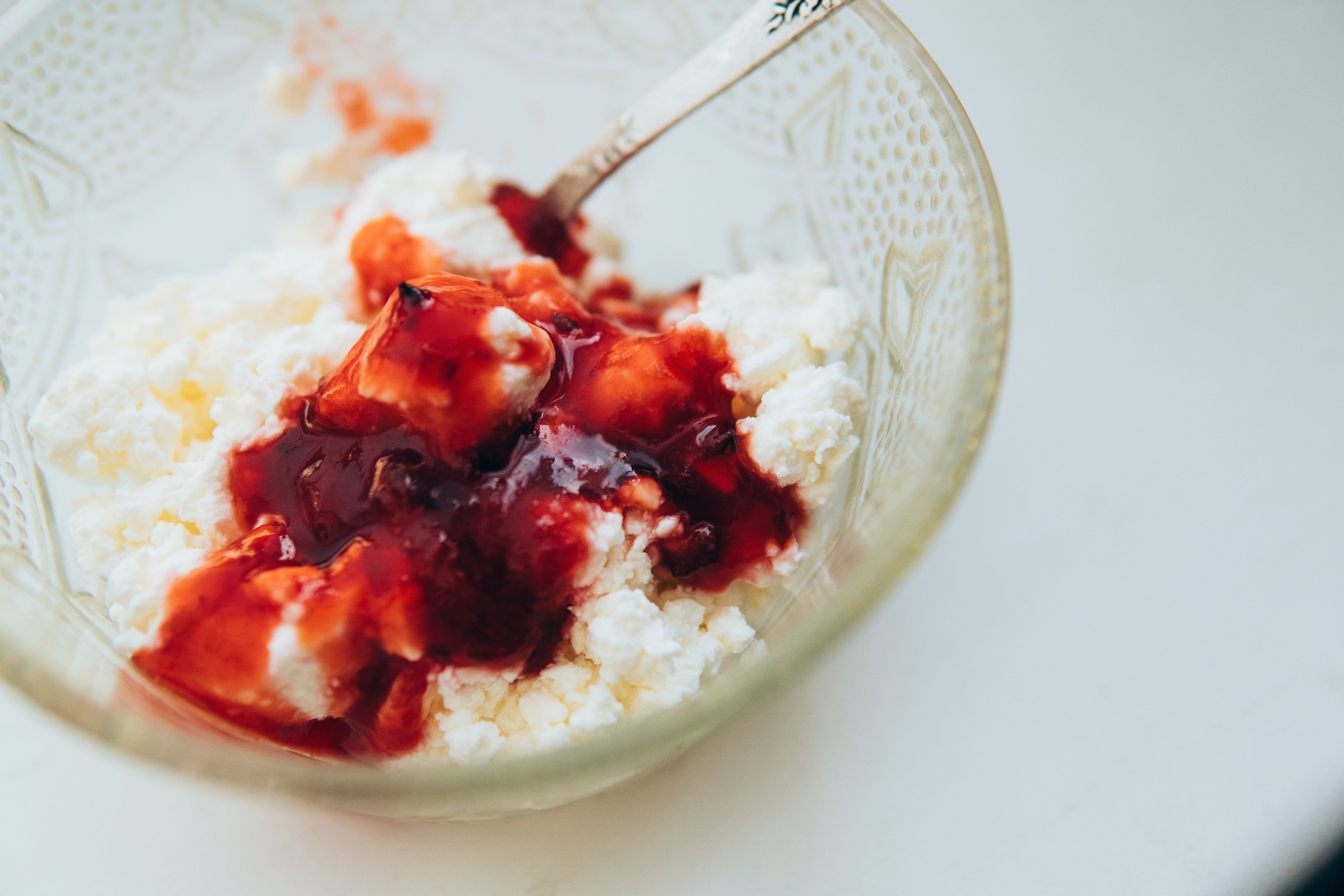
Cottage cheese
The American/British 'farmhouse cheese' — acid-whey coagulation + curd-grain texture, high casein protein, low fat, favored fitness substrate.
- Latin név
- Bos taurus + mesophilic Lactococcus lactis / Lactobacillus + rennet/whey straining + cream dressing
- FODMAP
- 🟢 low (lactose-reduced)
- Evidence
- ★ ★ (live LAB EFSA + high protein + fitness research)
- Microbiota
- Live mesophilic LAB + casein curds + postbiotic matrix
- What does it provide?
- "Cottage cheese" (cottage = small house, "farmhouse cheese") is high in casein protein (10–13 g/100 g), low in fat (1–4%), low in lactose (≈ 3 g/100 g) + live LAB (10⁶–10⁷ CFU/g in fresh versions). The characteristic "curd-grain" texture comes from the casein coagulum not being fully smoothed — small curds remain, mixed with a small amount of cream "dressing." Classic fitness and bodybuilding food: casein is slow-absorbing protein, ideal as evening meal or breakfast.
- How much?
- 100–200 g plain cottage cheese daily.
- When to avoid?
- Cow's milk protein allergy (strictly); galactosemia (absolute); severe lactose intolerance (choose lactose-free version); pasteurized long-shelf-life versions (low LAB); severe kidney disease (high protein); ≥ 2 hours separation from levothyroxine, iron supplements; infant < 6 months.
Cottage cheese is the traditional "farmhouse cheese" of British and Scandinavian peasant farms — the "cottage" (small house) name refers to this fresh cheese being made in simple rural households without cheese aging, with fresh acid-fermentation coagulation. Its origin dates back to the Stone Age: every dairy-based shepherd society makes some form of fresh acid-cheese. The "English cottage" tradition was established in 18th-century rural England and Welsh cuisine; the "American cottage cheese" is the 20th-century modern version: industrial pasteurization, cream-based dressing, "dietary" positioning.
In 20th-century fitness and bodybuilding culture, cottage cheese is the classic "core protein" substrate: low fat, high casein protein (slow absorption), low calorie/100 g, easily accessible. In the "lifters' food" category, alongside chicken-broccoli, cottage cheese-banana is the classic morning-evening. Modern clinical research (Madzima 2014, Buckley 2010) studies the muscle-protective and amino-synthesis effects of nighttime casein consumption.
🔬 Scientific Background
Cottage cheese production process: 1. Starter: mesophilic LAB mix (Lactococcus lactis subsp. lactis, L. lactis subsp. cremoris). 2. Fermentation (12–24 hours): pH 4.4 → casein coagulates. 3. Small cutting: coagulum cut into small cubes (1–2 cm), then heated (≈ 50 °C) — whey expelled, grainy texture formed. 4. Whey straining + rinsing: coagulum rinsed with cold water (Na reduction, fresh flavor). 5. Cream "dressing" added: 1–4% cream, small salt. Industrial versions' "dressing" contains cream and a bit of sugar.
High protein + low fat: 11 g protein/100 g, 1–4 g fat/100 g, ≈ 70–100 kcal/100 g — ideal for fitness diet.
Casein-dominant: 80% of protein is casein, 20% whey (as in milk). Casein is slow-absorbing (~ 4–7 hours), so ideal as evening meal — in Madzima (2014) and Snijders (2015) RCTs, evening casein consumption increased overnight muscle protein synthesis in athletes.
Live LAB: in fresh non-pasteurized versions 10⁶–10⁷ CFU/g LAB — EFSA claim valid (lactose digestion). Industrial long-shelf-life versions are pasteurized.
Clinical studies: Buckley (2010) reports that low-fat high-protein fresh cheeses (cottage cheese, quark, Greek yogurt) favorably affect body composition (fat reduction, muscle preservation) in calorie-controlled diets. Wallace (2018 J Food Sci) reports that live-LAB-containing cottage cheese contributes to gut-microbiome-positive effects.
Microbiome matrix: Lactococcus lactis starters produce bacteriocins (nisin), exopolysaccharides, and peptides — Bifidobacterium-elevating, anti-inflammatory postbiotic matrix. Sanlier (2019 Crit Rev Food Sci) places fresh cheeses in the classic "postbiotic + live LAB" category.
- + Fresh fruit (banana, apple, strawberry, blueberry): classic fitness snack.
- + Flaxseed, chia, walnut: omega-3 + fiber + LAB.
- + Fresh greens (tomato, cucumber, radish, scallion): low-FODMAP salad base.
- + Whole-grain bread, crackers, rice cakes: slow carb + slow protein.
- + Eggs: classic breakfast, high protein.
- + Fresh basil, oregano, cumin: flavor deepening.
- Added sugar / flavored versions (fruit cottage cheese): loses the protein advantage.
- High-Na foods (cheese, sausage, salty bread): industrial cottage cheese also contains Na.
- Levothyroxine (T4): calcium chelation — separate by ≥ 4 hours.
- Tetracycline, ciprofloxacin: calcium interference — separate by ≥ 2 hours.
- Iron supplements: separate by ≥ 2 hours.
- Heating to high temperatures (≥ 70 °C): LAB loss.
- Cow's milk protein allergy: strictly avoid.
- Galactosemia: absolute.
- Severe lactose intolerance: lower lactose, but sensitive individuals still react — choose lactose-free version.
- Severe kidney disease (CKD 4–5): high protein + phosphorus — moderate or avoid.
- Hypertension + Na restriction: choose "low-sodium" version (many cottage cheeses have 300–400 mg Na/100 g).
- Severe immunosuppression: live LAB avoided.
- Infant < 6 months: avoid.
- Histamine intolerance: moderate (fresh version OK).
- Hashimoto + iodine sensitivity: dietary amounts OK, levothyroxine separation.
- Chronic hypercalcemia: avoid.
"Cottage cheese is the same as quark." Partly a myth. The process is similar (mesophilic LAB fermentation + whey straining), BUT: cottage cheese has a small-curd texture + cream dressing (1–4% cream-salt); quark is smooth or grainy, often smooth texture. Cottage cheese is "small curds + liquid"; quark is dense.
"All cottage cheese is a high-protein source." Partly a myth. Classic low-fat cottage cheese (1–2%) has 11 g protein/100 g — excellent. "Cream-style" (4% fat) has 10 g protein, higher fat. "Whipped" or "dessert" cottage cheese often dominated by sugar + cream — lower protein, higher sugar.
"Eating cottage cheese at night builds muscle." Partly true. Snijders (2015) RCT reports that evening 30 g casein protein (≈ 250 g cottage cheese) increases overnight muscle protein synthesis by 22% — relevant for athletes. In average non-athlete adults, the effect is small.
"Cottage cheese is salted — bad for high blood pressure." Partly true. Commercial cottage cheese has 300–400 mg Na/100 g — high, but reducible by choosing "low-sodium" version. Classic homemade cottage cheese (rinsed) has less Na.
"Pasteurized is also live-cultured if labeled 'live'." Myth. "Live and active cultures" is only a permitted label if the starter LAB remains alive in the product — but many industrial cottage cheeses are "hot-packed" (heat-treated afterward) — check the label, "contains live cultures" or "pasteurized after culturing."
"0% fat cottage cheese is the best." Partly a myth. Full-fat cottage cheese (4%) contains MFGM matrix (phospholipid prebiotic) — absent in low-fat versions. Calorie target: 0%; general health: 2–4%.
"Vegan cottage cheese alternative is equivalent." Partly a myth. Vegan "cottage cheese" alternatives (soy-based, coconut-based) are similar in flavor, but the protein-amino-acid profile differs (soy OK, almond low lysine), live culture varies, and MFGM is absent.
🍳 Kitchen Protocol
Daily serving: 100–200 g plain cottage cheese.
Preparation pattern — homemade cottage cheese: 1. 2 liters whole milk + 2 tbsp live yogurt or kefir starter. 2. At room temperature 12–24 hours of fermentation. 3. Coagulum cut into 1–2 cm cubes. 4. Slow heating to ≈ 50 °C, small amount of salt. 5. Drain on cheesecloth, rinse with cold water. 6. Add 1–2 tbsp cream + ½ tsp salt. 7. Refrigerate.
Classic patterns:
Breakfast "muscle bowl": 200 g cottage cheese + 1 banana + 1 tsp flaxseed + ½ tsp cinnamon.
Salad bowl: cottage cheese + tomato + cucumber + basil + olive.
Stuffed baked potato: baked potato + cottage cheese + scallion + paprika.
Post-omelet "extra protein": scrambled eggs + 2 tbsp cottage cheese on top.
Snack with fresh fruit (apple + walnut + cottage cheese) — fitness snack.
"Lox bagel" style: bagel + cottage cheese + smoked salmon + scallion.
Storage: refrigerated airtight for 5–10 days.
What not to do: don't boil (LAB loss). Don't choose sweetened version if fitness target.
📚 References (selected)
1. EFSA NDA Panel. Scientific opinion on live yoghurt cultures and improved lactose digestion. EFSA Journal 2010;8(10):1763. 2. Wallace TC. Health effects of fermented dairy. J Food Sci 2018. 3. Sanlier N et al. Health benefits of fermented foods. Crit Rev Food Sci Nutr 2019;59(3):506–527. 4. Snijders T et al. Protein ingestion before sleep increases muscle mass and strength gains during prolonged resistance-type exercise training in healthy young men. J Nutr 2015;145(6):1178–1184. 5. Madzima TA et al. Pre-sleep dairy protein ingestion: muscle protein synthesis in athletes. Br J Nutr 2014;111(1):71–77. 6. Buckley JD, Howe PR. Long-chain omega-3 PUFAs and body weight regulation. Obes Rev 2010. 7. Codex Alimentarius. Standard for Cottage Cheese (CXS 273-1968, Rev. 2022). 8. Marco ML et al. Health benefits of fermented foods: microbiota and beyond. Curr Opin Biotechnol 2017;44:94–102.