


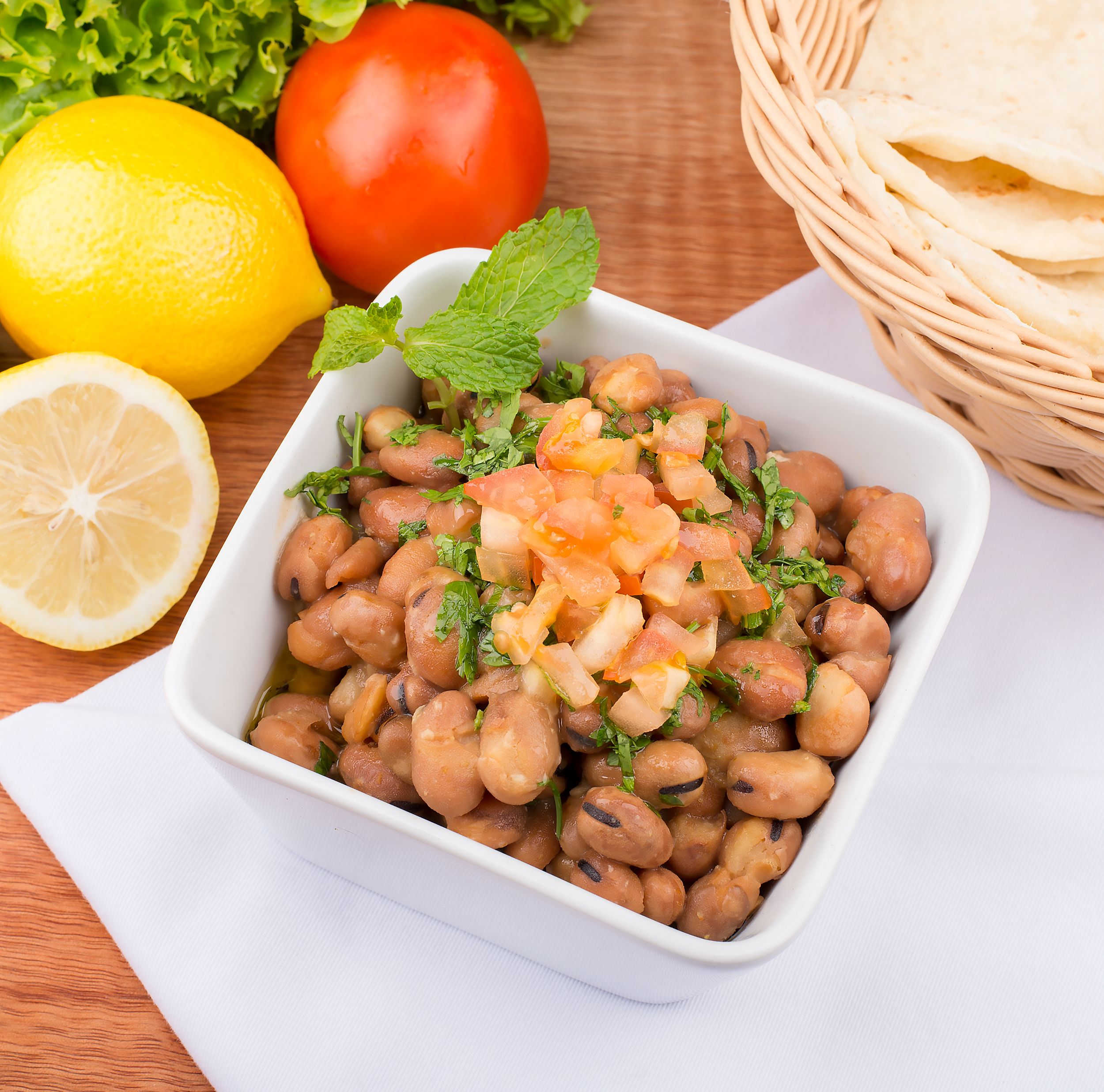
Fava Bean
The ancient bean of the Mediterranean — a natural L-DOPA source and prebiotic GOS, but watch out for favism.
Fava Bean in 1 minute
What does it provide? Plant protein (≈ 26 g/100 g dry), levodopa (L-DOPA — Parkinson drug precursor, ≈ 0.25 g/100 g in fresh green bean, even higher in sprouts), GOS prebiotics (raffinose, stachyose, verbascose), folate (≈ 423 μg/100 g dry, one of the highest sources), and iron (≈ 7 mg/100 g dry). It contains vicine and convicine — two glycosides that can trigger hemolytic crisis ("favism") in G6PD-deficient individuals.
How much? Fresh green fava (in pods) in season 100–150 g/serving, dried, soaked, cooked 80–120 g/serving, weekly 2–3×. In Parkinson's disease, dietetic protocols complementing L-DOPA therapy have studied 100–250 g fresh green bean/day (Rabey 1992, Vered 1994).
When to avoid? G6PD deficiency (favism acute hemolytic anemia risk — this is the classic indication), MAOI antidepressant therapy (tyramine and L-DOPA interaction with hypertensive crisis), Parkinson's L-DOPA replacement with fluctuating dose (motor fluctuation), allergy, IBS flare (GOS), severe kidney disease (potassium, protein).
The fava (or broad) bean originates from the eastern Mediterranean coast and the Fertile Crescent — its domestication began as early as the 7th millennium BCE, making it one of Europe's oldest domesticated legumes, long the main protein source before the arrival of beans (Phaseolus) from the Americas. Pythagoras's famous prohibition against his disciples "eating beans" probably refers to favism — in the Mediterranean region where the Greeks lived, G6PD deficiency was common. The Romans held fava as both food of the poor and a mourning dish: at the Lemuria festival, they spat beans from their houses for the ghosts of the dead. In ancient Egypt it was under sacral taboo. In the Middle Ages, fava remained a staple peasant food across Europe; in Hungary, under the name "lóbab," this traditional stew remained popular until the mid-20th century. (Britannica)
Scientific Background
Fava bean is significant with three clinically interesting component groups. (1) L-DOPA (levodopa): natural occurrence in fresh green bean (≈ 0.25 g/100 g, up to 5 g/100 g in sprouts and aged sprout extracts) — the active ingredient of Parkinson's medication. Vered et al. (1994 Clin Neuropharmacol) and Rabey et al. (1992 J Neurol Neurosurg Psychiatry) pilot studies showed that consuming 250 g fresh green fava raised plasma L-DOPA levels and provided temporary motor symptom improvement in Parkinson's patients. However, dietary L-DOPA intake is unpredictable: season-, variety-, and ripeness-dependent — so cannot be recommended even as a supplement instead of medication; established L-DOPA replacement is pharmacological.
(2) Favism (G6PD deficiency): glucose-6-phosphate dehydrogenase (G6PD) is an X-linked enzymopathy — common in the Mediterranean region, Africa, and the Middle East (due to malaria evolutionary selection). The vicine and convicine in fava beans (and their metabolites, divicine and isouramil) deplete glutathione of G6PD-deficient red blood cells, causing acute oxidative hemolysis (Luzzatto 2018 Lancet Haematology). Clinical picture: within 24–48 hours, jaundice, dark urine, fatigue; severe cases require supportive therapy. Knowledge of population G6PD status is critical in Mediterranean and southern European populations.
(3) Prebiotic GOS and folate: raffinose-family oligosaccharides are effective Bifidobacterium substrates (Slavin 2013 Nutrients), although they can cause FODMAP symptoms in IBS-sensitive individuals. Folate content is outstanding (≈ 423 μg/100 g dry) — critical for pregnancy preparation and methylation cycle.
At the microbiome level, pulse-enriched diets significantly raise Faecalibacterium prausnitzii and Roseburia proportions (Monk 2018 J Funct Foods, pulse RCT). Sprouted fava further increases bioavailable L-DOPA and GABA content.
- + Vitamin C source (lemon, pepper): boost iron absorption 2–4×.
- + Whole grain: complementary amino acid profile — complete plant protein.
- + Olive oil, Mediterranean spices: classic Mediterranean pattern; olive-oil-cooked fava is the basis of Italian "fave e cicoria" and Egyptian "ful medames."
- + Soaking + cooking (24+ hours soaking, discard cooking water): reduces some vicine/convicine, better tolerance (but NOT a safety guarantee for G6PD-deficient individuals).
- + Gradual introduction: GOS tolerance build-up.
- MAOI antidepressants (phenelzine, tranylcypromine): L-DOPA + tyramine synergy can cause hypertensive crisis.
- Parkinson's L-DOPA medication (Madopar, Sinemet) with fluctuating meal pattern: unpredictable plasma L-DOPA peak → motor fluctuation.
- Large protein dose together with L-DOPA replacement: large neutral amino acids compete with L-DOPA at the blood-brain barrier — protein-restriction strategy is needed.
- G6PD deficiency (favism): strict total avoidance. This is the classic indication — family history check in the Mediterranean region.
- Parkinson's disease with L-DOPA treatment: individual neurological consultation — predictable dosing needed.
- Severe kidney disease (CKD 3–5): potassium and protein restriction.
- IBS flare: GOS high FODMAP — avoid.
- Gout acute flare: moderate purine.
- Allergy (rarer, but exists): strict avoidance.
- Luzzatto L, Arese P. Favism and glucose-6-phosphate dehydrogenase deficiency. N Engl J Med 2018;378(1):60–71. https://www.nejm.org/doi/full/10.1056/NEJMra1708111
- Vered Y et al. The effect of Vicia faba consumption on plasma levodopa concentrations in Parkinson's disease. Clin Neuropharmacol 1994;17(3):238–243. https://journals.lww.com/clinicalneuropharm/abstract/1994/04000/bioavailability_of_levodopa_after_consumption_of.4.aspx
- Rabey JM, Vered Y, Shabtai H, Graff E, Korczyn AD. Improvement of Parkinsonian features correlate with high plasma levodopa values after broad bean (Vicia faba) consumption. J Neurol Neurosurg Psychiatry 1992;55(8):725–727. https://pmc.ncbi.nlm.nih.gov/articles/PMC489215/
- Monk JM et al. Diets enriched with cooked navy bean or chickpea differentially modulate microbiota composition and short-chain fatty acid concentrations. J Funct Foods 2018;47:18–26.
- Slavin J. Fiber and prebiotics: mechanisms and health benefits. Nutrients 2013;5(4):1417–1435. https://www.mdpi.com/2072-6643/5/4/1417
- USDA FoodData Central — Broad beans (fava), mature seeds. https://fdc.nal.usda.gov/
- Monash University. Broad beans — FODMAP serving guidance. https://www.monashfodmap.com/about-fodmap-and-ibs/high-and-low-fodmap-foods/