


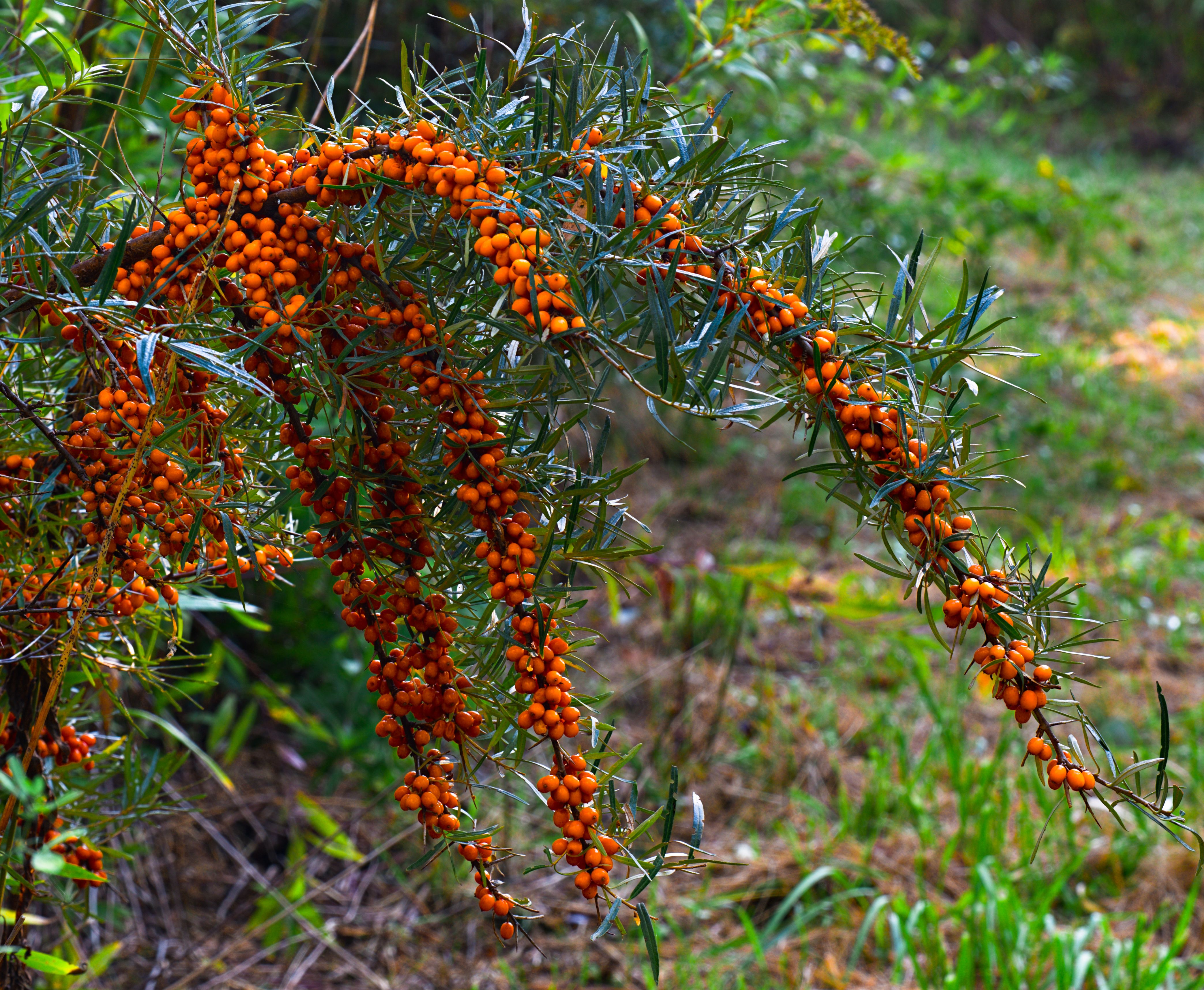
Sea Buckthorn
The Himalayan polyphenol champion — rare omega-7, record vitamin C, clinically documented mucosal support.
Sea Buckthorn in 1 minute
What does it provide? Rare omega-7 fatty acid (palmitoleic acid, 16:1 n-7) — its dietary sources are sea buckthorn and macadamia nut. Record vitamin C content (600—1500 mg/100 g fresh berry — 8—20× that of citrus), high carotenoid matrix (beta-carotene, lycopene, zeaxanthin 200—500 mg/100 g), tocopherols, flavonoids (quercetin, kaempferol, isorhamnetin).
How much? 15—30 g fresh berry or 1—2 tbsp (10—15 g) sea buckthorn paste / day. Clinical RCTs (Larmo 2010) used 30 g lyophilized powder. Oil capsules at 1—2 g/day dose.
When to avoid? Allergy (rare). High-dose supplement to be avoided in pregnancy (safety RCT lacking). Anticoagulant context: high vitamin C + omega-7 has mild antiplatelet potential — pause recommended 1 week before surgery.
Sea buckthorn has been a millennia-old player in traditional Tibetan, Mongolian, and Chinese (Yellow River valley) medicine. The Si bu yi dian (Tibetan Four Tantras, 8th century) mentions it for more than 30 indications, and it was part of soldiers' rations in Genghis Khan's army — according to Mongolian sources, even the horses were strengthened with "sea-buckthorn milk" (a milky emulsion of the seeds). The name "Hippophae" comes from two Greek words: hippos (horse) + phaos (shining) — the legend holds that a horse's coat became shiny after consuming sea buckthorn.
Sea buckthorn entered European medicine in the mid-20th century — led by Russian, Eastern European, and Scandinavian research. From the 1950s, the Soviet Union prepared radiation-protective formulations ("Oblepikha") of its "Sputnik program" from sea buckthorn oil. Finnish and Eastern European modern phytotherapy (Larmo, Yang, Suomela groups) documented clinical indications with human RCTs in the 2000s. In Hungary it has emerged in the last decade as a "functional fruit" — in the form of organic sea-buckthorn paste, lyophilized powder, and syrups.
Scientific Background
Sea buckthorn's bioactive matrix is exceptionally complex. The berry contains three distinct fractions: pulp oil (palmitoleic-acid-dominant), seed oil (α-linolenic + γ-linolenic acid), and aqueous fraction (vitamin C + flavonoids).
Palmitoleic acid (16:1 n-7), an omega-7 fatty acid, has rare dietary sources: sea buckthorn (30—40% of pulp oil) and macadamia nut (≈ 17%) are significant; animal sources (butter, eggs) contain only trace amounts. Palmitoleic acid has an anti-inflammatory profile — according to Yang 2009 Lipids in vitro and small human pilots, palmitoleic acid intake reduces CRP levels and improves mucosal function in dry eye and dry mouth.
Clinical evidence is most robust for mucosal support. Larmo 2010 J Nutr RCT showed that 30 g lyophilized sea-buckthorn berry over 90 days significantly reduced CRP levels and metabolic syndrome markers in overweight women. Larmo 2014 Eur J Nutr further RCT confirmed dry-eye symptom improvement with sea-buckthorn oil 1—2 g/day in Sjögren's syndrome patients. Yang 2013 J Funct Foods documented atopic dermatitis symptom relief in a 4-week intervention.
The vitamin C content is record-breaking (600—1500 mg/100 g fresh berry) — 8—20× that of citrus. The content is stable during cooking, because the high flavonoid matrix (quercetin, kaempferol, isorhamnetin) regenerates oxidized ascorbic acid. This dual effect explains the traditional "scurvy-prevention" use during long Siberian winters.
The carotenoid matrix (beta-carotene + lycopene + zeaxanthin + lutein) offers a dual benefit: a provitamin-A source (beta-carotene → retinol) and macular-pigment support (zeaxanthin + lutein → eye health). Sea-buckthorn seed oil may be an alternative to classic AREDS supplements in AMD (age-related macular degeneration), although dedicated RCT data is still sparse.
At the microbiome level, sea buckthorn's polyphenol matrix shows selective Bifidobacterium and Lactobacillus support in in vitro fermentation studies; the Akkermansia muciniphila axis is supported in preclinical animal data, without direct human RCT evidence. Gut-barrier strengthening occurs via palmitoleic-acid-mediated tight-junction expression (Cao 2008 Lipids Health Dis preclinical). The evidence is ★★ (moderate) — mechanistically robust, with limited human RCTs.
Because of the high acid content (pH 2.5—3.5 in fresh juice), sea buckthorn is rarely consumed on its own — syrups, pastes, smoothie blends, or lyophilized powders are typical.
- + Yogurt or kefir (carbohydrate + fat): softens the acidic profile, and palmitoleic acid absorbs better in a fat matrix.
- + Honey or date (sour-sweet balance): classic Siberian sea-buckthorn syrup recipe.
- + Oily nuts (almond, walnut): lipid matrix supports carotenoid absorption.
- + Tea (green or black): polyphenol synergy, immunomodulation.
- + Smoothie (banana + spinach + apple): varied antioxidant matrix.
- + Pomegranate or elderberry: dual anthocyanin-carotenoid polyphenol stack.
- + Bone broth or collagen: mucosal + gut-barrier indirect support.
- On an empty stomach, high dose: GI irritation, acid reflux — high vitamin C + high acid sensitivity.
- GERD flare: the high acid content may worsen reflux.
- Iron supplement at the same meal: the high vitamin C aids iron absorption, which on its own is good — BUT polyphenols may also chelate it. A complex interaction — temporal separation (≥ 1 hour) recommended.
- High-dose aspirin or clopidogrel: sea buckthorn's palmitoleic acid + flavonoid mild antiplatelet effect — bleeding warning at high-dose combinations.
- High-temperature, long cooking (≥ 100 °C, > 30 min): vitamin C is partially lost, carotenoids degrade.
- Sugar concentration (factory syrup 50—70% sugar): glycemic load, the polyphenol advantage disappears.
- Pregnancy (high-dose supplement): dietary amount is safe, but concentrated oil capsule or high-dose paste should be avoided long-term — safety RCT is lacking.
- Diabetes with insulin-pump treatment: commercial syrup is high in sugar (to be avoided); fresh berry has low glycemic index and is safe. Sugar-free (xylitol) variants preferred.
- GERD or active gastritis: high acid — small amounts within meals.
- Kidney stones (oxalate): moderate oxalate content, monitoring recommended.
- Allergy (rare, IgE-mediated): sea-buckthorn allergy is rare but exists; first use a small dose.
- Anticoagulant / antiplatelet therapy: consult a doctor before high-dose oil capsule or paste; dietary amount is safe.
- Young children (under 3 years): dietary amount is safe; high-dose oil capsule not recommended.
- Larmo PS et al. Effects of sea buckthorn berry on infections and inflammation: a double-blind, randomized, placebo-controlled trial in healthy adults. J Nutr 2010;140(11):2090—2096. https://pubmed.ncbi.nlm.nih.gov/17593932/
- Larmo PS et al. Oral sea buckthorn oil attenuates tear film osmolarity and symptoms in individuals with dry eye. J Nutr 2010;140(8):1462—1468. https://pubmed.ncbi.nlm.nih.gov/20554904/
- Yang B et al. Effects of dietary supplementation with sea buckthorn (Hippophae rhamnoides) seed and pulp oils on atopic dermatitis. J Nutr Biochem 1999;10(11):622—630.
- Mishra KP et al. Cardiovascular effects of sea buckthorn (Hippophae rhamnoides) extract in hyperlipidemic subjects: pilot trial. Med Sci Monit 2008;14(8):CR398—402.
- Suomela JP et al. Absorption of flavonols derived from sea buckthorn (Hippophae rhamnoides) and their effect on emerging risk factors for cardiovascular disease in humans. J Agric Food Chem 2006;54(19):7364—7369. https://pubs.acs.org/doi/abs/10.1021/jf061889r
- Cao Q et al. Palmitoleic acid (16:1 n-7) — characterization and effects on human health. Lipids Health Dis 2018;17:101 (mechanism review).
- EMA/HMPC. European Union herbal monograph on Hippophae rhamnoides L., fructus. 2017 (preliminary).
- USDA FoodData Central — Sea buckthorn berry raw nutrient profile (NDB #173962).
- Wang H et al. Hippophae rhamnoides berry attenuates oxidative stress: review and meta-analysis. Food Funct 2022;13(11):6080—6091.
- Monash University. Sea buckthorn — Low FODMAP serving guidelines (15 g fresh green).