


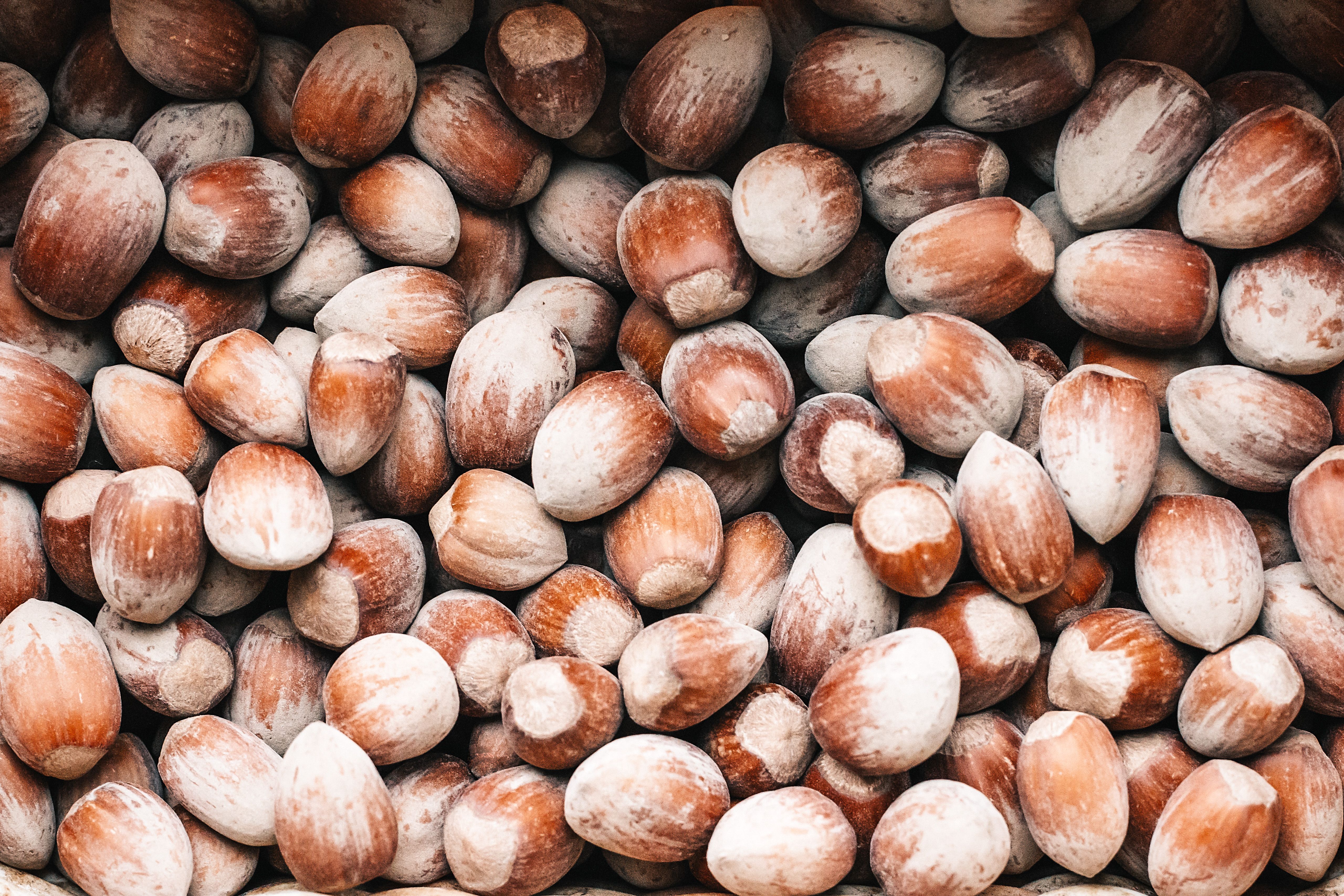
Hazelnut
The Mesolithic nut — Stone Age favorite, foundation of Piedmontese confectionery, and a restrained but real SCFA booster.
In 1 minute
What does it provide? MUFA-dominant fats (oleic acid ≈ 75%), high vitamin E content (≈ 15 mg/100 g — one of the highest among tree nuts), skin polyphenols (flavan-3-ols, proanthocyanidins), and insoluble fiber — cardiometabolic protection + restrained but measurable microbiome effect.
How much? 28–30 g/day (a handful, ≈ 20–25 nuts) with pellicle (brown skin). Perna 2016 meta-analysis: 30–60 g/day hazelnut, 4–12 weeks, LDL cholesterol ≈ −7%.
When to avoid? Tree-nut allergy (the most common European nut allergen), birch-pollen cross-reactivity (Cor a 1 protein), IBS elimination phase.
Hazelnut is native to much of Europe, and thousands of Mesolithic sites yield charred shell middens of it — it was one of Stone Age humans' most important plant foods. On the Scottish island of Colonsay and at other sites, massive shell middens have been excavated; radiocarbon dating points to the period between 6000–4000 BCE, meaning hazelnut was clearly part of northern European hunter-gatherer groups' nutritional base well before grain cultivation became widespread. Celtic folk belief honored the hazelnut as the tree of wisdom: according to Irish legend, the salmon of a feast acquired all the world's knowledge by eating nine sacred hazelnuts that fell into the Boyne river — the hero Finn mac Cumhaill burned his finger while cooking that very fish, and so personally partook in the knowledge. Ancient authors — Theophrastus and Pliny — also mention hazelnut and its cultivation; in the Roman world it was present as both an ornamental and utility plant.
During the medieval and early modern periods, cultivation became established in Mediterranean and Central European regions: from the 18th–19th centuries, Piedmontese Turkish hazelnut became the world's primary confectionery base, and Turin's pastry chefs gave birth to gianduja cream for that very reason — when cocoa became expensive during the Napoleonic Wars, much more hazelnut was mixed into chocolate, and so the world's first hazelnut spread was born, from which Nutella later branched off. Nutella's recipe was developed in 1964 by Pietro Ferrero's son Michele in the small town of Alba — today 2.2 kg of it is consumed worldwide every second. Turkey accounts for about 70% of the global hazelnut market, while Italian and Spanish growing regions feed the narrower delicacy segment. **(Society of Antiquaries of Scotland, ScienceDirect)
🔬 Scientific Background
Hazelnut's bioactive matrix rests on three pillars. MUFA fat: ≈ 75% oleic acid — one of the highest among tree nuts, similar to olive oil. Vitamin E (α-tocopherol): ≈ 15 mg/100 g — outstanding antioxidant content. Polyphenols in the pellicle: flavan-3-ols (catechin, epicatechin), B-type proanthocyanidins, gallic acid conjugates — concentration here can be 10–20× higher than in the kernel.
Clinical evidence arrives from two directions. Lipid profile: several RCTs (Tey 2013, Perna 2016, Di Renzo 2017) showed LDL cholesterol reduction (≈ −7%) and favorable Apo-B reduction with 30–60 g/day hazelnut; the vitamin E + MUFA + polyphenol matrix is synergistic. Microbiome and SCFA: Liccardo 2019 in hyperlipidemic children showed a significant increase in fecal acetate after 8 weeks of in-shell hazelnut consumption, while 16S-based compositional change was small — this fits the "functional (metabolite) effect is stronger than the taxonomic" pattern seen in other tree nuts (almond, walnut).
In vitro, hazelnut skin extracts promote Lactobacillus/Bifidobacterium growth (prebiotic potential). The skin by-product (several thousand tons annually in processing plants) is now becoming an active research area as a functional food additive.
- + Retain pellicle (brown skin): 80% of polyphenols are here. From blanched (white) hazelnuts, skin polyphenol disappears.
- + Dark chocolate (70%+): classic Piedmontese pattern — cocoa flavanol + hazelnut proanthocyanidin synergy, Mediterranean dessert.
- + Olive oil + Mediterranean salad: MUFA + vitamin E synergistic antioxidant matrix.
- + Breakfast oatmeal + berries: broader SCFA profile, polyphenol diversity.
- + Whole-grain bread + ricotta: composite protein + fiber + fat — satiety-enhancing.
- + Yogurt/kefir (live culture): synbiotic synergy with moderate GOS content.
- High heat, long roasting (≥ 180 °C, 20+ minutes): polyphenol loss, acrylamide formation.
- Heavy blanching: strips the pellicle → 80% drop in polyphenol intake.
- Large amounts of chocolate/sugary hazelnut spread (e.g., Nutella in large servings): glycemic load + trans fat → cardiometabolic benefit disappears. "Hazelnut is healthy, so Nutella is too" is a false inference (see myths).
- Iron supplementation + large hazelnut serving: polyphenol chelation — ≥ 2 hours separation.
- Rancid hazelnut: although MUFA is more stable than PUFA, after prolonged room-temperature storage it can go rancid — ROS load.
- Birch-pollen season + large serving (OAS-sensitive): oral allergy syndrome flare.
- Tree-nut allergy: hazelnut is the most common European tree-nut allergen — strict total avoidance (Cor a 9, Cor a 14 markers for severe systemic reaction, Cor a 1 for milder oral symptoms).
- Birch-pollen cross-reactivity (PR-10/Bet v 1 family): oral allergy syndrome (itchy mouth, lips) — mainly in pollen season, mainly raw. Roasted hazelnut is often tolerated.
- IBS elimination phase: > 10 nuts GOS/fructan-loading. In reintroduction, start with 5 nuts.
- Infant, child under 4: whole hazelnut is a choking hazard; can be given in hazelnut butter (after allergy history check).
- Chronic kidney disease (stage 3+): moderately high potassium, phosphorus — dose control.
- Active peptic ulcer / active IBD flare: insoluble fiber irritation.
- Aflatoxin-sensitive populations: Turkish hazelnut is generally well controlled, but discard rancid/moldy nuts immediately.
Daily serving
28–30 g (a handful, ≈ 20–25 nuts) with pellicle.
Preparation pattern
- Raw, with pellicle: the gentlest form; soak 8 hours for flavor balance.
- Gentle roasting: 140–150 °C, 10–12 minutes — pellicle separates more easily, flavor experience increases.
- Grind fresh: pesto, hazelnut spread, pastry base.
Classic patterns
Gianduja (classic, low-sugar): 100% roasted hazelnut + 70%+ dark chocolate + minimal honey — Piedmontese tradition, in moderation.
Hazelnut pesto: hazelnut + parsley + olive oil + Parmesan + garlic — pasta base.
Hazelnut salad dressing: ground hazelnut + olive oil + vinegar + Dijon mustard — for warm salad.
Breakfast oatmeal: oats + hazelnut + dried blueberry + kefir drizzle — synbiotic breakfast.
Italian baci (kiss bonbon): whole roasted hazelnut + dark chocolate coating — evening dessert, in moderation.
Storage
In an airtight jar, in a cool dark place — in-shell hazelnut 1 year, shelled 6 months, frozen 1 year. Hazelnut spread refrigerated, 3–6 months.
What not to do
Don't peel off the pellicle. Don't roast above 180 °C. Don't store ground hazelnut at room temperature for days. Don't equate Nutella with "whole hazelnut" from a microbiome standpoint.
References
[1] Pelvan E, Olgun EO, Karadağ A, Alasalvar C. Phenolic profiles and antioxidant activity of Turkish Tombul hazelnut samples (natural, roasted, and roasted hazelnut skin). Food Chem 2018;244:102–108.
[2] Tey SL et al. Long-term consumption of high energy-dense snack foods on sensory-specific satiety and intake. Br J Nutr 2013;109(2):320–328.
[3] Perna S et al. Effect of hazelnut consumption on blood lipids and body weight: a systematic review and Bayesian meta-analysis. Nutrients 2016;8(12):747.
[4] Liccardo D et al. Pediatric NAFLD and hazelnut: an 8-week pilot trial. Children 2019.
[5] Di Renzo L et al. Hazelnut and the gut: an in vitro and in vivo study. Frontiers in Microbiology 2017.
[6] Mistry HD et al. Hazelnut skin extract: a source of natural antioxidants. Food Chemistry 2021.
[7] Sankaranarayanan R et al. Nuts and the gut microbiome: a systematic review of RCTs. Adv Nutr 2022.
[8] Monash University. High and Low FODMAP foods. Monash FODMAP database.