


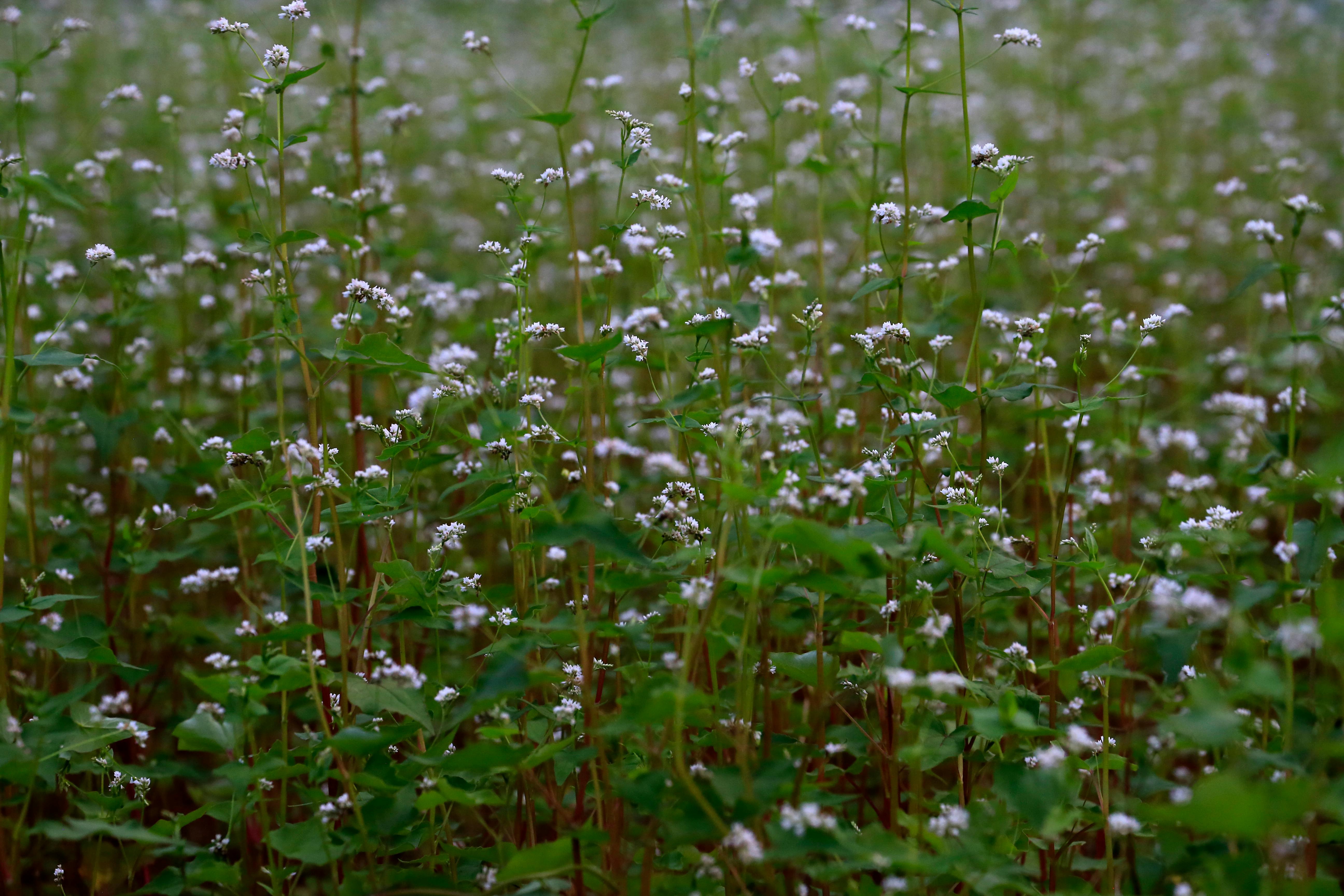
Buckwheat
The Tatar pseudocereal — rutin polyphenol, the Polygonaceae family, and gluten-free kasha.
In 1 minute
What does it provide? Rutin (quercetin-3-rutinoside, antioxidant, buckwheat's unique polyphenol), pectin/hemicellulose fibers, RS3 after cook-and-chill, complete amino acid profile, D-chiro-inositol (insulin sensitivity improver). Naturally gluten-free pseudocereal.
How much? 60–80 g dry (~135 g cooked = 1 cup) per meal, 2–4×/week. Pacheco 2010 pilot RCT examined buckwheat-D-chiro-inositol in metabolic syndrome and showed modest insulin sensitivity improvement (see References).
When to avoid? Buckwheat allergy (rare but IgE-mediated, severe), fagopyrin photosensitivity (only with large quantities of sprouts/green shoots), processing cross-contamination for celiacs.
Buckwheat is surprisingly not a grain at all, but a member of the knotweed family (Polygonaceae) — botanically closer relative to sorrel and rhubarb than to wheat. Its homeland is the mountainous region of Northern China, especially the edges of Yunnan and the Tibetan Plateau, where according to archaeobotanical and palynological data it has been cultivated for at least 6,000–8,000 years. In Northeast Asia it was likely domesticated from several centers simultaneously, and out of the many related species two main lines spread as culinary crops: common buckwheat (Fagopyrum esculentum) and the more cold-tolerant Tartary buckwheat (F. tataricum), which is especially rich in rutin but with a more bitter taste.
Buckwheat reached Europe through Central Asia, supposedly via the Tatar invasions from the 13th–14th centuries — hence the Central European "tatárka" and the French "blé noir" ("black wheat") names. In mountainous regions it quickly found a home: in many Slovenian, Polish, Belarusian, and Russian kitchens, "kasha" became a defining food of peasant life, just as soba noodles in the Japanese islands from the 8th–9th centuries. In Central Europe pohánka became a characteristic Lenten food in northern and Transylvanian cuisine, but later, during the 19th century, was pushed into the background by the potato and corn expansion. Today, buckwheat has been brought back into the spotlight by gluten-free diets and polyphenol research (rutin!).
🔬 Scientific Background
Buckwheat is a pseudocereal, belonging to the knotweed family (Polygonaceae) — not a grass (Poaceae), so it is naturally gluten-free. Two main cultivated species: common buckwheat (F. esculentum) and the cold-tolerant Tartary buckwheat (F. tataricum), the latter with significantly higher rutin content (≈ 1–5%).
Rutin (quercetin-3-O-rutinoside): buckwheat's most important polyphenol, antioxidant + capillary-stabilizing. It is metabolized in interaction with the gut microbiota — human microbiota transforms rutin into smaller, bioactive phenolic units (3,4-dihydroxyphenylacetic acid, ferulic acid derivatives), which can cross the blood-brain barrier and exert neuro-protective effects. Rutin absorption is limited — the clinical effect is mostly mediated through microbial metabolites.
Starch-RS3: technologically confirmed that cook → chill cycles and repeated heat-cool cycles increase retrograded (RS3) starch in buckwheat porridge/groats — butyrate-boosting fermentation.
Complete amino acid profile: similar to quinoa, buckwheat is also a complete protein source — with high lysine and arginine content. Key in plant-based diets.
D-chiro-inositol: buckwheat is a unique source of this insulin-sensitivity-improving cyclic polyol (Pacheco-Diabetes 2010 RCTs showed modest glycemic improvement).
Human evidence: animal and in vitro studies, reviews indicate microbiome-modulating (favorable taxon shifts, SCFA increase); human data are promising but limited. Buckwheat bran and its fractions in in vitro fermentation are well SCFA-producing (propionate/butyrate) and show bifidogenic potential.
Fagopyrin (phototoxic fluorescent compound) — found in buckwheat sprouts and green shoots, can cause photosensitivity in case of high-dose consumption (fagopyrism). The seed, flour, kasha in normal dietary quantities are safe.
- + "Cook-and-chill → lightly reheat" RS3 protocol: repeated heat-cool cycles further raise the RS ratio.
- + Toasting (kasha style): dry-toast in a pan → nutty aroma, more enjoyable.
- + Yogurt/kefir (live cultures): synbiotic synergy, rutin-microbial metabolism support.
- + Legumes (lentil, bean): super-complete amino acid profile + broader prebiotic matrix.
- + Vitamin C source (lemon, peppers): rutin stabilization + non-heme Fe absorption.
- + Omega-3 source (flax, walnut, fatty fish): anti-inflammatory synergy.
- Wheat-containing soba instead of "100% buckwheat" soba for celiacs: most market soba contains 30–60% wheat — read the label carefully.
- Buckwheat sprouts + strong summer sunbathing: theoretical fagopyrism risk at high doses.
- Strong acidic medium (plentiful lemon juice for a long time): rutin stability worsens at high acidity.
- Too long, high-temperature cooking: polyphenol degradation.
- Tartary buckwheat from a celiac mill: look for the certified "gluten-free" label.
- Buckwheat allergy (rare but SEVERE, anaphylactic reactions): strictly avoid. More prevalent in Asia than in Europe.
- Celiac disease: gluten-free, BUT processing cross-contamination risk (especially soba noodles) → certified product.
- Fagopyrism sensitivity + high sprout consumption: avoid in summer, in intense sunshine.
- Active IBS flare: low FODMAP (Monash: ≈ 135 g cooked green), but start with a small portion.
- Severe kidney disease (CKD 4–5): moderate potassium and phosphorus — dosing with dietitian.
- Anticoagulant treatment (warfarin): rutin is a theoretical blood-thinning enhancer (clinically rarely relevant at normal doses, but to be monitored).
Daily serving
60–80 g dry (1 cup cooked) per meal, 2–4×/week.
Preparation pattern
- Kasha-style toasting: dry buckwheat groats 3–5 minutes in a pan → 1:2 water ratio, to a boil, then on low heat 15–18 minutes.
- Classic cooking: 1:2 buckwheat-to-water, 12–15 minutes.
- "Cook-and-chill" RS3: cooked buckwheat → 12–24 hour cooling → as salad the next day or lightly reheated.
- Tartary buckwheat tea: 1 tsp Tartary buckwheat grain + 200 ml hot water + 5 minutes steeping → rutin concentrate.
Classic patterns
Central European buckwheat with cabbage: toasted buckwheat + sauerkraut + onion + bacon.
Russian kasha: toasted buckwheat + butter + boiled egg + scallion.
Polish kasza gryczana: roasted buckwheat + mushroom + parsley.
Japanese soba (100% buckwheat): buckwheat flour noodles with broth or cold tsuyu sauce.
Modern fusion: buckwheat salad with roasted beets, goat cheese, walnut.
Storage and avoidances
Storage: Dry buckwheat in an airtight jar in a dark place 6–12 months (shorter than wheat due to higher fat content). Cooked buckwheat in the fridge 4 days.
What not to do: Don't overcook (mushy texture). Don't consume sprouts exclusively in the sun (fagopyrism). Don't substitute wheat-based flour for 100% buckwheat soba in celiac disease.
References
[1] Li SQ, Zhang QH. Advances in the development of functional foods from buckwheat. Crit Rev Food Sci Nutr 2001;41(6):451–464.
[2] Pacheco LS et al. D-chiro-inositol from buckwheat improves insulin resistance in metabolic syndrome: a pilot RCT. Nutrition 2010.
[3] Christa K, Soral-Smietana M. Buckwheat grains and buckwheat products — nutritional and prophylactic value. Czech J Food Sci 2008;26(3):153–162.
[4] Hou Z et al. Rutin from buckwheat is metabolized by human gut microbiota into bioactive phenolic acids. Food Funct 2017.
[5] Skrabanja V et al. Resistant starch in buckwheat: cook-cool cycle effects. J Agric Food Chem 2007.
[6] Wieslander G, Norbäck D. Buckwheat allergy. Allergy 2001;56(8):703–704.
[7] Stojilkovski K et al. Fagopyrin content in buckwheat grain, sprouts, and herba. Pharmacogn Mag 2013.
[8] Holasova M et al. Polyphenolic compounds in buckwheat. Czech J Food Sci 2002.
[9] Monash University. High and Low FODMAP foods — buckwheat groats and flour. Monash FODMAP database.