


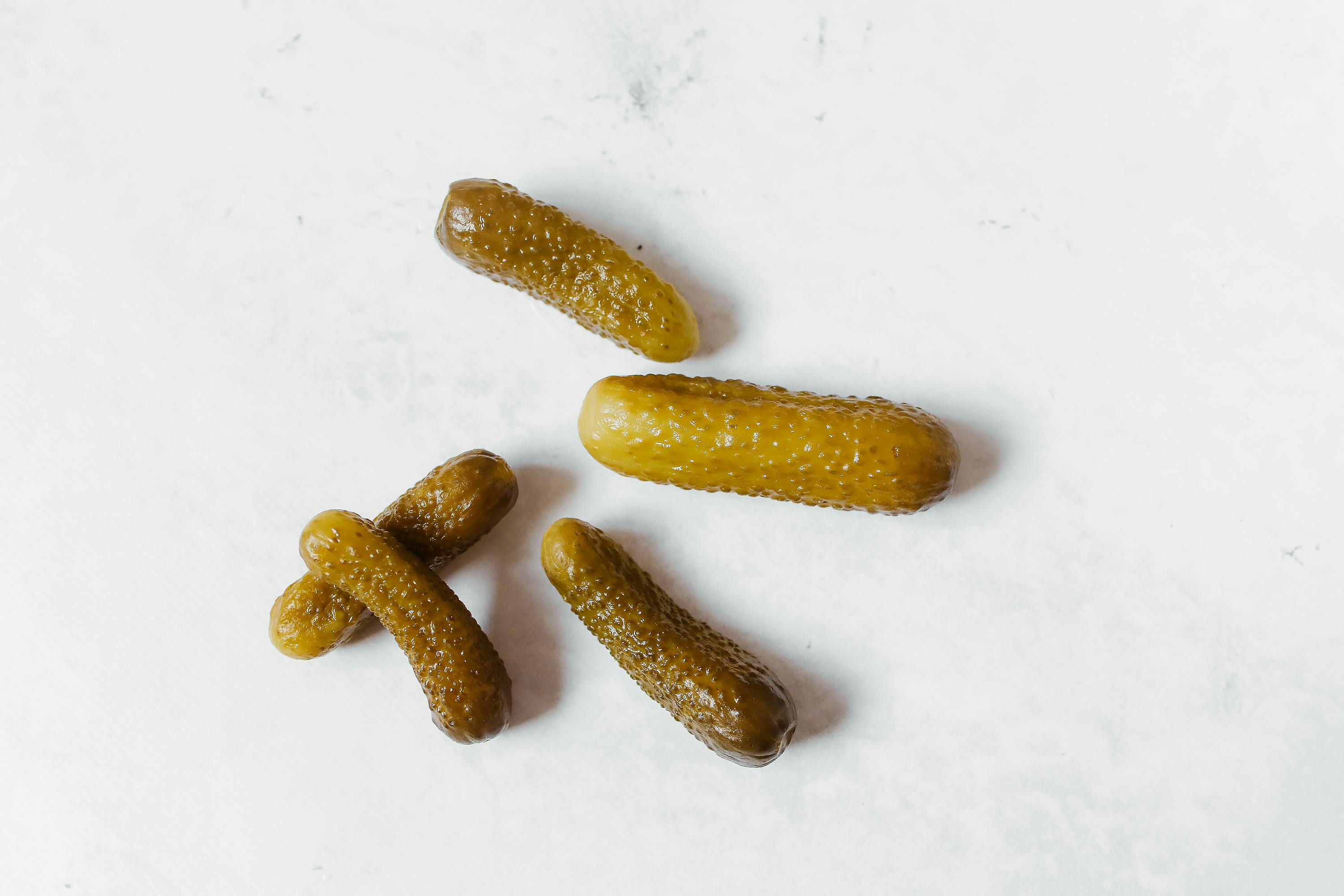
Brined cucumber
The classic of Hungarian summer — sun-ripened in salty brine, started with a slice of sourdough. NOT a vinegar pickle.
In 1 minute
What does it provide? The classic HUNGARIAN SUMMER variant: sun-ripened lacto-fermentation started with sourdough bread — dill, garlic, 3% brine, 24–72 hours in a warm place. The yeasts (Saccharomyces) and LAB of the bread crust accelerate fermentation; the end result is a pH < 4.2 cucumber with crisp, fresh aromas, live Lactiplantibacillus plantarum and Leuconostoc — markedly different in flavor and cultural attachment from the industrial cold-ripened version (VIII.2). Pickle juice (the brine) is a classic Hungarian electrolyte: ~500 mg Na, K, and lactic acid in 30 ml.
How much? 1–2 slices (≈ 30–80 g) daily, cold, as a side dish; summer tradition: with cold goulash, paprika potatoes, boiled meat. Pickle juice 30 ml as a morning sports-drink alternative or against muscle cramps (Miller 2010 RCT). Eat the homemade, refrigerated version — most flavorful within 1 week, after which it becomes overly sour.
When to avoid? MAO inhibitor therapy (tyramine → hypertensive crisis); strict Na restriction (hypertension, heart failure — 500–700 mg Na/100 g); active reflux disease, gastric ulcer flare; a poorly ripened sun batch (>30 °C, slow pH drop → microbial safety risk — when uncertain about taste/smell, discard). Detailed condition-specific contraindications (histamine intolerance, immunosuppression, infants) are in the section below.
The story of brined cucumber begins in the northern Indian mountains: the cucumber was domesticated here at least three thousand years ago, and from there it spread both eastward and westward along the Silk Road. The pickling of vegetables is an even older practice: according to archaeologists, vegetables were already being soaked in salty brine in Mesopotamia around 2030 BCE, and from Middle Eastern caravanserais via the Balkans, the method reached Central and Eastern Europe, where the salt-fermented, vinegar-free version of cucumber became the basis of both winter preservation and summer pickling.
Hungarian "kovászos uborka" is a distinctly summer variant: a slice of sourdough bread placed on top of dill, garlic, and salty water provides the starter yeasts and LAB bacteria, and the hot summer heat completes the fermentation in a few days. According to traditional written sources, sun-ripened brined cucumber made in a wide-mouthed jar became widespread in Hungary from the mid-19th century, and the peasant cuisine of the Great Plain still preserves this bridge between the summer variant and the winter Central European pickling tradition.
🔬 Scientific Background
Brined cucumber is a spontaneous lacto-fermentation started with bread: LAB microbiota present on the surface of cucumbers placed in 3% brine are accelerated by the yeasts and LAB of the sourdough bread. The characteristic succession: Leuconostoc mesenteroides → Lactiplantibacillus plantarum/brevis/pentosus → Pediococcus. The Hungarian summer "sun-ripened" variant reaches pH < 4.2 within 24–72 hours, which makes it safe.
Brined cucumber ≠ vinegar pickle. This is the most important clarification. The vinegar (acidified) pickle is preserved with acetic acid, not fermented — no live LAB in it, the source of acidity is vinegar. Brined cucumber is lactic-acid fermented, with live microbes and a postbiotic matrix. The two products differ both in flavor and nutritional effect.
Clinical context (not only cucumber-specific, but the fermented vegetable category): - Wastyk 2021 (Stanford): 10-week fermented-food diet, microbiome diversity↑, 19 inflammatory signaling proteins↓. - Sauerkraut crossover 2025: 100 g/day fresh vs. pasteurized → species-level microbiome change, serum SCFA elevation. - Nielsen 2018 (IBS pilot): lacto-fermented cabbage produced symptom improvement in IBS (analogous matrix). - Stanford ISAPP consensus: the microbiome benefits of fermented vegetables are acknowledged by robust regulatory bodies.
The sodium context: brined cucumber contains 500–700 mg Na/100 g — not negligible. The good news: rinsing can reduce the Na, but also the surface LAB. Moderate consumption (50–100 g/day) is generally safe.
- + Whole-grain bread, legumes, cooked-then-cooled RS3 rice: fiber + LAB = synbiotic.
- + Cold serving (NOT boiled): preserves live LAB.
- + Yogurt, kefir, sauerkraut: multi-fermented diet.
- + Cold roast meat, cheese, cold platter: classic Hungarian pattern.
- + Dill, garlic (in moderation): carminative, FODMAP-moderated.
- + Brined-cucumber juice ("pickle juice"): sports drink, electrolyte replacement, occasionally for muscle cramps.
- High-Na meals (bacon, salted fish, instant noodles): totals add up.
- MAO inhibitor therapy: tyramine → risk of hypertensive crisis.
- Hot soup/cooked dish ≥ 70 °C: don't cook it in, live LAB will be lost.
- Antibiotic course: the effect is small, but wait until the course ends if you want a live-culture effect.
- Large amounts on an empty stomach: acidity → reflux.
- Iron supplementation: separate by ≥ 2 hours.
- Severe hypertension, heart failure, Na restriction: portion control.
- Active reflux disease, gastric ulcer flare: acidity irritates.
- Histamine intolerance: biogenic amines — test with a small portion.
- MAO inhibitor therapy: strictly avoid.
- Infant, < 2 years: high Na + choking risk.
- Severe kidney failure with Na/K limits: portion control.
- Severe immunosuppression: avoid live microbes.
- IBS flare, SIBO: start with a small portion.
- Chronic heart failure in decompensation: to be avoided.
Daily serving
1–2 medium slices (≈ 30 g) daily for introduction.
Maintenance: 50–100 g (≈ 2–4 slices) daily or 3–4 × 100 g per week.
Preparation pattern — Hungarian brined cucumber
- 1 kg pickling cucumbers (small to medium), washed, scored at both ends.
- Jar bottom: 1 large bunch of fresh dill + 2–3 cloves of garlic + optionally caraway.
- Pack the cucumbers tightly into the jar.
- Brine: 1 liter of boiling water + 30 g salt (non-iodized) — stir, let cool to lukewarm.
- Pour over the cucumbers so it covers them.
- On top: 1 slice of sourdough bread (with crust).
- Weight on top (small plate) so everything stays under the brine.
- In the sun/warm place → 24–72 hours (to taste).
- When ready → discard the bread, refrigerate.
Classic patterns
Hungarian brined: dill + garlic, sun-ripened.
Polish ogórki kiszone: longer cold fermentation, horseradish.
Russian solyonye: currant leaf, mustard seed.
On a cold platter: with salad, boiled meat.
Pickle juice shot: 30 ml juice in the morning — electrolyte boost.
Storage
Refrigerated airtight 2–4 months. Brined cucumber is ripe within 1 week; later it becomes overly sour.
What not to do
Don't cook at high heat. Don't leave the bread in the brine (starts mold). Don't use iodized salt. Don't open daily (oxygen → mold).
References
[1] Pérez-Díaz IM et al. Fermentation of cucumbers — review of the microbial ecology. J Food Prot USDA-ARS.
[2] Wastyk HC et al. Gut-microbiota-targeted diets modulate human immune status. Cell 2021;184(16):4137–4153.
[3] Nielsen ES et al. Lacto-fermented sauerkraut improves IBS symptoms. Food Funct 2018;9(10):5323–5335.
[4] McDonald LC et al. Acid tolerance of LAB. Appl Environ Microbiol 1990.
[5] Marco ML et al. Health benefits of fermented foods (ISAPP). Curr Opin Biotechnol 2017;44:94–102.
[6] Miller KC et al. Reflex inhibition of electrically induced muscle cramps in hypohydrated humans (pickle juice). Med Sci Sports Exerc 2010.
[7] Han K et al. Comparison of fresh versus pasteurised sauerkraut on the human gut microbiota and serum short-chain fatty acids: a randomised crossover trial. Front Microbiol 2025.
[8] Monash University. Pickled cucumber FODMAP serving guide.