
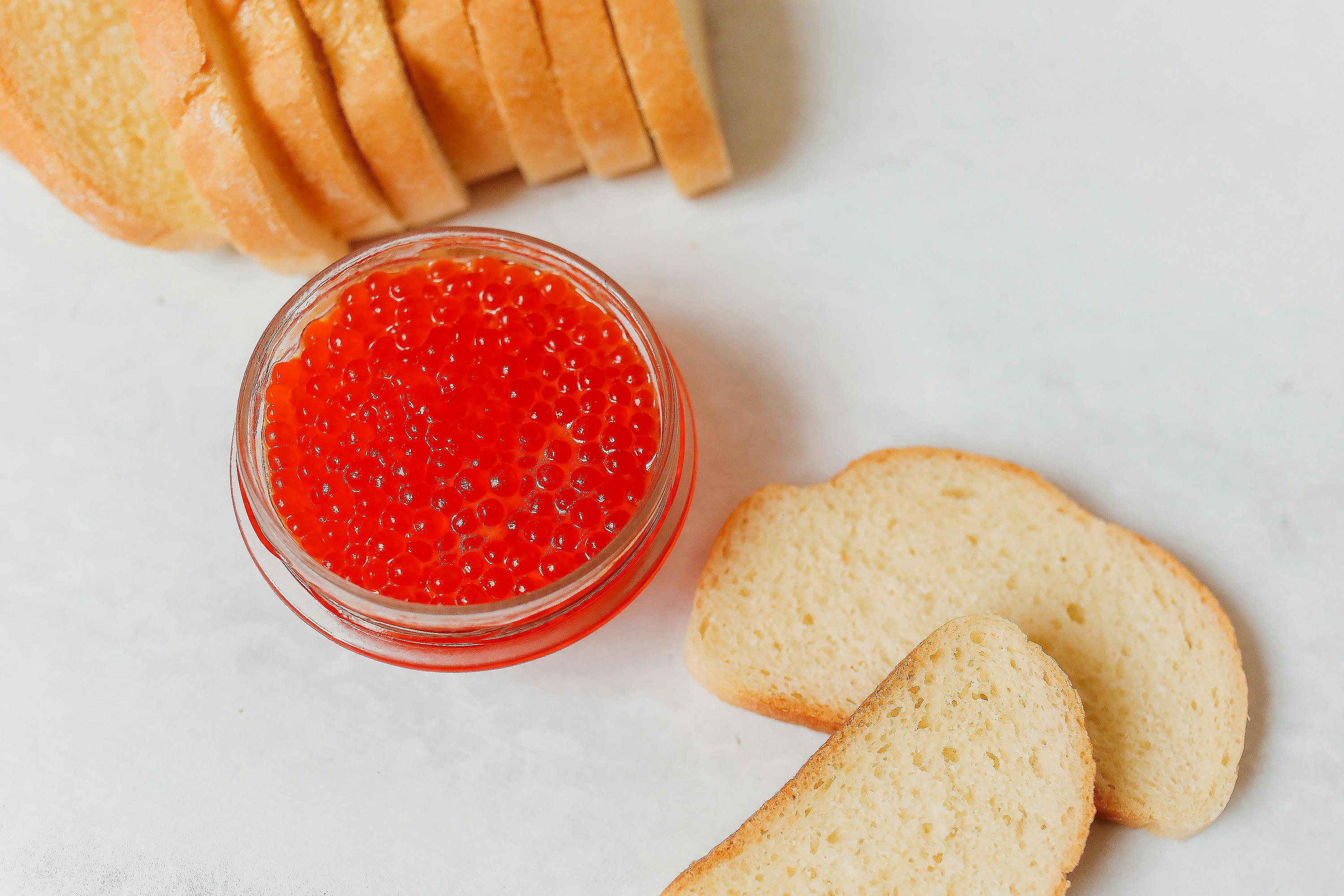
Fish roe / caviar
The "premium phospholipid" — high EPA + phosphatidylcholine, and the Central European sturgeon tradition.
In 1 minute
What does it provide? Phospholipid-bound omega-3 (EPA + DHA, 6–10 g/100 g — the phospholipid format absorbs better and crosses the blood-brain barrier more efficiently than fish-oil triglyceride, Schuchardt 2011), vitamin B12 (≈ 20 µg/100 g, 8× the daily reference — red blood cell formation and methylation), vitamin D (≈ 30 µg/100 g), choline (≈ 300 mg, phosphatidylcholine — brain development and liver function), and selenium.
How much? 1–2 tablespoons (15–30 g) occasionally, not a daily ritual. 1 tbsp ikura ≈ 1.5 g EPA + DHA — a single serving covers the EFSA pregnancy 200 mg/day DHA recommendation. MSC-certified wild Alaskan salmon roe (ikura) is a more affordable and nutritious alternative.
When to avoid? Fish allergy (parvalbumin — absolute ban; shellfish allergy is NOT cross-reactive); during pregnancy or immunosuppression, unpasteurized fresh roe (Listeria risk — invasive listeriosis); hypertension/CKD/heart failure (high Na, 1500–2000 mg/100 g); wild sturgeon caviar without CITES labeling (legally prohibited). Detailed condition-specific contraindications (gout flare, liver disease, infants) in the detailed section.
Caviar has been a centuries-old luxury of Persian and Russian aristocracy: the names "beluga," "osetra," and "sevruga" come from Caspian sturgeon species (Huso huso, Acipenser gueldenstaedtii, A. stellatus), and from the late 19th century became a defining element of Parisian, London, and Berlin grand-restaurant culture. Auguste Escoffier in his 1903 Le Guide Culinaire already codified the meticulous rules of caviar service (mother-of-pearl spoon, iced bed, blini, crème fraîche). In the middle decades of the 20th century, the Soviet Union, exploiting its Caspian sturgeon-roe monopoly — often by overfishing — exported the luxury westward.
At the start of the 21st century, the Caspian wild sturgeon stock dramatically declined due to overfishing and habitat degradation: CITES (Washington Convention) in 2006 effectively halted international trade of wild-caught sturgeon roe. Since then, the market has been dominated by aquaculture sturgeon roe — mainly Italy (Calvisius), France, China, and more recently Central Europe (Hortobágy and other domestic farms). The local Acipenser ruthenus (sterlet) and A. baerii (Siberian sturgeon) farmed roe also reaches the European market. Alternative "substitute caviar" — salmon roe (ikura), lumpfish, tobiko — has democratized the luxury: MSC-certified wild Alaskan ikura is also nutritionally competitive with sturgeon caviar. From the microbiome perspective, fish roe's high phospholipid-DHA content is one of the most effective forms for brain development and inflammation reduction, while B12 and choline are cofactors of the methylation cycle and axial gut–brain microbiome support. (CITES, Wikipedia, Calvisius, Schuchardt et al. 2011)
🔬 Scientific Background
In fish roe, DHA is predominantly in phospholipid form (phosphatidylcholine-DHA, phosphatidylethanolamine-DHA) — in human intervention studies (Schuchardt et al., Prostaglandins Leukot Essent Fatty Acids 2011), phospholipid-DHA is demonstrably better selectively absorbed and crosses the blood-brain barrier more efficiently than triglyceride-form fish oil. EFSA recommends 200 mg/day DHA in pregnancy and lactation — 1 tablespoon of ikura covers this in a single serving.
100 g of fish roe covers 8× the daily B12 reference, about 60% of daily choline needs, and several times the vitamin D — outstanding supplementation in atrophic gastritis, complementing vegetarian diet, and in the elderly population. Cholesterol content is high (≈ 500 mg/100 g), but a typical 15–30 g serving means only 75–150 mg, and modern lipidology (USDA 2015) shows that weekly 1–2 occasional servings don't meaningfully worsen serum LDL in healthy individuals.
Food safety: fresh, refrigerated fish roe carries Listeria monocytogenes risk — during pregnancy only pasteurized form is suitable for consumption (EFSA). Salting (1500–2000 mg Na/100 g) requires moderation in hypertension. Fish allergy (parvalbumin) cross-reactivity is possible; shellfish allergy (tropomyosin), however, is NOT cross-reactive with fish roe.
Microbiome aspect: the phospholipid-DHA matrix increases the Bifidobacterium and Akkermansia ratio in human intervention studies (Nature Communications, gut–brain axis cohorts). B12, choline, and phospholipid together are cofactors of the methylation cycle, phosphatidylcholine synthesis, and microbiome metabolism. Sustainability: wild sturgeon caviar has been under CITES Appendix II ban since 2006 — only farmed sturgeon roe is acceptable (Calvisius, Petrossian, Central European farms, Chinese farms). MSC-certified wild Alaskan sockeye/coho ikura is an excellent, more affordable choice (CITES, MSC).
- + Blini (buckwheat pancake) + sour cream/crème fraîche + finely chopped red onion: the classic Russian-French service — fiber and probiotic alongside fish roe's omega-3 + phospholipid is optimal.
- + Hard-boiled egg: choline synergy (egg choline + roe phospholipid-DHA) — maternal pregnancy matrix and childhood brain development.
- + Sourdough whole-grain rye bread + extra-virgin olive oil: fiber + polyphenol + phospholipid-DHA.
- + Lemon juice + dill: vitamin C (iron absorption) + anti-inflammatory antioxidant terpene.
- + Avocado: monounsaturated fat and phospholipid-DHA are synergistic in the lipid matrix.
- + Trout, salmon sushi with nori: sea algae iodine + fish roe B12 — combined thyroid and hematopoiesis support.
- + Potato (layered): starch matrix slows Na absorption.
- Stirred into hot food (hot pasta, baked dish, soup): heat breaks down phospholipid-DHA and ruins the eating experience — serve only cold, raw.
- Salted cheese + salted meat + salted bread together: cumulative Na intake to be avoided in hypertension and kidney disease. 1 tbsp of roe already contains 300–400 mg Na.
- BPA-containing can long storage: roe's fatty matrix increases BPA absorption; glass-stored form preferred.
- Alcohol in large amounts: high fat content + alcohol raises pancreatitis risk.
- Unpasteurized, fresh fish roe in pregnancy: Listeria risk — to be avoided. Pasteurized canned acceptable.
- High-phytate diet in the same meal: can worsen B12 absorption — though fish roe is Cu/Zn-poor.
- Pregnancy: fresh, unpasteurized fish roe to be avoided due to Listeria risk. Pasteurized canned (jarred, heat-treated) acceptable. DHA intake is a pregnancy indication — yes, from a controlled source.
- Hypertension, chronic kidney disease, heart failure: due to high Na (1500–2000 mg/100 g), moderate.
- Fish allergy (parvalbumin): absolute ban. Shellfish allergy (tropomyosin) is NOT cross-reactive with fish roe.
- Immunosuppression (chemotherapy, transplant, neutropenia): raw, unpasteurized form to be avoided (Listeria, norovirus).
- Chronic liver disease: moderate due to high fat and cholesterol content.
- CITES aspect: wild sturgeon caviar (Acipenser, Huso) only from CITES-labeled, farmed source. Smuggled wild roe is ethically and legally prohibited.
- Gout, hyperuricemia: fish roe is moderately purine-rich — to be avoided during flare.
- Hypercholesterolemia in hyperresponder phenotype: high cholesterol content can worsen individual LDL response.
- Infants (< 6 months): not recommended. After 6–12 months gradually, in small amounts in pasteurized form.
Serving: 1–2 tablespoons (15–30 g) occasionally. Not a daily supplement, but a concentrated, rare serving.
Preparation pattern — Russian blini with caviar:
1. Thin buckwheat blini baked (or store-bought pancake).
2. Top with 1 tbsp crème fraîche / sour cream.
3. 1 tbsp sturgeon caviar or salmon roe.
4. Finely chopped red onion, fresh dill, lemon zest.
Preparation pattern — Central European trout-roe on rye sandwich:
1. Sourdough rye or whole-grain bread.
2. Thin layer of butter / sour cream spread.
3. 1 tbsp Central European trout roe.
4. Fresh dill, lemon zest, freshly cracked pepper.
Classic patterns:
- Russian zakuski: blini + sturgeon caviar + crème fraîche + vodka (in moderation).
- Japanese gunkan-maki ikura: sushi rice + nori wrap + salmon roe + wasabi.
- Scandinavian smørrebrød: rye bread + fish roe + hard-boiled egg + dill.
- Sourdough + trout roe: sourdough bread + sour cream + trout roe (from Hortobágy farms).
Storage: Unopened jarred sturgeon caviar refrigerated at 0–4 °C for 1–2 months (until producer expiry). After opening 1–2 days. Salmon roe after opening 2–3 days. Pasteurized canned roe after opening 5–7 days, airtight covered. Don't freeze — the phospholipid matrix and texture break down.
What not to do: Don't heat (hot pasta, baked dish) — phospholipid-DHA breaks down. Don't serve with a metal spoon (flavor oxidation) — traditionally mother-of-pearl or wooden spoon. Don't eat raw, unpasteurized form in pregnancy or immunosuppression. Don't buy "wild" sturgeon caviar without CITES labeling.