


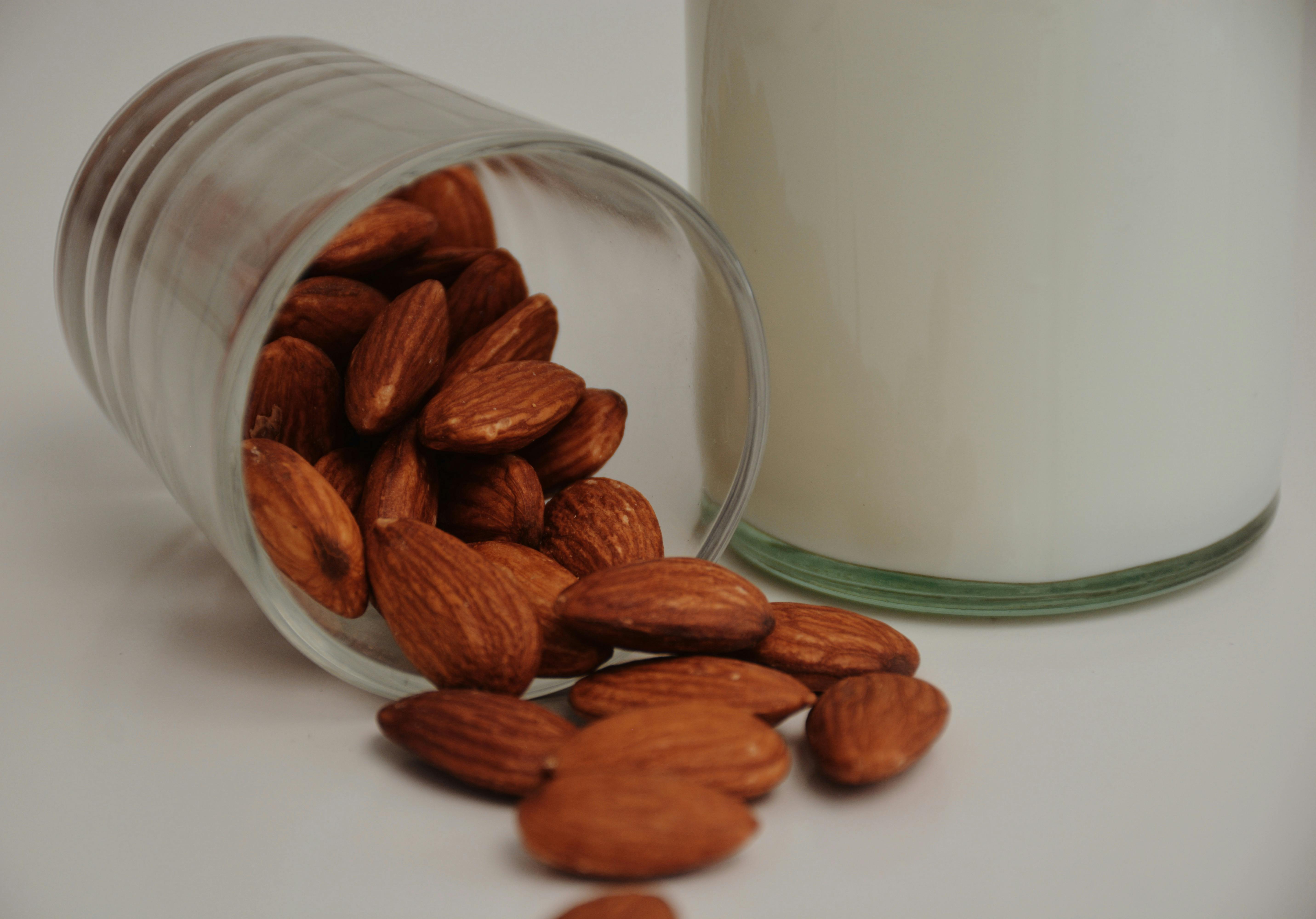
Almond
Millennia-old seed of the Levant — polyphenol in the skin, LDL reduction in the plasma, butyrate in the colon.
In 1 minute
What does it provide? Healthy, oleic-dominant fat (monounsaturated, ≈ 50%), skin polyphenols (proanthocyanidin — 80–90% in the brown pellicle), prebiotic GOS fiber (galacto-oligosaccharide, food for butyrate-producing bacteria), and high vitamin E content (25 mg/100 g, antioxidant). Clinical RCTs (Liu 2014, Holscher 2018) show significant Bifidobacterium and butyrate increases — hence the 0.1 mmol/L LDL reduction.
How much? 28–56 g/day (≈ 23–46 nuts) with skin, as part of a meal (not on an empty stomach). The FDA heart-health claim minimum is 42 g/day; clinical RCT protocols used 50–56 g/day doses for 6–12 weeks.
When to avoid? Tree-nut allergy (often severe, strict total avoidance); IBS elimination (low-FODMAP) phase above 10 nuts (GOS load); nickel-contact allergy during strict diet; bitter (wild) almond raw — toxic due to cyanogenic glycoside (amygdalin); kidney-stone tendency (oxalate) above 30 g/day; child under 4 with whole nuts (choking).
The almond is one of the Old World's earliest domesticated fruit trees: archaeological evidence indicates cultivation in the Levant and Mediterranean from the early Bronze Age, in the 3rd–2nd millennium BCE — almonds were even found in Tutankhamun's tomb as an import item, indicating that they already represented a trade luxury at the end of the pharaonic era. The Romans knew it as "amygdalus," and Pliny mentions several varieties; ancient and medieval agricultural texts document the continuity of Mediterranean cultivation. In Greek mythology, the Thracian queen Phyllis was turned into an almond tree while waiting for her lost love — when Prince Acamas finally returned and embraced the bare tree, it immediately put forth its first blossom. This is how the almond became the symbol of early-blooming hope in Mediterranean cultural history.
Medieval Spain and Moorish Sicilian kitchens made the seed famous: the word marzipan is said to come from the Persian-origin, Arabic-mediated marzapán, and spread throughout Christian Europe from Toledan convent recipes. From the 19th century onward, California took on the role of the world's leading growing region, where Spanish missionaries planted the first almond groves — today the vast majority of global almond consumption originates from this region. The 2003 FDA qualified health claim ("1.5 oz almond/day may contribute to reduced heart disease risk") is one of the most important turning points in marketing and research history for tree nuts. **(NCBI, FDA Docket 02P-0505)
🔬 Scientific Background
Almond's bioactive matrix is multi-component: ≈ 50% MUFA (mainly oleic acid), ≈ 13% fiber (insoluble + soluble, GOS concentrated in the skin), ≈ 21% protein, and more than 30 polyphenols found in the brown coat (pellicle) — particularly B-type proanthocyanidins, flavonols (quercetin, kaempferol, isorhamnetin), and catechins. During digestion, due to almond's cell wall, only ≈ 70% of the fat is released (Mandalari 2008) — this explains why whole almond delivers fewer calories than its theoretical value (≈ 130 kcal/28 g, not 170).
Clinical evidence stands on three pillars. LDL cholesterol reduction: more than 20 RCTs and meta-analyses (Musa-Veloso 2016) show a consistent, moderate LDL-C reduction (≈ −0.1 mmol/L with 50 g/day almond) — this is the basis of the FDA qualified health claim. Butyrate increase: in Liu 2014 RCT, 8 weeks of almond significantly raised fecal butyrate and the Bifidobacterium/Lactobacillus ratio — the key is the GOS + skin polyphenol matrix. Postprandial glycemia: almond moderates both acute and chronic glycemic response, especially as part of starchy meals.
At the microbiome level, Liu 2014, Burns 2016, and Holscher 2018 RCTs all show a similar pattern: prebiotic shift toward Lactobacillus, Bifidobacterium, Roseburia, with decreasing opportunistic taxa. Whole community composition change is modest; functional (SCFA, butyrate) change is larger.
- + Retain pellicle (brown skin): the majority of polyphenols are here. From blanched (white) almonds, skin polyphenol disappears.
- + Breakfast oatmeal (β-glucan) or whole-grain muesli: complex fiber matrix → broader SCFA profile, better postprandial glycemia.
- + Yogurt/kefir: synbiotic synergy — almond GOS + live culture, stronger bifidogenic effect.
- + High-vitamin-C fruit (berries, kiwifruit): polyphenol stabilization + improved non-heme iron absorption.
- + Along with a meal (not on an empty stomach): the fat + protein + fiber matrix slows glucose absorption.
- + Mediterranean diet (olive oil, vegetables, legumes): the PREDIMED-like pattern, in which tree nuts (including almond) were an integral part — this is the best-documented cardiometabolic pattern.
- Iron supplementation + large amount of almond: polyphenols + phytates chelate non-heme iron — time separation (≥ 2 hours).
- Tetracycline/quinolone antibiotics + calcium-rich almond: chelate formation → antibiotic level drop. Separate by 2 hours.
- Levothyroxine (thyroid hormone) + high fiber/phytate content at the same time: absorption decrease. Take the medication 30–60 minutes before almond consumption.
- High heat (≥ 180 °C, 20+ minutes): acrylamide formation (similar to other roasted nuts), polyphenol loss.
- Empty stomach + large amount (> 60 g): GI bloating (GOS load).
- Sweetened, salted, chocolate-coated almond: glycemic load + sodium → cardiometabolic benefit disappears.
- Tree-nut allergy: strict total avoidance. Almond allergy is often severe, rarely life-threatening.
- IBS elimination phase (FODMAP protocol): > 10 nuts is GOS-loading. Reintroduction starts with 5 nuts, gradual increase.
- Nickel-contact allergy / SNAS: almond is moderately high in nickel — avoid during strict diet.
- Chronic kidney disease (stage 3+): moderately high oxalate + phosphorus + potassium — dose control per dialysis regimen.
- Kidney stones (calcium-oxalate stone tendency): moderately high oxalate; ≤ 30 g/day + plenty of fluids.
- Infant, child under 4: whole almond is a choking hazard; can be given as almond butter (after allergy history check).
- Active IBD flare: insoluble fiber + skin may cause GI irritation. Safe in remission.
- Bitter (wild) almond: contains cyanogenic glycoside (amygdalin), toxic. Only sweet (Prunus dulcis var. dulcis) can be eaten raw.
Daily serving
28 g (≈ 23 nuts) per the FDA qualified health claim; 42 g (≈ 35 nuts) for maximum documented effect. RCT protocol: 50–56 g/day.
Preparation pattern
- Raw, with pellicle: the gentlest form; for flavor opening, soak 8 hours.
- Gentle roasting: 150 °C, 10–12 minutes — flavor deepening, polyphenol loss < 15%.
- Almond butter (100%): only from whole nuts, no added sugar/oil.
Classic patterns
Spanish salmorejo enriched: tomato + olive oil + reduced, topped with ground almond — Mediterranean polyphenol matrix.
Moroccan tagine: chicken + dried fruit + almond + spices — protein + fat + polyphenol synergy.
Breakfast oatmeal: oats (β-glucan) + ½ handful almond + berries + kefir — synbiotic heart matrix.
Italian pasta con pesto di mandorle: almond + basil + olive oil + Parmesan + garlic — Sicilian variation.
Marzipan (traditional, low-sugar): almond flour + a little honey + egg white — festive occasion, in moderation.
Storage
In an airtight jar, in a cool dark place — in-shell almond 1 year, shelled (with pellicle) 6 months, frozen 1 year. Almond butter refrigerated, 3–6 months.
What not to do
Don't peel off the pellicle. Don't roast above 180 °C. Don't eat bitter (wild) almond raw. Don't store ground/flour at room temperature for days (oxidation).
References
[1] FDA. Qualified health claims: letter of enforcement discretion — nuts and coronary heart disease. Docket No. 02P-0505, 2003.
[2] Mandalari G et al. Bioaccessibility of macronutrients in almonds: implications for nutrition. Br J Nutr 2008;100(2):282–289.
[3] Liu Z et al. Prebiotic effects of almonds and almond skins on intestinal microbiota in healthy adult humans. Anaerobe 2014;26:1–6.
[4] Burns AM et al. Diet quality improves for parents and children when almonds are incorporated into their daily diet. Nutr Res 2016;36(1):80–89.
[5] Holscher HD et al. Almond consumption and processing affects the composition of the gastrointestinal microbiota of healthy adults: a randomized controlled trial. Nutrients 2018;10(2):126.
[6] Musa-Veloso K et al. The effects of almond consumption on fasting blood lipid levels: a systematic review and meta-analysis of randomised controlled trials. J Nutr Sci 2016;5:e34.
[7] Berryman CE et al. Effects of daily almond consumption on cardiometabolic risk and abdominal adiposity in healthy adults with elevated LDL-cholesterol: a randomized controlled trial. J Am Heart Assoc 2015;4(1):e000993.
[8] Monash University. High and Low FODMAP foods. Monash FODMAP database.