
Spirulina
The "blue-green super-protein" — phycocyanin pigment, 60% plant protein, and NASA-cohort evidence.
In 1 minute
What does it provide? Cyanobacteria-derived complete protein, phycocyanin pigment (antioxidant), GLA, and β-carotene — with anti-inflammatory, lipid- and glucose-modulating effects.
How much? 1–5 g/day in powder or tablet form — start low (1 g), increase gradually. Most clinical trials used 1–8 g/day.
When to avoid? Phenylketonuria (PKU — phenylalanine content), autoimmune disease flare (immunostimulant), anticoagulant therapy, spirulina of unknown (wild) origin (cyanotoxin, heavy-metal contamination). Never consume unverified, "natural pond" spirulina.
Spirulina is technically not an alga but a filamentous cyanobacterium — evolutionarily closer to bacteria than to plants. Despite this, it served for thousands of years as a traditional food in two separate cultures: the Aztecs gathered it from the surface of Mexico's Lake Texcoco under the name "tecuitlatl," and sold it as sun-dried cakes in the markets of Tenochtitlan — already described by the 16th-century chronicler Bernardino de Sahagún. In Africa, around Lake Chad, the Kanembu people consume it to this day under the name "dihé," drying it on clay tablets and mixing it into millet stews and sauces.
The scientific "rediscovery" began in 1940, when French botanist Pierre Dangeard documented the use around Lake Chad, and then after Belgian botanist Jean Léonard's 1964 expedition, the French Institut Français du Pétrole launched indoor cultivation research. In the 1970s, NASA considered it as astronaut food (due to its high protein-to-volume ratio), and the 1974 UN World Food Conference called it "the best food of the 21st century." From the 2000s onward, it became a main player in the dietary supplement industry, while WHO and IIMSAM (a UN observer-status organization) study it as a tool against childhood malnutrition from India to Burkina Faso.
🔬 Scientific Background
60–70% of spirulina's dry matter is protein, containing all essential amino acids — although methionine and cysteine content is lower than in animal proteins. Digestibility is excellent (PDCAAS ≈ 0.7–0.8) because the cell wall is a thin peptidoglycan layer (not cellulose as in chlorella) — therefore it is absorbable without cooking or cell-wall disruption.
Phycocyanin is spirulina's blue pigment (10–15% of the protein content), a strong antioxidant and COX-2 inhibitor based on in vitro and animal data. Human RCT meta-analyses (Serban 2016, Hamedifard 2019) documented moderate LDL (≈ –10–15 mg/dL), TG, and blood-pressure reduction at 1–10 g/day doses, in 8–12-week interventions. Data on NAFLD and HbA1c are promising but weaker.
B12 issue — critical myth zone: spirulina contains pseudo-B12-like corrinoids (mainly adenosyl-pseudocobalamin), which, however, are not active in the human metabolic system — moreover, some studies suggest they may competitively block the absorption of genuine B12. Watanabe (1999, 2007) clearly states: spirulina is NOT a B12 source for vegans — pseudo-B12 is inactive in the human body.
At the microbiome level, human data are limited: animal experiments and a few small human studies showed Lactobacillus and Bifidobacterium proportions increasing while Enterobacteriaceae decreased. Phycocyanin, on reaching the colon, ferments in a polyphenol-like manner. Spirulina polysaccharides (calcium-spirulan, immulina) are immunomodulating.
Contamination risk: wild spirulina may contain microcystin (a hepatotoxic cyanotoxin) due to other cyanobacterial contamination. Controlled indoor or closed-system cultivation (Hawaii, California, Greece, Taiwan) minimizes this. Heavy-metal accumulation (lead, arsenic, mercury) is also quality-dependent — a third-party-tested product from a quality manufacturer is essential.
- + Vitamin C-rich matrix (lemon, tomato, orange): increases the bioavailability of iron and phycocyanin; stabilizes polyphenols against oxidation.
- + Healthy fat (avocado, olive, flaxseed): carotenoids (β-carotene, zeaxanthin) are fat-soluble — eaten together increases absorption.
- + Polyphenol sources (green tea, cacao, berries): combined antioxidant synergy, phycocyanin stabilization.
- + Live cultures (kefir, yogurt, sauerkraut): synbiotic effect — spirulina polysaccharides and probiotic strains together strengthen microbiome modulation.
- + Fiber-rich matrix (oats, flaxseed, legumes): the combination of spirulina protein + soluble fiber yields a more stable glucose response than either alone.
- + B12-containing source (nori, egg, meat, or supplement): NEVER consider spirulina as B12 replacement — always supplement with a genuine source.
- Immunosuppressants (cyclosporine, tacrolimus, mycophenolate, biologics — TNF inhibitors, IL-17/23 inhibitors): spirulina is immunostimulating (NK-cell and macrophage activation) — autoimmune flare and weakening of therapeutic effect possible.
- Anticoagulants (warfarin, DOACs), antiplatelets: γ-linolenic acid (GLA) and some phycocyanin fractions have weak antiplatelet activity — additive bleeding risk at high doses.
- Iron supplementation (capsule, drops): separate timing by ≥ 2 hours — chlorophyll and some spirulina proteins can chelate.
- Phenylalanine-containing medications or aspartame-containing drinks (in PKU patients): spirulina contains significant phenylalanine (≈ 4–5% dry matter).
- Cold drink + raw powder: the powder clumps, unpleasant texture — mix into warm or room-temperature smoothies, or first make a paste with a little liquid.
- Empty stomach + high dose (≥ 5 g) on first occasion: nausea, vomiting possible — start with a meal.
- Phenylketonuria (PKU): spirulina contains ≈ 4–5% phenylalanine — absolute contraindication.
- Autoimmune disease active flare (SLE, RA, MS, IBD, psoriasis active phase): due to the immunostimulant effect, it can worsen — in remission only after medical consultation.
- Wild spirulina of unknown origin: microcystin contamination can lead to liver damage — never consume pond, unverified product.
- Thyroid disease with iodine sensitivity: spirulina's iodine content is low (negligible compared to sea algae), but products from quality manufacturers are preferred.
- Gout, high uric acid level: the high protein and purine content (especially relative to dry matter) can provoke a flare — try with a low dose (1 g), or avoid.
- Kidney disease (chronic, GFR < 60): the high protein load is to be avoided — medical consultation.
- Pregnancy and breastfeeding: culinary-dose (1–2 g/day) spirulina from a verified source is likely safe, but high-dose supplementation is to be avoided — little human data.
- 2 weeks before surgery: stop high doses (bleeding risk).
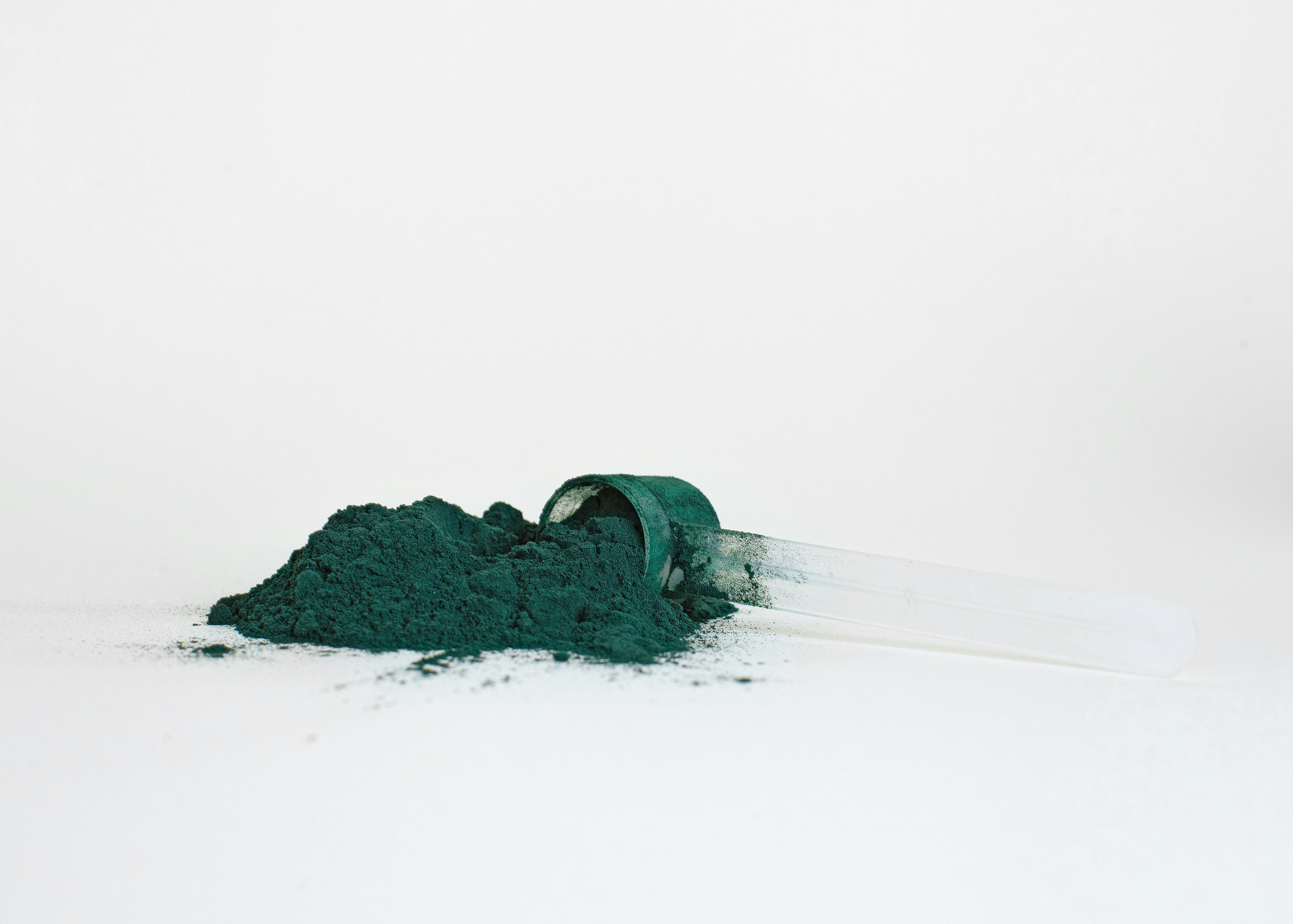
Daily serving: 1–5 g/day powder or 2–10 tablets of 500 mg. Start with 1 g, increase to 2–3 g after 1 week.
Preparation pattern:
1. Smoothie: 1–3 g powder + 1 banana + 200 ml plant milk + 1 pinch of lemon zest + 1 tbsp almond butter — blend. Lemon and fat together improve bioavailability.
2. Energy bar: dates + rolled oats + almond + 2 g spirulina powder + cacao — pressed into a mold, chilled.
3. Salad dressing: 1 g powder + olive oil + lemon juice + Dijon mustard + salt — homogeneous, intense green dressing.
4. Tablet: with a meal, 2–4 in the morning, 2–4 in the evening — first time start with a low dose.
Storage: airtight, dark glass, in a cool place — phycocyanin is light- and heat-sensitive. To be consumed within 6 months of opening. Do NOT store in a warm, humid place.
What not to do: don't cook it (≥ 60 °C destroys phycocyanin and reduces amino-acid quality). Don't buy from unknown sources. Don't use as a B12 replacement.